
Emo-tAsS: Closing the Loop Between Affective Computing and Vocational Disability Support
Introducing an Emotion-Driven Assistance System for Cognitively Impaired Individuals
This paper introduces Emo-tAsS, a speech-driven, workplace-integrated assistance system designed for individuals with cognitive and physical disabilities. The system utilizes an Automatic Emotion Recognition (AER) pipeline based on Deep Neural Networks and Bag-of-Audio-Words (BoAW) to adapt instructional complexity based on the user's emotional state, achieving a baseline Unweighted Average Recall (UAR) of 43.4% on atypical speech data.
TL;DR
The Emo-tAsS project introduces an emotionally-sensitive assistance system designed to help individuals with cognitive disabilities navigate workplace tasks. By analyzing the user's voice for emotional cues like stress or sadness, the system dynamically adjusts its instructional complexity, providing a personalized safety net that enhances worker confidence and independence.
Context & Motivation: Why Static Instructions Fail
In sheltered workshops, tasks that seem trivial to many—such as preparing a cleaning trolley—require complex memory recall and process abstraction. For individuals with cognitive impairments, high stress levels or low mood can drastically reduce their ability to focus.
The authors identify a major gap in current assistive tech: emotional blindness. Most systems provide the same instructions regardless of whether the user is calm or frustrated. Emo-tAsS addresses this by hypothesizing that a system which "senses" frustration can intervene with more detailed, patient guidance, effectively acting as a digital job coach.
Methodology: The Architecture of Empathy
The system is built on a client-server architecture using Ruby on Rails, but its "brain" lies in two parallel speech processing subsystems:
- Automatic Speech Recognition (ASR): Built using the Kaldi toolkit with a Max-out Deep Neural Network. It translates the user's queries into commands.
- Automatic Emotion Recognition (AER): This is the core innovation. It extracts low-level descriptors (LLDs) such as pitch, loudness, and spectral features.
The system uses the Bag-of-Audio-Words (BoAW) approach. Much like "Bag-of-Words" in text processing, this technique quantizes acoustic features into a "codebook" of audio words. The frequency of these words forms a histogram that represents the emotional "signature" of the utterance, which is then classified by a Support Vector Machine (SVM).
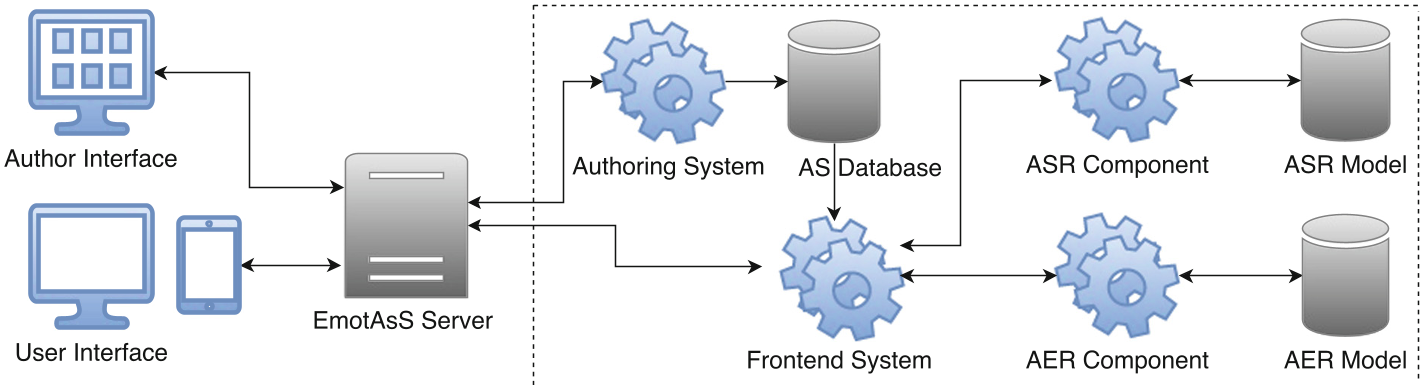 Figure 1: The Emo-tAsS system management interface for caregivers to customize interventions.
Challenges in Atypical Speech Data
One of the paper's most significant contributions is its focus on atypical speech. Recognizing emotions in individuals with neurological or mental disabilities is far more complex than in standard datasets due to unique prosodic patterns and speech irregularities. The researchers collected a spontaneous speech database from 17 participants in a real-world workshop setting, supervised by psychologists to ensure ethical and professional management of the provoked emotions.
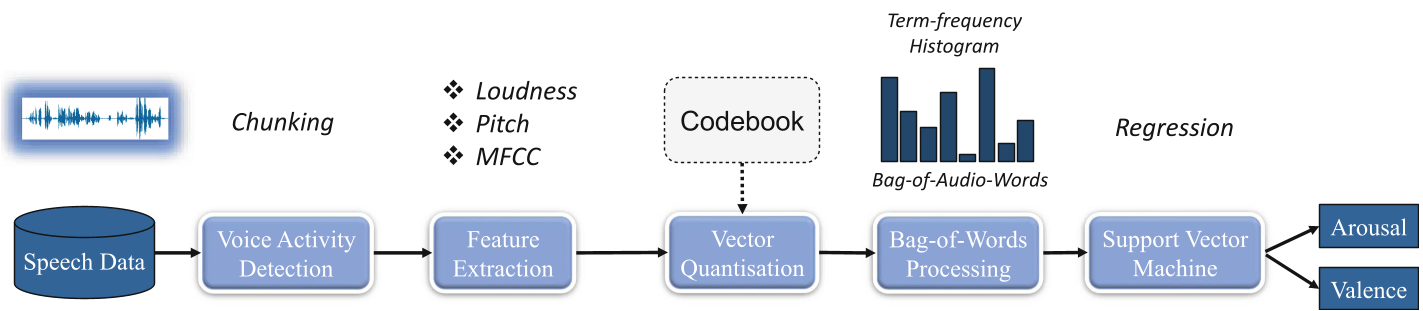 Figure 2: The pipeline from audio chunking to continuous Arousal/Valence prediction.
Experimental Results: Performance Benchmarks
The team evaluated the system against four classes: Anger, Happiness, Neutral, and Sadness.
- Single Model Performance: The BoAW+SVM approach achieved a 41.3% UAR for the "Sadness" class.
- Fusion Strategy: By combining the standard ComParE feature set with the BoAW approach, they achieved a 43.4% UAR.
While these numbers may seem lower than traditional emotion recognition tasks, they represent a robust baseline for in-the-wild, atypical speech—a domain where standard models often fail completely.
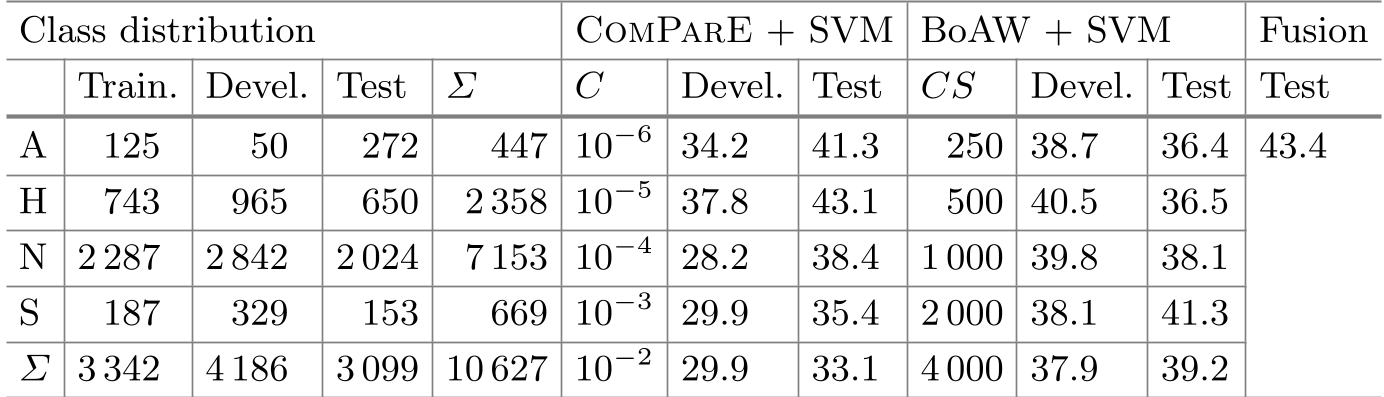 Table 1: Performance comparison across different feature configurations and hyperparameter settings.
Critical Insight & Future Outlook
The true value of Emo-tAsS isn't just in the SVM accuracy; it's in the dynamic instructional logic. The system's ability to "lighten the load" when a user's mood improves (providing shorter instructions) and "hand-hold" during distress (providing longer descriptions) mimics human pedagogical intuition.
Limitations: The current Word Error Rate (30%) and Emotion Recall (43.4%) suggest that the system still requires a fallback (like the specialized keyboard mentioned in the paper) to ensure reliability in critical work steps.
Next Steps: The authors point toward generative models and transfer learning. As we move into the era of Large Language Models (LLMs), the potential to merge these emotional signals into a multi-modal GPT-like assistant could revolutionize how we support neurodiversity in the workforce.
Conclusion
This work demonstrates that affective computing is moving out of the lab and into the workshop. By treating emotion as a first-class data input, Emo-tAsS paves the way for a more inclusive, empathetic future for industrial human-machine interaction.