
Emotion-Driven Lifelogging: Turning Brain Signals into Digital Memoirs
Poster abstract: Emotion-driven lifelogging with wearables
This paper presents an emotion-driven lifelogging system that integrates wearable EEG sensors with smart glasses to capture daily moments automatically. By leveraging brain-computer interface (BCI) techniques, the system triggers recording (image, audio, or video) based on detected emotional shifts, eliminating the need for manual user intervention.
TL;DR
This research introduces a wearable system that "feels" your emotions to capture your life. By combining an EEG headband with Google Glass, the system automatically records photos or videos when it detects significant emotional changes. It addresses the dual challenges of EEG signal noise in mobile settings and the high computational cost of emotion recognition through a clever edge-to-cloud architecture.
The Problem: The "Lag" in Capturing Life
Lifelogging—the practice of digitalizing daily experiences—is vital for therapy (e.g., neurodegenerative diseases) and social sharing. However, manual logging is intrusive. By the time you reach for your phone to record a "memorial moment," the moment has often passed.
Furthermore, using EEG (electroencephalogram) to automate this process is hard because:
- Signal Instability: Moving around causes EEG electrodes to shift, creating spikes that look like emotions but are actually just noise.
- Resource Constraints: High-accuracy emotion recognition is too heavy for a pair of smart glasses to run locally without draining the battery in minutes.
Methodology: Intelligence at the Edge
The authors developed a system that treats your brain as the ultimate "shutter button."
1. Filtering Noise from Reality
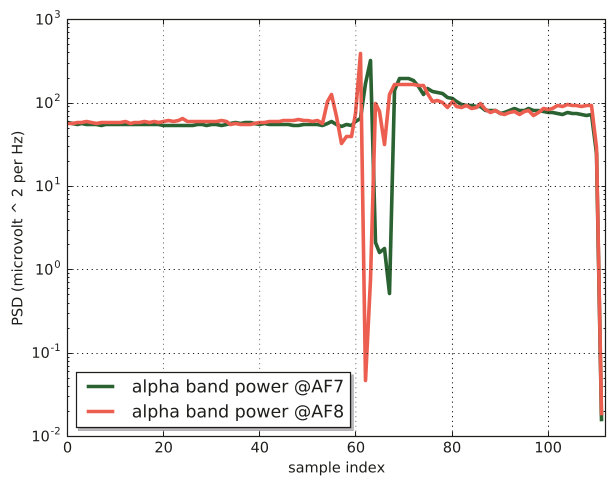
To solve the electrode shift problem, the authors observed that when a headband moves, all electrodes usually show a correlated change because the headband is a rigid body. Real emotional signals, however, are localized or lack this uniform correlation. By cross-referencing EEG spikes with accelerometer data, the system filters out false triggers caused by physical movement.
2. A Two-Stage Recognition Pipeline
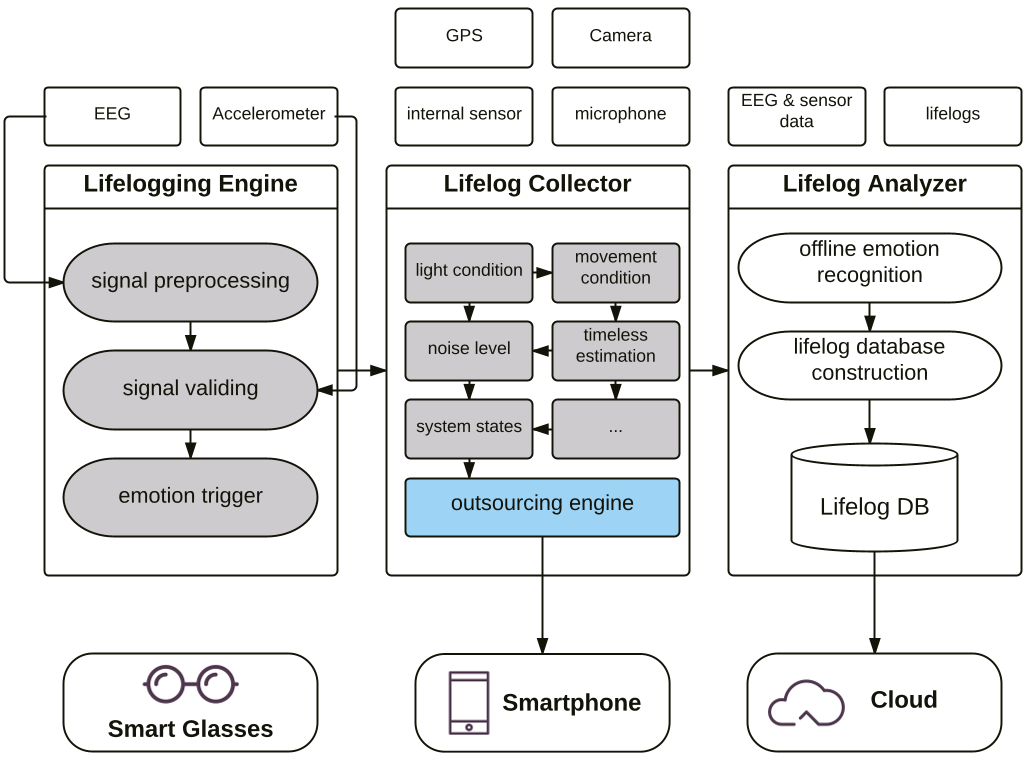
To preserve battery, the system doesn't try to "classify" your emotion constantly. Instead:
- On-Glass: A lightweight algorithm monitors emotional trends.
- On-Cloud: Only when a significant change is detected does the system upload the data to a remote server for deep analysis and "emotional tagging."
3. Context-Aware Logging
When triggered, the system doesn't just record blindly. It runs an optimization framework to decide: Should I record a high-res video, a photo, or just audio? This decision is based on battery levels, light conditions (don't take photos in the dark), and available network bandwidth.
Experiments and Prototype
The team built a functional prototype using the Muse EEG headband and Google Glass.
- Hardware Integration: The headband communicates via Bluetooth to the Glass, while the Glass offloads heavy sensing tasks to a smartphone via Wi-Fi.
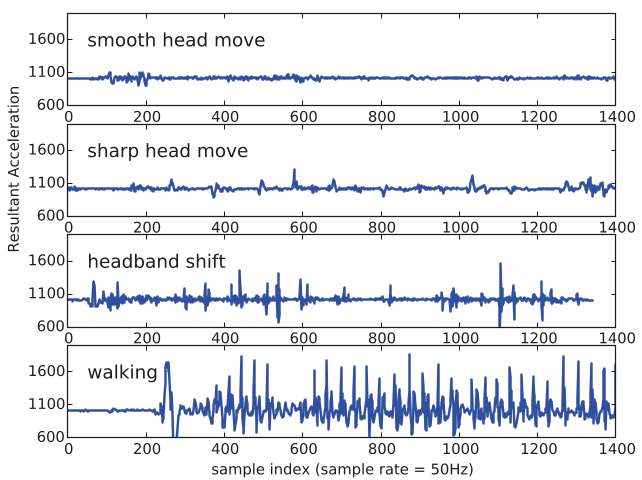
- Reliability: As shown in the signal analysis, the integration of motion sensors effectively distinguishes between a user laughing (emotional) and a user adjusting their glasses (mechanical noise).
Critical Insight: Why This Matters
The brilliance of this work lies not in "perfect" emotion recognition, but in Resource Orchestration. By treating the smartphone, the glasses, and the cloud as a single unified system, the authors show that we can run sophisticated BCI (Brain-Computer Interface) applications on hardware that was never meant to handle them.
Limitations & Future Work
While the electrode-shift detection is clever, the system still relies on a "30-second window" for triggering, which might still be too slow for instantaneous emotional spikes. Future iterations might benefit from Deep Learning models optimized for the edge (like TinyML) to reduce the latency of the cloud-tripping stage.
Conclusion
This poster abstract demonstrates a future where our devices are in sync with our internal states. By solving the "noise" and "power" problems of EEG-based wearables, the authors bring us one step closer to a world where our digital logs are as rich and emotional as our biological memories.