
Cognitive Map-Based Emotion Generation: Crafting the Soul of Virtual Humans
Emotion generation for virtual human using Cognitive Map
The paper introduces a novel emotion generation model for virtual humans using a <strong>Cognitive Map (CM)</strong> framework. By integrating the <strong>PAD (Pleasure-Arousal-Dominance)</strong> emotion space with the <strong>Five-Factor Model (FFM)</strong> of personality, the system achieves realistic, time-evolving emotional responses and maps them to 3D facial animations via a competitive learning network.
TL;DR
Researchers have developed a sophisticated emotion engine for virtual humans that utilizes Cognitive Maps to bridge the gap between external stimuli and internal psychological states. By combining the PAD Emotion Space with Personality Traits (FFM), the model simulates how a virtual agent feels, remembers, and expresses emotions through 3D facial animations that evolve realistically over time.
Context: Beyond "If-Then" Emotions
In the quest for harmonious human-computer interaction, making a machine "intelligent" is no longer enough; it must also be "affective." Historically, emotion generation relied on rigid rule-based systems (which fail in new scenarios) or black-box neural networks (which lack structural transparency). This paper positions itself as a structural middle ground, using Cognitive Maps (CM) to model the causal relationships between personality, mood, and transient emotions.
The Core Insight: The Affective Trinity
The authors argue that a virtual human's reaction isn't just a byproduct of a single stimulus. It is governed by three layers:
- Personality (Stable): Defined by the Five-Factor Model (Openness, Conscientiousness, Extraversion, Agreeableness, Neuroticism).
- Mood (Medium-term): A background state represented in the PAD (Pleasure-Arousal-Dominance) space.
- Emotion (Short-term): Highly dynamic states that decay over time.
The "Aha!" moment of this paper is the Emotion Update Equation, which accounts for "Emotion Fading." Just as humans don't stay angry forever, the model calculates a decay constant based on personality, ensuring that emotions naturally return to a neutral state.
Methodology: The Cognitive Reasoning Engine
1. The Architecture
The system uses a directed graph (Cognitive Map) where nodes represent concepts (like User Expression, Internal Emotion, Mood) and edges represent causal weights.
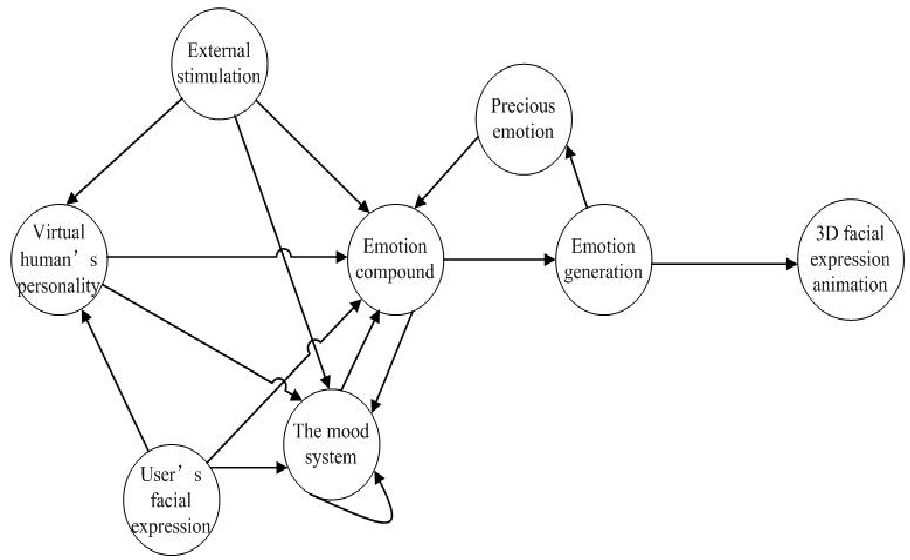 Figure 1: The architecture illustrates the flow from external stimuli (visual/auditory) through the Cognitive Map to generate the 3D facial output.
2. Mathematics of Feeling
The update rule for the emotion state is elegantly defined: This formula captures the inertia of current emotion, the decay factor, the external stimulus, and the influence of the current mood.
3. Expression Mapping
Because PAD space is continuous (a 3D vector) but facial expressions are often discrete, the authors use a Competitive Learning Network. This maps the abstract internal vector to one of 24 basic expressions, calculating the "Intensity" as the magnitude of the PAD vector.
Experimental Results: Realistic Transitions
The researchers tested the system in an "Intelligent Virtual Human System." The results showed that the agent doesn't just "switch" expressions; it transitions.
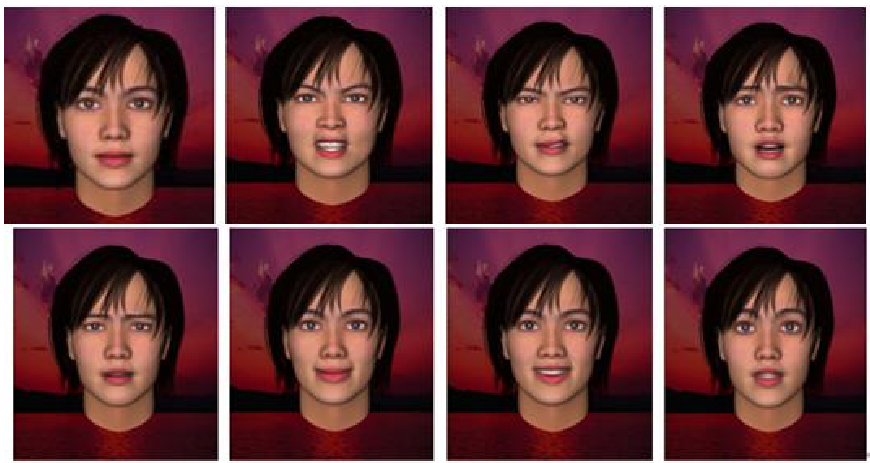 Figure 2: Seven basic facial expressions generated by the system (Anger, Disgust, Fear, Sadness, etc.).
In one scenario, the virtual human begins in a "Dependent" mood. When reproached, it doesn't just show anger; it shows "disappointment" with a specific intensity. If praised later, the speed and type of emotional recovery depend entirely on the pre-set personality traits (e.g., a highly neurotic agent might stay sad longer).
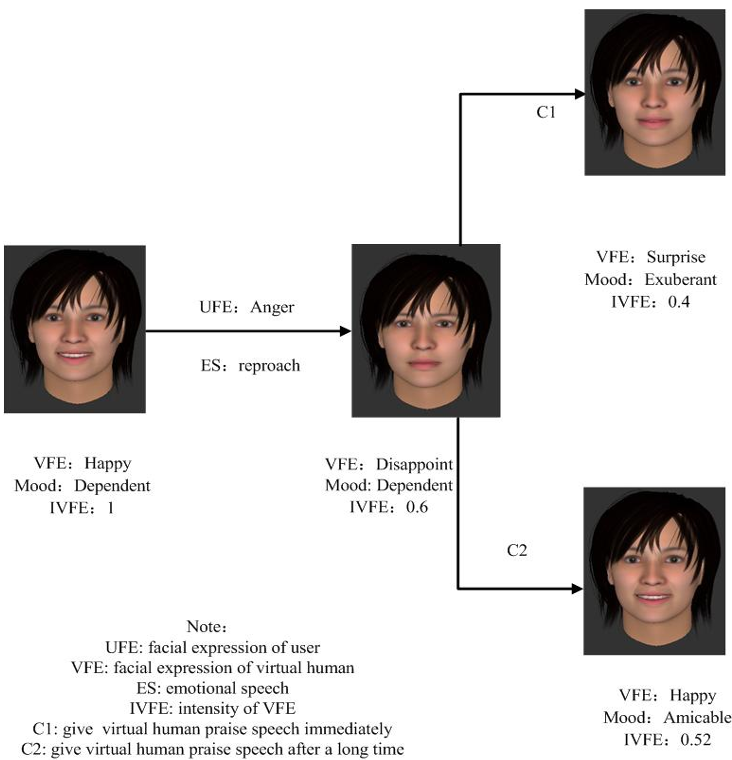 Figure 3: A sequence showing the dynamic shift in intensity and state as the virtual human interacts with a user over time.
Critical Insight & Future Outlook
While the mapping between Cognitive Maps and PAD Space is robust, the paper's reliance on a predefined training set of 1,000 samples is a limitation in the era of Big Data. However, the logic remains sound: personality provides the bias, mood provides the context, and the cognitive map provides the reasoning.
Future work will likely involve merging this structural "psychological" approach with Generative AI (LLMs) to create virtual humans that not only show emotion through their faces but express it through nuanced, personality-driven dialogue.
Conclusion
This work provides a foundational framework for "believable" AI. By treating emotion as a time-sensitive, causal process rather than a static classification problem, the authors move us one step closer to virtual entities that feel—and respond—like us.