
Emotion Labeling Model: Bridging the Gap Between Affect and Cognition in E-Learning
Towards an Emotion Labeling Model to Detect Emotions in Educational Discourse
This paper introduces an Emotion Labeling Model designed to detect students' affective states within collaborative e-learning environments. By integrating Rhetorical Structure Theory (RST) with Sentiment Analysis, the system transforms educational discourse (chat, forums, wikis) into a graphical emotional structure to enhance student awareness and tutor feedback.
TL;DR
In the realm of Computer-Supported Collaborative Learning (CSCL), emotions are often the "silent" drivers of success or failure. This paper presents a novel Emotion Labeling Model that utilizes a layered discourse analysis—combining Rhetorical Structure Theory (RST) and Sentiment Analysis—to make emotional states visible to both students and tutors. The results are striking: a 42% improvement in high-achievement students when emotion-aware feedback is integrated into the learning process.
Problem & Motivation: The "Cold" Virtual Classroom
While e-learning provides flexibility, it often lacks the emotional nuance of face-to-face interaction. Tutors struggle to identify when a student is frustrated or disengaged because the "affective information" is buried in raw text. Prior research has shown that negative emotions like frustration and fear (especially regarding new ICT tools) can cripple group performance if left unmanaged. The authors argue that without a formal method to label and visualize these emotions, tutors cannot provide the necessary affective scaffold to ensure students feel safe and valued.
Methodology: The Five-Layer Analysis
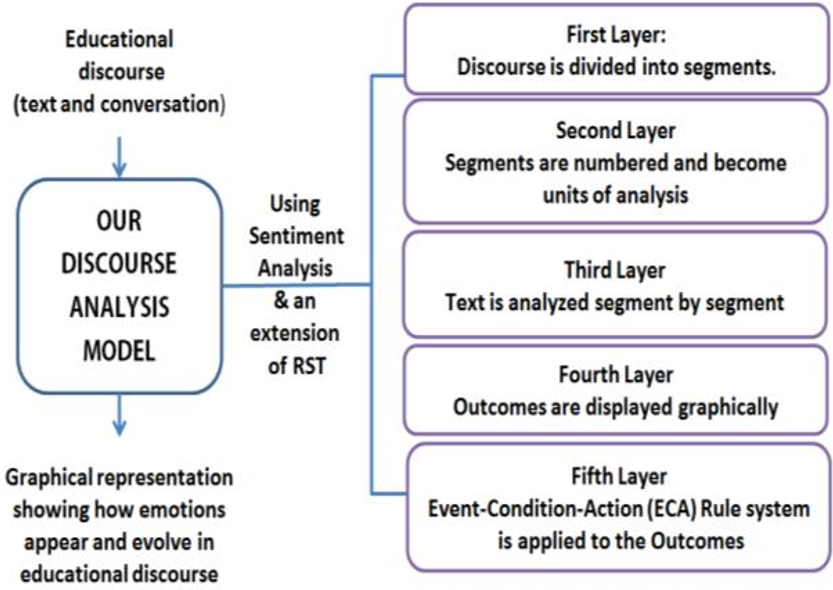
The core of the paper is a structured workflow that translates raw educational discourse into a map of human feelings.
- Segmentation: Breaking discourse into units (moves/sentences).
- Numbering: Establishing a sequential unit of analysis.
- The Dual-Analysis Core:
- Extended RST: Identifies the linguistic structure (nucleus vs. satellite) and the relationship between units.
- Sentiment Analysis: Assigns a valence (Positive, Neutral, Negative) to each segment.
- Graphical Representation: Visualizing the "Emotional Structure" so stakeholders can see the evolution of feelings over time.
- Intervention (ECA Rules): Using "Event-Condition-Action" rules to help tutors intervene effectively.
Experiments: Real-World Impact
The authors set up a controlled experiment with 16 high school students participating in a "JIGSAW" collaborative strategy task involving Wikis and Chats.
The Results
- Performance: The experimental group (with the labeling model) outperformed the control group significantly. 75% of the experimental group achieved marks over 7, versus only 33% in the control group.
- Engagement: Participation rates were higher across all virtual spaces when students and tutors were aligned emotionally.
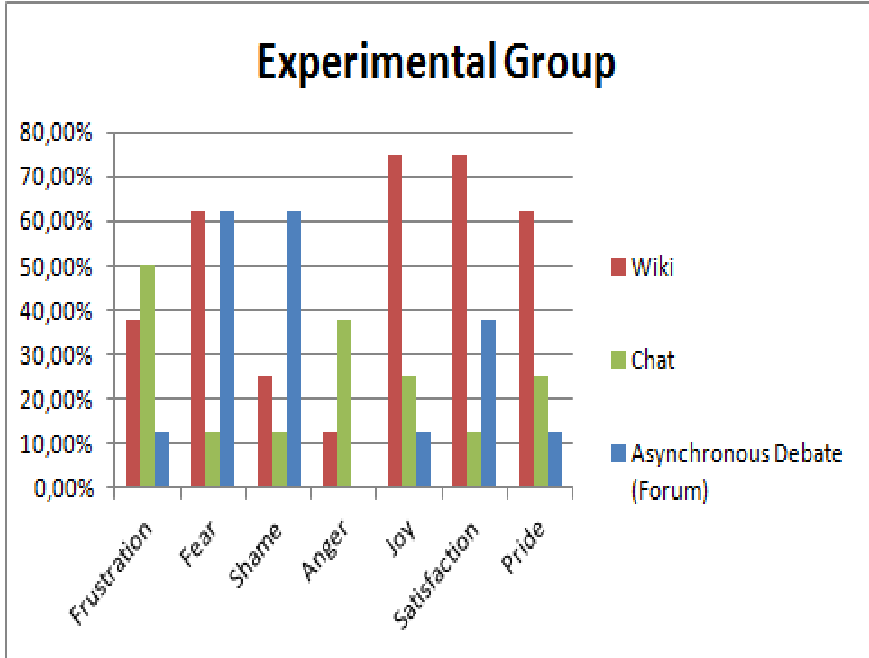
- Quantitative Insights: The use of the Achievement Emotions Questionnaire (AEQ) confirmed that detected negative valences in the chat often corresponded to the difficulty of using the technology, allowing for targeted feedback.
Critical Insight: The "Tutor-Feedback Gap"
One of the most honest findings in this work is the Tutor-Feedback Gap. Despite the model's success in performance metrics, the questionnaire revealed that students in the experimental group still felt the tutor could have done more to manage real-time emotions. This suggests that while valence (Positive/Negative) is a great start, the model needs to evolve toward detecting discrete emotions (e.g., distinguishing between "anger" and "confusion") to give the tutor more precise "medication" for the group's "illness."
Conclusion
This paper marks a transition from viewing e-learning as a purely cognitive challenge to seeing it as a socio-affective experience. By providing a technical framework to visualize the "Emotional Structure" of discourse, the researchers have opened the door for smarter, more empathetic e-learning platforms.
Takeaway for the Future: Expect future Intelligent Tutoring Systems (ITS) to treat your frustration with a software bug as seriously as your misunderstanding of a physics concept.