
From Clicks to Feelings: The Evolution of Multimodal Emotion Mining
Emotion Mining: from Unimodal to Multimodal Approaches
2021-01-01
Summary
Problem
Method
Results
Takeaways
Abstract
This paper provides a comprehensive review of Emotion Mining, transitioning from unimodal techniques (text, audio, video) to multimodal integration. It evaluates psychological emotion theories (Discrete vs. Dimensional), catalogs benchmark datasets, and discusses the shift toward Deep Learning architectures like CNNs and LSTMs for Affective Computing.
## TL;DR
Emotion recognition is evolving from simple text-based Sentiment Analysis to complex **Multimodal Affective Computing**. By integrating facial expressions, vocal prosody, and textual semantics, researchers are achieving significantly higher accuracy (up to 78.2% precision). This paper reviews the transition from "Unimodal" silos to "Multimodal" fusion, highlighting how Deep Learning is bridging the gap between psychology and silicon.
## The Core Challenge: The Complexity of Human Affect
Why is emotion recognition so difficult? In human psychology, "Affect" is a psychophysiological response, while "Sentiment" is a socialized opinion. Traditionally, AI has treated these separately:
- **Sentiment Analysis** focused on text (NLP).
- **Affective Computing** focused on biosignals and facial cues.
The problem is that a single modality is often ambiguous. A "sarcastic" tweet might look positive in text but reveals negative sentiment through audio tone or facial micro-expressions. Current SOTA (State-Of-The-Art) research strives to synchronize these disparate streams.
## Methodology: The Architecture of Fusion
The authors break down the emotion mining pipeline into three core stages: acquisition, pre-processing, and fusion.
### 1. The Psychological Foundation
Before building models, we must define the "target." The paper compares **Discrete Theories** (e.g., Ekman’s 6 basic emotions: Anger, Disgust, Fear, Joy, Sadness, Surprise) with **Dimensional Models** (e.g., Russell’s Circumplex Model focusing on *Valence* and *Arousal*).
### 2. Deep Learning Architectures
The paper highlights the shift from manual feature engineering to **Deep Neural Networks (DNNs)**.
- **CNNs**: Perfect for spatial features in facial expression images.
- **LSTMs (Long Short-Term Memory)**: Critical for capturing "temporal variations"—how an emotion unfolds over a sentence or a video clip.
### 3. Fusion Strategies
How do we combine data?
- **Feature-level Fusion**: Merging raw feature vectors into one massive input.
- **Decision-level Fusion**: Running separate models for text, audio, and video, then "voting" on the final result.

*Figure 1: Conceptual bridge between Affective Computing (Biosignals) and Sentiment Analysis (Text).*
## Experimental Insights & SOTA Comparison
The review analyzes various benchmark datasets such as **IEMOCAP** (Audio-Visual) and **SemEval** (Text). A key takeaway from the literature synthesis is the performance gap:
| Modality Combination | Precision |
| :--- | :--- |
| Visual + Text | 72.45% |
| Visual + Audio | 73.21% |
| **Multimodal (All three)** | **78.20%** |
The results confirm a "synergy effect": the model's understanding of human state is more than the sum of its parts. Feature-level fusion generally outperforms decision-level fusion, suggesting that the *interplay* between modalities contains vital information that is lost if processed in isolation.
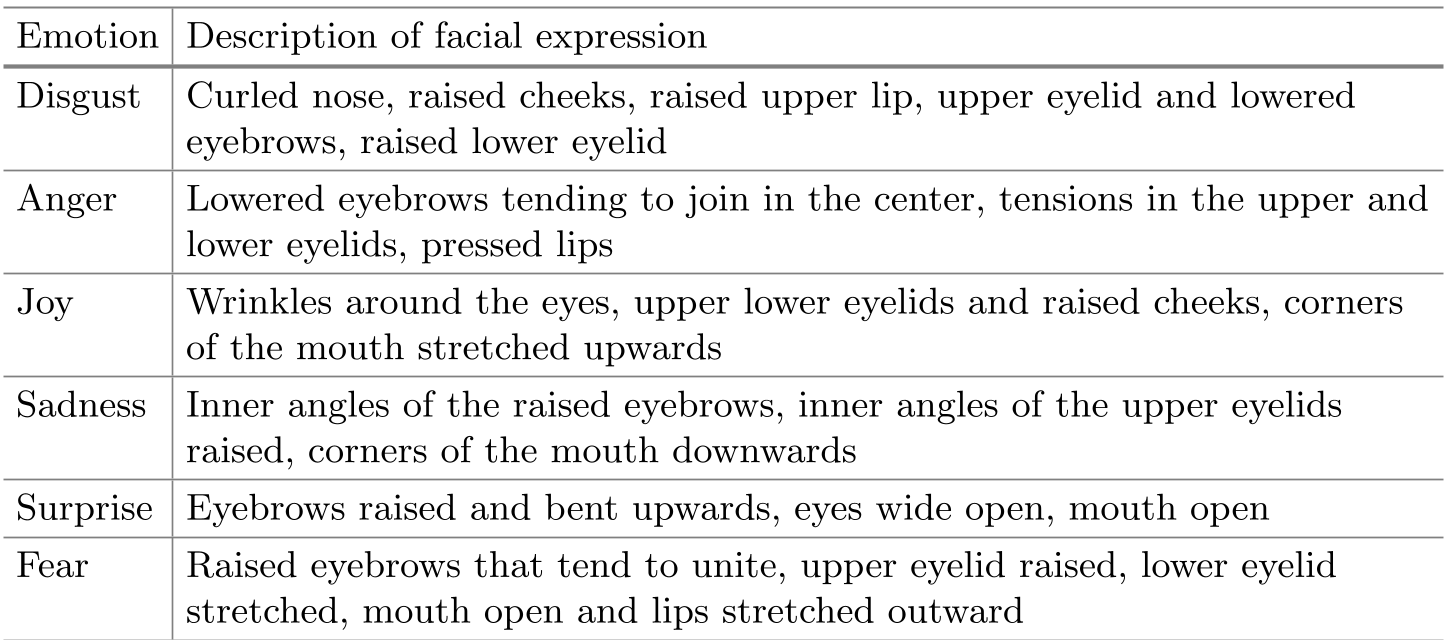
*Table 1: The Facial Action Coding System (FACS) provides the muscular "alphabet" for emotion detection.*
## Critical Analysis & Future Outlook
While the results are promising, several "bottlenecks" remain:
1. **Annotation Bias**: Humans only agree on sentiment about 60-65% of the time, creating a "ceiling" for supervised learning.
2. **Hardware Constraints**: Processing high-res video and audio in real-time on mobile devices requires significant optimization (Hardware Accelerators).
3. **Context Gap**: Existing models still struggle with domain-specific language (e.g., medical vs. social media).
**Final Takeaway**: The future of AI interaction lies not in "reading words," but in "sensing state." By combining Deep Learning with robust psychological frameworks, we are moving toward Clinical Decision Support Systems that can monitor mental health through a smartphone camera and a chat log.
## References
*Zucco, C., Calabrese, B., & Cannataro, M. "Emotion Mining: from Unimodal to Multimodal Approaches."*