
Decoding the Digital Soul: How Personality and Emotion Predict User Experience
Incorporating Emotion and Personality-Based Analysis in User-Centered Modelling
The paper introduces a predictive framework for user-centered modeling by correlating social media interactions with personality traits and emotional responses. By leveraging IBM Watson Developer Cloud tools, the authors achieve a 75.44% accuracy in predicting system states (Failure vs. Idle) based on the psychological linguistic patterns of users.
TL;DR
Can a software system "feel" your frustration? This paper explores a novel user-centered modeling approach that correlates system performance with the psychological state of its users. By analyzing Facebook interactions through the lens of the Big Five personality traits and IBM Watson's linguistic tools, the researchers built a model capable of predicting server status with 75.44% accuracy based purely on user sentiment and personality.
Background & Motivation
Current predictive models for user behavior often treat users as black boxes, focusing on what they do rather than why they do it. The authors argue that understanding the interaction between a user's stable personality (traits) and their transient reactions (emotions) is the key to building truly intuitive, adaptive systems. The primary motivation was to see if the "digital footprint"—the breadcrumbs of text we leave on social media—can provide a reliable proxy for measuring the health of a complex socio-technical system.
Methodology: The Psycholinguistic Stack
The researchers deployed a multi-stage analysis pipeline:
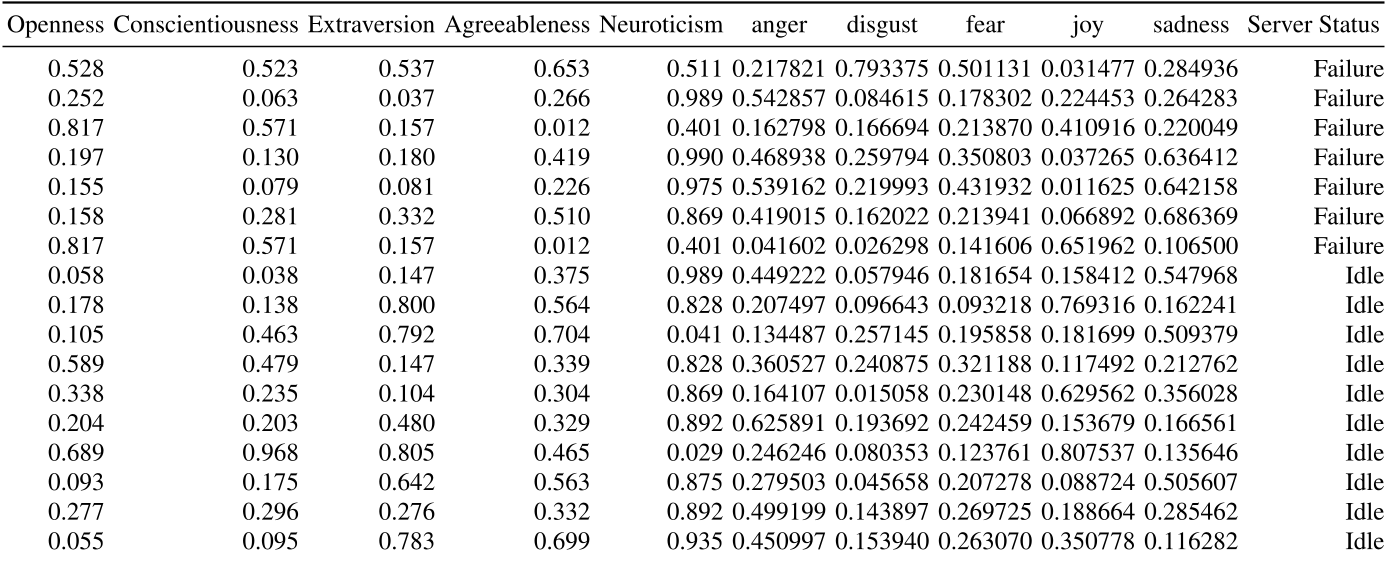
- Data Acquisition: Interactions from 391 users were collected from a mobility portal, alongside server status logs (defined as "Idle" or "Failure").
- Psychometric Extraction:
- IBM Watson Personality Insights was used to map users to the Big Five (Openness, Conscientiousness, Extraversion, Agreeableness, Neuroticism).
- IBM Watson Tone Analyzer extracted emotional tones (Anger, Disgust, Fear, Joy, Sadness) from user comments.
- Feature Selection: Through linear regression and Pearson correlation, the team filtered out non-significant factors (like "Agreeableness") to focus on high-impact variables like "Neuroticism" and "Joy."
Key Insights & Experimental Results
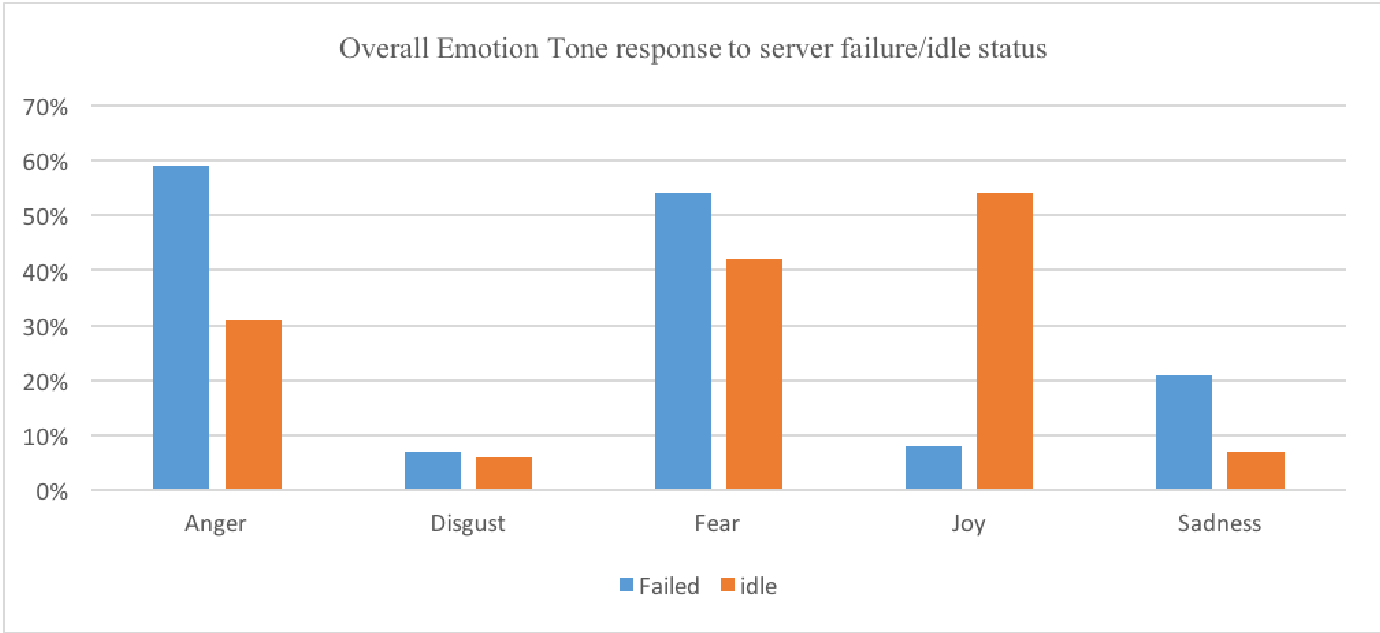
The study found a striking correlation between system failure and specific emotional outbursts.
- The "Joy" Indicator: As expected, "Joy" scores plummeted during server failures. Interestingly, "Joy" correlated with almost all personality traits except Agreeableness, suggesting that Agreeable people maintain a baseline tone regardless of system state.
- Neuroticism vs. Stability: Users scoring high in Neuroticism (low emotional stability) showed the strongest correlation with Anger and Sadness during technical glitches.
- Classification Power: By using these psychological markers as inputs for a neural network, the researchers achieved a solid classification rate.
Deep Insight: Beyond Simple Sentiment
Standard sentiment analysis (positive vs. negative) is often too blunt for UX design. This paper proves that personality acts as a filter. A "Failure" event doesn't trigger the same emotional response in an "Open" individual as it does in a "Neurotic" one. By incorporating these stable traits, the model gains an inductive bias that makes it more robust than simple keyword matching.
Conclusion and Future Outlook
While the sample size for the neural network was relatively small (n=57 for testing), the 75% accuracy serves as a strong "proof of concept."
Future Work includes:
- Gender-based analysis: Do emotional responses to technical errors vary by gender?
- Granular Event Mapping: Moving beyond a binary "Idle vs. Failure" to include specific scenarios like "Account Hacked" or "Unexpected Data Loss."
This research paves the way for "empathy-aware" systems that could, for instance, offer more detailed technical explanations to "Analytical" users while providing immediate reassurance to "Neurotic" users during a system crash.