
Hybrid Intelligence in Emotion Recognition: Scaling PCA, GMM, and GLCM for Real-Time Affective Computing
Emotion recognition model based on facial expressions
The paper proposes an end-to-end facial emotion recognition (FER) framework utilizing a hybrid feature extraction pipeline (PCA, GMM, and GLCM) coupled with a Support Vector Machine (SVM) classifier. It achieves superior performance in recognizing seven universal emotions—neutral, joy, surprise, anger, sadness, fear, and disgust—with a benchmarked accuracy of 93%.
TL;DR
This research introduces a refined "end-to-end" facial expression recognition (FER) model that targets seven core human emotions. By fusing PCA for global structure, GLCM for texture analysis, and GMM for statistical modeling, the author presents an SVM-driven architecture that achieves 93% accuracy, outperforming several LBP (Local Binary Pattern) variants in both speed and precision.
Background & Motivation: Moving Beyond Static Recognition
Emotions are universal, yet their digital capture is notoriously difficult due to "transient features"—those subtle wrinkles and muscle shifts that appear only for milliseconds. Traditional computer vision often focuses on "permanent features" (eyes, lips), missing the dynamic context of human affect.
The author identifies a tripartite challenge in the current SOTA:
- Complexity: High-dimensional image data slows down real-time processing.
- Illumination Sensitivity: Recognition drops significantly under varying light conditions.
- Scope: Most models recognize too few emotional states to be useful in professional settings like tourism management or medical treatment.
Methodology: The Feature Extraction Trio
The core of this paper is its sophisticated pipeline for turning raw facial pixels into "emotion-ready" feature vectors.
1. Principal Component Analysis (PCA)
PCA acts as the "summarizer." It reduces the variables of the training set by representing images as linear combinations of principal components (eigenfaces), ensuring the most critical variance is retained while dumping computational noise.
2. Gaussian Mixture Models (GMM)
Unlike standard parametric models, GMM provides a semi-parametric structure that resolves local differences in data distribution. Significantly, the author notes that implementing GMM in the frequency domain makes the system robust against lighting changes without requiring intensive "illumination standardization."
3. Gray Level Co-Occurrence Matrix (GLCM)
To capture the nuances of skin texture (e.g., the furrow of a brow), GLCM analyzes the spatial relationship of pixels. The model focuses on four specific properties: Energy, Inverse, Entropy, and Contrast, effectively mapping the "surface signature" of an emotion.
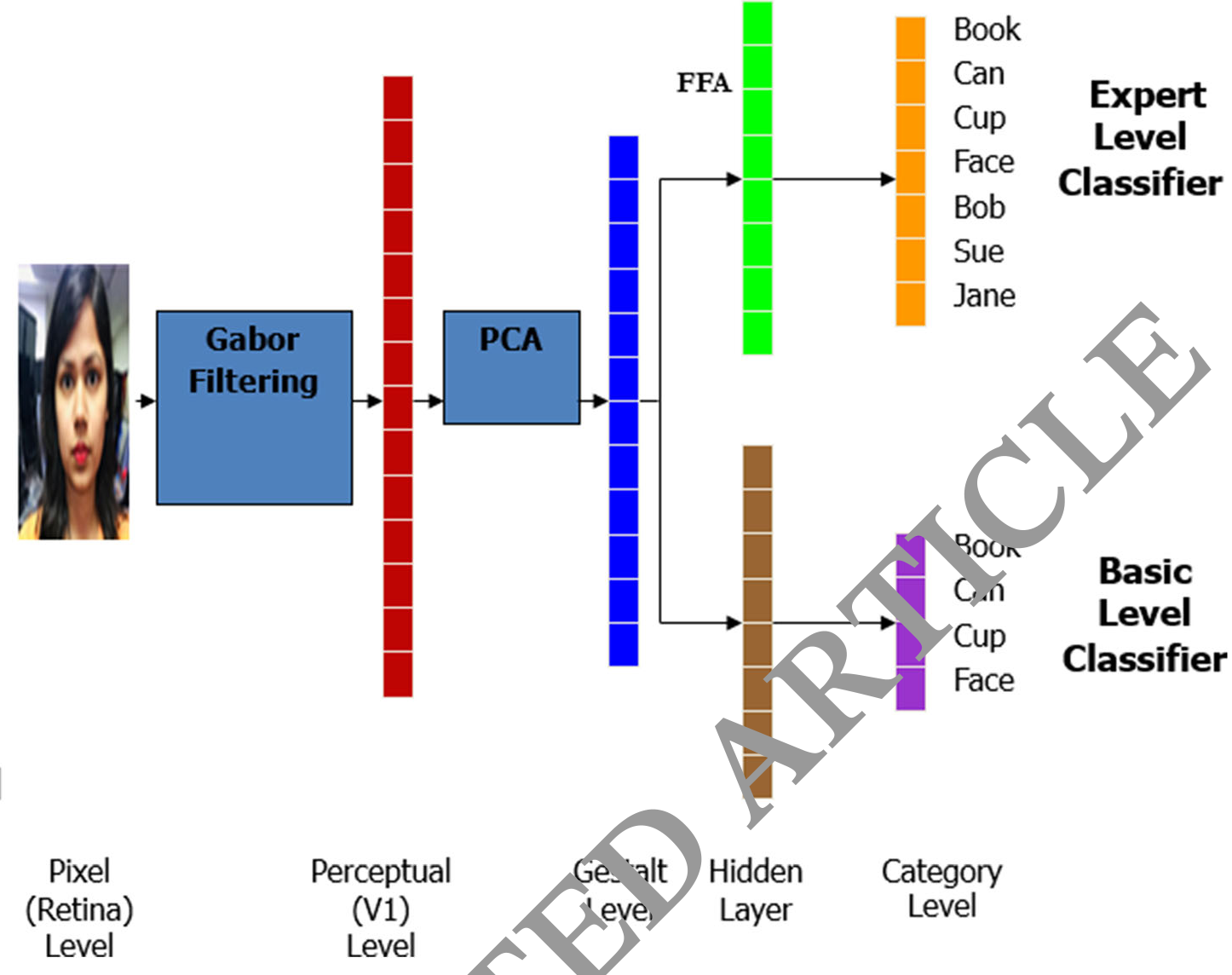 Figure: The proposed workflow for image mining and emotion classification.
Experiments and Results
The model was tested against several benchmarks, including the JAFFE and CK+ datasets.
Key Findings:
- SVM vs. KNN: The SVM classifier showed consistently higher performance, particularly after dimensionality reduction.
- Accuracy Peaks: The system achieved 93% accuracy for specific emotion clusters.
- Efficiency: The proposed solution outperformed current solutions across all emotion categories in terms of processing time. For example, "Surprise" detection was optimized from 172ms to 165ms, a critical gain for real-time video feeds.
 Table: Processing time (ms) comparison between the proposed solution and current baselines.
Emotion-Specific Analysis
The system excelled at identifying high-intensity emotions like Happy and Surprise, while noting that "Depression" and "Fear" remain the most difficult to distinguish due to overlapping facial markers.
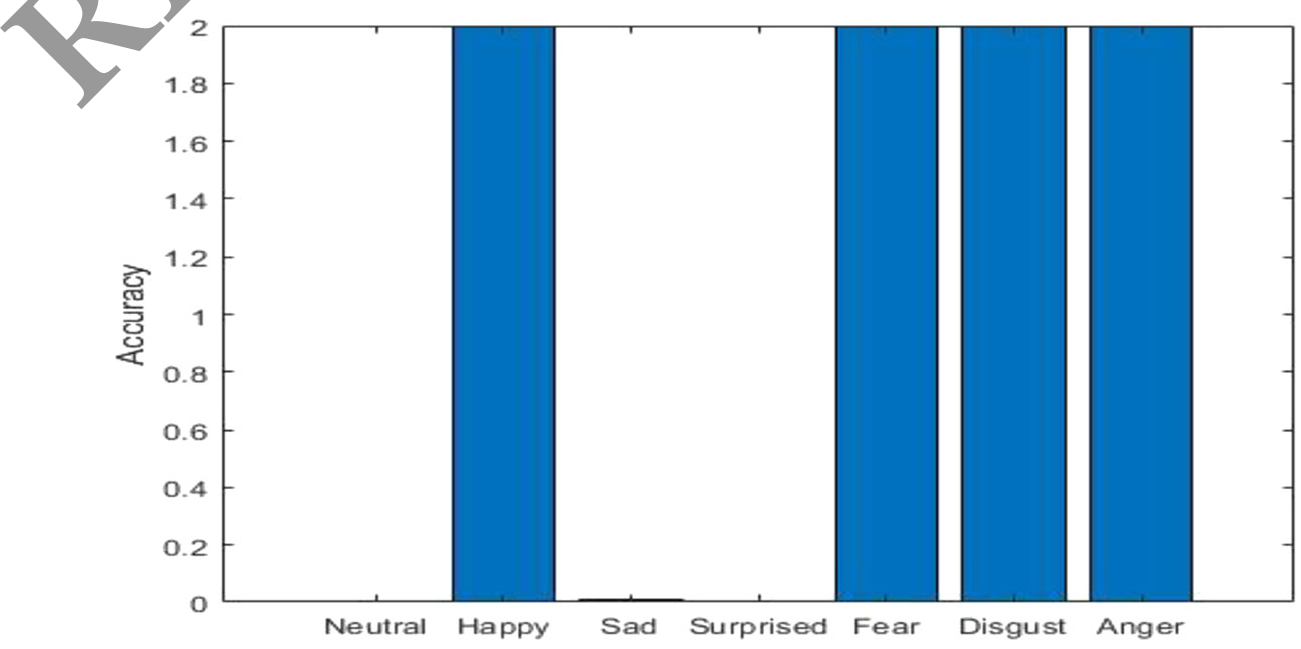 Figure: Accuracy distribution for Happy sentiment identification.
Critical Insight: The Future of Affective IoT
The author concludes that the value of FER extends far beyond simple "face tagging." By creating a "spatial emotion-wrongdoing relationship model," the research hints at future applications in Biometric Security and Predictive Surveillance, where emotional "hotspots" can be used to prevent violations before they occur.
Limitations: While the PCA+GMM+GLCM pipeline is robust, the author acknowledges the need for an even larger training set to handle "micro-expressions" with greater clinical precision. Future work will likely look toward Multi-wavelet transforms to further refine image quality in specialized domains like MRI and CT brain imaging.
Conclusion
This paper effectively bridges the gap between classic statistical methods and modern machine learning. By leveraging the specific strengths of PCA, GMM, and GLCM, it provides a high-accuracy, low-latency framework that is ready for deployment in human-computer interaction (HCI) and industrial surveillance.