
Beyond Emojis: Designing Emotional Intelligence for Companion Systems
Towards Emotion Recognition in Human Computer Interaction
The paper explores "Companion Technology" for Human-Computer Interaction (HCI), framing emotion recognition as a multimodal pattern recognition problem. It transitions from traditional basic emotion categories to application-specific user "dispositions" and proposes a framework for integrating machine learning under conditions of data sparsity and label uncertainty.
TL;DR
Artificial intelligence is moving beyond being a mere tool to becoming a "Companion." To achieve this, Technical Systems must move past recognizing simple "Happy" or "Sad" tropes and instead detect complex user dispositions like frustration, over-strain, or disengagement. This paper redefines affective computing by focusing on practical HCI contexts, multimodal fusion, and the strategy of learning from sparse, uncertain real-world data.
The "Ground Truth" Crisis in Affective Computing
Most AI models today are trained on "acted" datasets—actors pretending to be angry or joyful. In reality, human interactions with computers are far more subtle. The authors identify several critical pain points:
- Emotional Scarcity: Users rarely display "basic" emotions (like fear or disgust) while using a spreadsheet or a coffee machine.
- Complexity of Expression: Real-world emotions are often weak, idiosyncratic, and integrated across multiple channels—voice, facial micro-expressions, and physiological changes.
- The Labeling Dilemma: Unlike object detection, there is no absolute "Ground Truth" for how someone feels. Human raters often disagree, making traditional supervised learning problematic.
From Archetypes to "User Dispositions"
The core innovation proposed is shifting the classification target. Instead of chasing the elusive "Universal Emotions," the authors suggest a taxonomy of seven dispositions critical for a "Companion" (such as a digital trainer or organizer):
- Bored
- Disengaged
- Frustrated
- Helpless
- Over-strained
- Angry
- Impatient
By narrowing the field to these specific states, the system can provide actionable feedback—like reducing information complexity when a user is "Over-strained" or offering encouragement when they are "Helpless."
Methodology: Multimodal Fusion & Sparse Learning
The paper emphasizes that emotion recognition is essentially a multimodal integration task. A sigh (audio) combined with a furrowed brow (video) and an increased heart rate (biophysical) provides a much higher confidence score than any single modality.
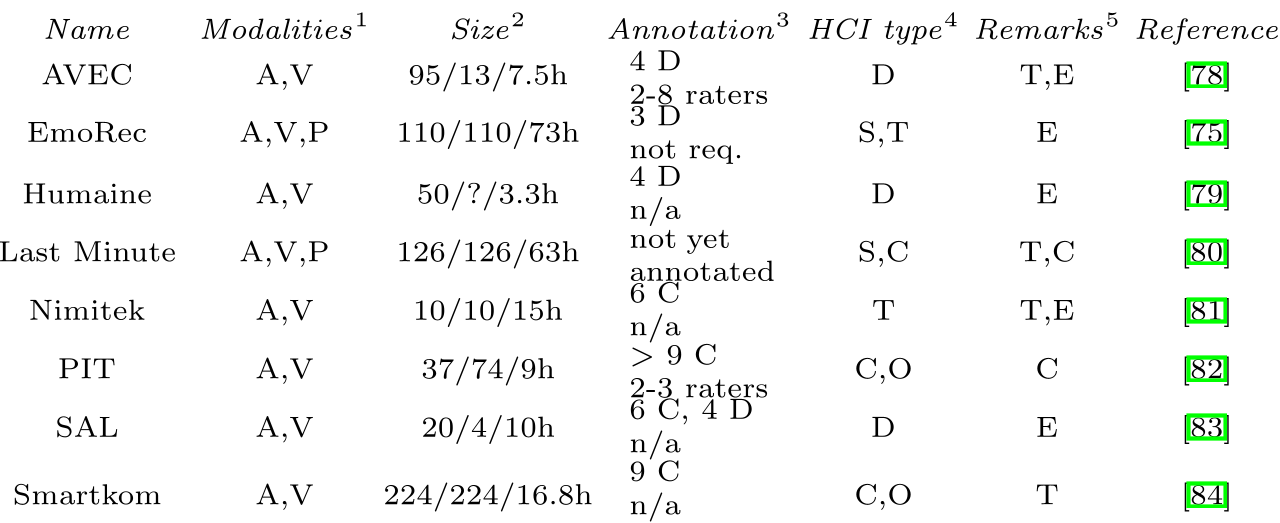 The table above highlights the variety of modalities (A=Audio, V=Video, P=Physiological) used in current SOTA datasets like EmoRec and LAST MINUTE.
To solve the data problem, the authors point toward:
- Classifier Fusion: Combining multiple weak classifiers from different sensors to create a robust decision.
- Semi-Supervised Learning: Leveraging the vast amounts of unlabeled natural data using co-training and entropy minimization techniques.
Deep Insight: The Feedback Loop
The authors argue for a "dyadic" approach. A true Companion doesn't just detect emotion; it displays it. This creates a stabilizing feedback loop in the interaction, allowing the human and the computer to reach a shared understanding of the task status.
Critical Analysis & Conclusion
While the paper provides a visionary framework for Companion systems, it acknowledges that we are still in the "infancy" of affective computing. The reliance on Wizard of Oz (WOZ) methodology—where a human secretly controls the "intelligent" system to gather data—shows how far we are from truly autonomous emotional intelligence.
Takeaway: The future of HCI isn't about machines that "feel," but machines that accurately interpret our disposition toward a task. By focusing on specific roles (Trainer, Organizer, Servant), we can build specialized models that perform far better than generic "one-size-fits-all" emotional detectors.