
Decoding Human Sentiment: The Fundamentals of Multi-modal Emotion Recognition
14247_Emotion Recognition From Multiple Modalities: Fund
This tutorial paper provides a comprehensive overview of Multi-modal Emotion Recognition (MER), covering psychological models, affective modalities (explicit cues like facial expressions and implicit stimuli like text/images), and state-of-the-art computational frameworks. It highlights how MER achieves superior performance—averaging a 9.83% improvement over uni-modal systems—through data complementarity and robustness.
TL;DR
Emotion is not a single-channel signal. While a face might show a smile, the voice might tremble, and the text might be sarcastic. This paper serves as a senior-level tutorial on Multi-modal Emotion Recognition (MER), detailing how machines can synthesize explicit cues (facial, vocal, physiological) and implicit stimuli (text, images) to achieve "Emotional Intelligence." By leveraging deep learning and complex fusion strategies, MER systems now approach human-level accuracy in sentiment analysis.
The "Why": Why Multi-modal?
As the Turing Award winner Marvin Minsky once said, "The question is not whether intelligent machines can have any emotions, but whether machines can be intelligent without emotions."
Traditional uni-modal systems often fail due to:
- Ambiguity: Is "What great weather!" positive? Not if the accompanying image is a storm.
- Sensor Failure: In real-world "wild" settings, a camera might be obscured, but the audio remains available.
- The Affective Gap: The disconnect between binary pixel data and the subtle, subjective nature of human feelings.
MER solves this by providing data complementarity (filling in the gaps) and model robustness (averaging out the noise).
Methodology: The Architecture of Feeling
The paper breaks down a standard MER framework into a sophisticated pipeline.
1. Representation Learning
Each modality requires a specialized "translator":
- Text: Evolution from One-hot to Transformers (BERT, XLNet) to capture long-range dependencies.
- Audio: Transitioning from hand-crafted features (Pitch, Jitter) to CNNs processing Spectrograms.
- Visual: Using 3D CNNs to capture spatial-temporal changes in facial expressions.
2. The Art of Fusion
The "Secret Sauce" of MER is how modalities are combined:
- Early Fusion: Concatenating features at the start. Simple, but suffers if timing isn't perfectly synchronized.
- Late Fusion: Voting based on individual modality decisions. Robust but misses "cross-talk" between channels.
- Model-based Fusion (The SOTA standard): Using Attention Mechanisms or Tensor Fusion Networks (TFN) to learn which modality is most reliable at any given moment.
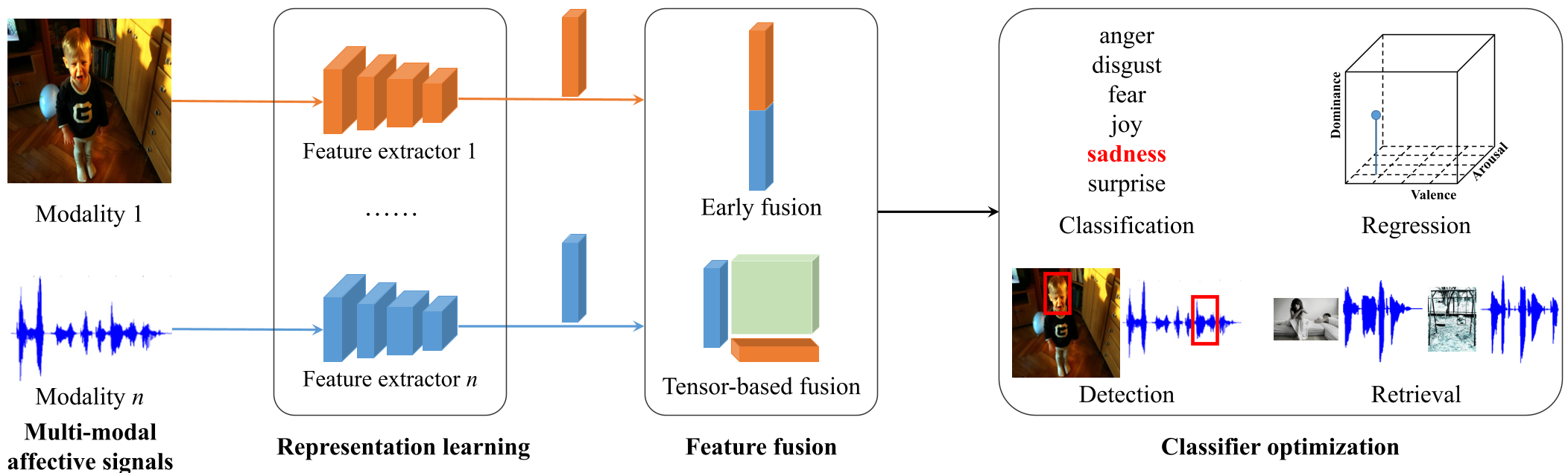 Figure 1: A general MER framework involving representation, fusion, and optimization.
Experiments & The Reality Check
The authors conducted a rigorous comparison using the CMU-Multimodal SDK.
Key Insight: Data matters as much as the architecture. The switch from GLOVE to XLNet/BERT embeddings pushed models from "good" to "near-human." In the CMU-MOSI benchmark, the Multimodal Adaptation Gate (MAG) reached an Accuracy of 85.7%, nearly matching the human baseline of 85.7%.
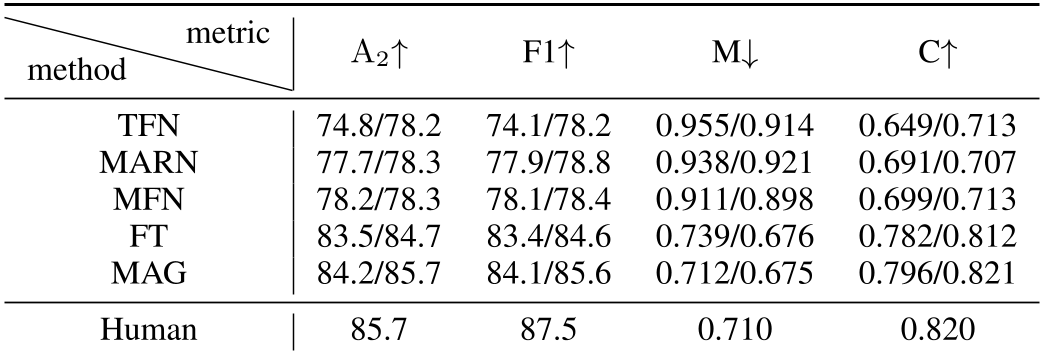 Table 1: Comparison of SOTA methods showing the superiority of MAG and Transformer-based models.
Critical Challenges & Future Horizons
Despite the high accuracy, the "wild" remains unconquered.
- Perception Subjectivity: How do we handle the fact that a storm makes one person sad and another person excited? The paper suggests Label Distribution Learning (LDL) to model the probability of multiple emotions simultaneously.
- Cross-modality Inconsistency: When the text says one thing and the voice says another (sarcasm), current models still struggle with the "higher-order" logic required for detection.
- Domain Adaptation: We have great data for movies, but how do we transfer that model to a companion robot for the elderly without retraining from scratch?
Conclusion: Toward Artificial Emotional Intelligence
This tutorial makes it clear: we are moving past "Sentiment Analysis" (is this a 5-star review?) toward "Emotional Intelligence." The future of MER lies in contextual modeling—understanding the age, culture, and personality of the user—and deploying these models on the edge (phones and wearables) while strictly maintaining privacy and ethics.
Senior Editor's Takeaway: MER is no longer a niche sub-field. It is the bridge that will transform AI from a processing tool into a truly interactive partner.