
Robust Mandarin Emotion Recognition: Leveraging Compressed Sensing for Noise Mitigation
Emotion Recognition from Noisy Mandarin Speech Preprocessed by Compressed Sensing
This paper proposes a noise-resilient Mandarin Speech Emotion Recognition (SER) framework using Compressed Sensing (CS) for signal reconstruction and denoising. By integrating a novel Binary Tree Support Vector Machine (BT-SVM) and Information-Theoretic Feature Selection (DISR), the method achieves an 81.6% accuracy on reconstructed speech, surpassing the performance on both noisy and original clean samples.
TL;DR
Environmental noise is the nemesis of Speech Emotion Recognition (SER). This paper introduces a preprocessing pipeline using Compressed Sensing (CS) to reconstruct noisy Mandarin speech. By prioritizing the sparsity of voiced segments, the system not only recovers the signal but actually enhances emotional recognizability, achieving a SOTA-level accuracy of 81.6%, which surprisingly outperforms results from the original "clean" recordings.
Context & Motivation
Most SER models are "lab-grown"—trained on pristine, studio-recorded datasets. However, real-world Human-Computer Interaction (HCI) happens in noisy streets and echoing rooms. Previous attempts to solve this via standard speech enhancement often distort the subtle prosodic cues (pitch, energy, duration) that carry emotional weight.
The authors' core insight is that speech is naturally sparse in the frequency domain (specifically using DCT). Compressed Sensing allows us to recover the "essential" parts of the speech signal from a limited number of noisy projections, effectively acting as a filter that ignores non-sparse noise.
Methodology: The CS + BT-SVM Pipeline
1. Compressed Sensing as Preprocessing
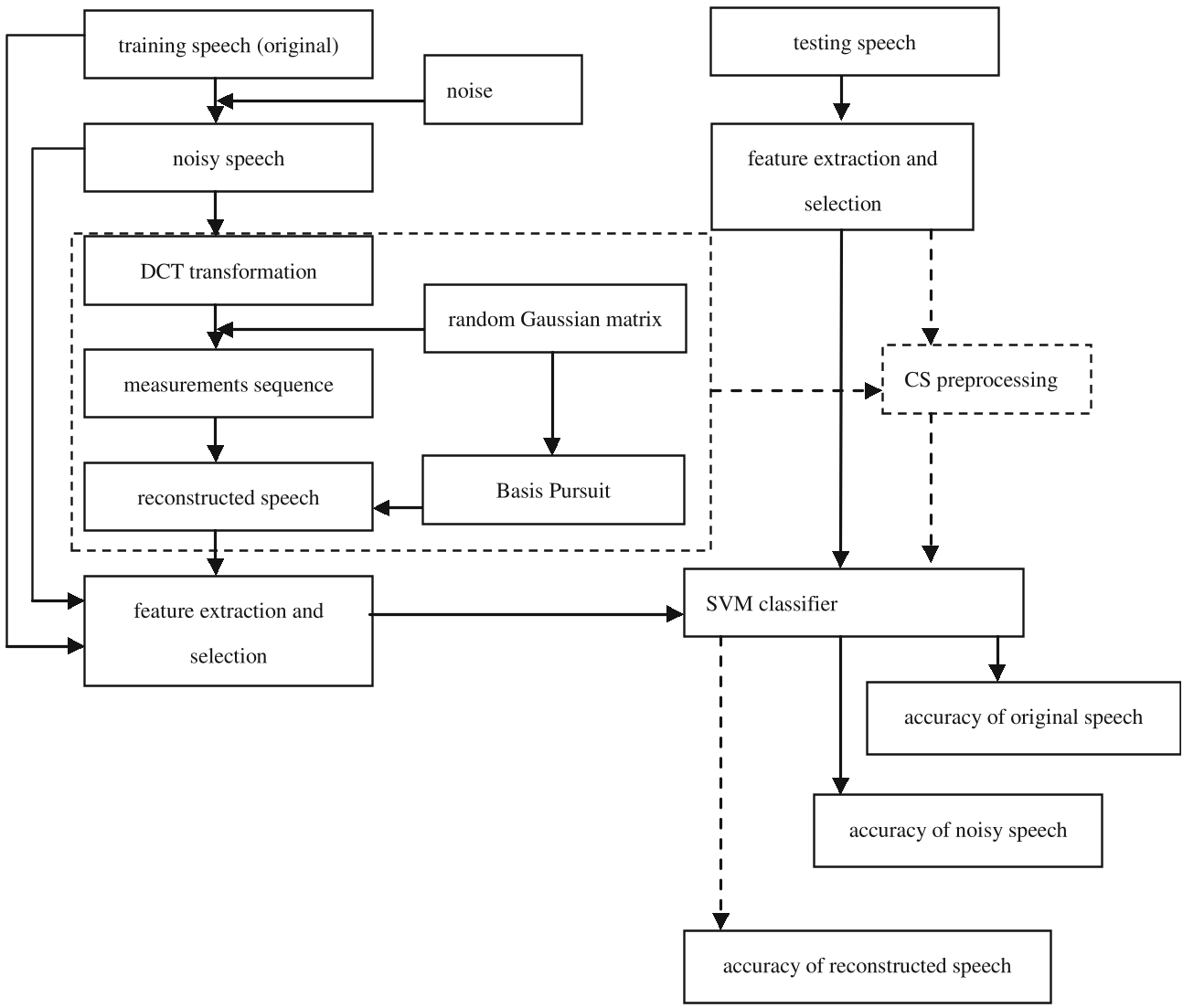
The framework treats noise removal as a signal reconstruction problem. Using the Restricted Isometry Property (RIP) and -norm minimization (Basis Pursuit), the system reconstructs the signal from a small set of measurements .
- The "Voiced" Advantage: Voiced speech (vowels) has high energy and high sparsity in the DCT domain. Noise, being stochastic, is not sparse. Therefore, the CS reconstruction naturally preserves the "emotional" voiced parts while suppressing the "noisy" unvoiced or background parts.
2. Feature Engineering & DISR Selection
Instead of using all 45 extracted acoustic features (Prosody, Voice Quality, and Spectral), the authors apply Double Input Symmetrical Relevance (DISR). This information-theoretic approach selects features that have high mutual information with the emotion class while minimizing redundancy.
3. Binary Tree SVM (BT-SVM)
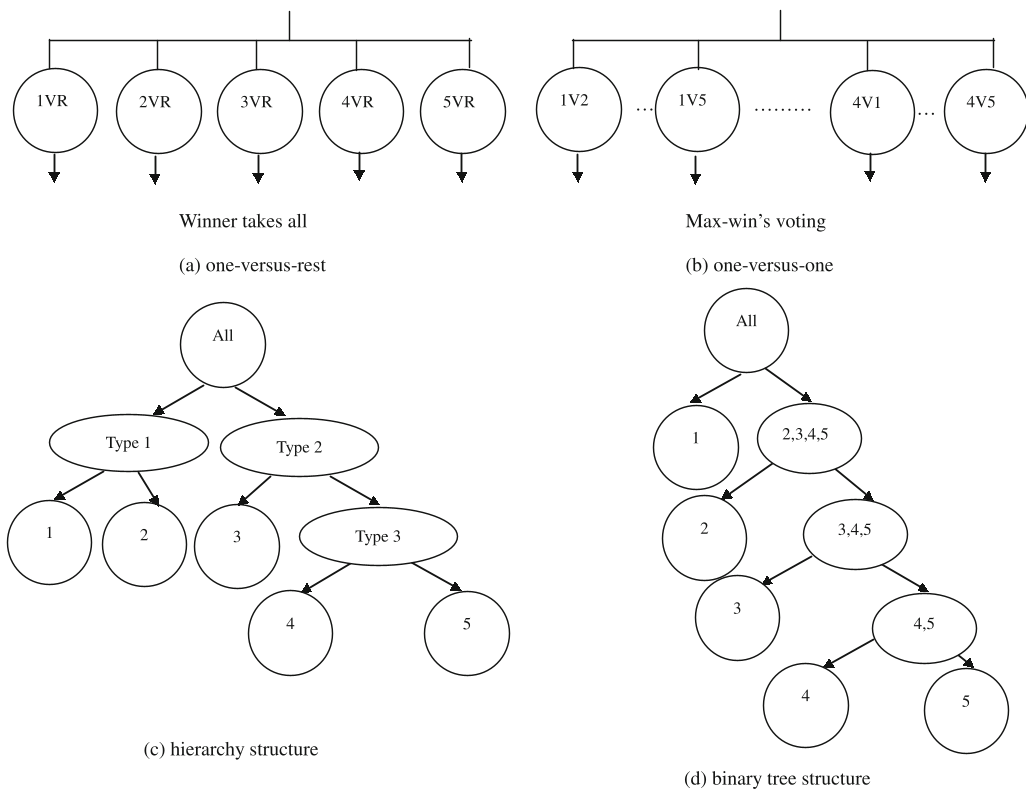
Standard SVMs are binary. To handle five emotions (Angry, Fear, Happy, Neutral, Sad), the authors designed a Binary Tree structure. This hierarchy reduces the complexity of each decision boundary and minimizes the cumulative error compared to "One-vs-Rest" strategies.
Experimental Results: Better Than "Clean"?
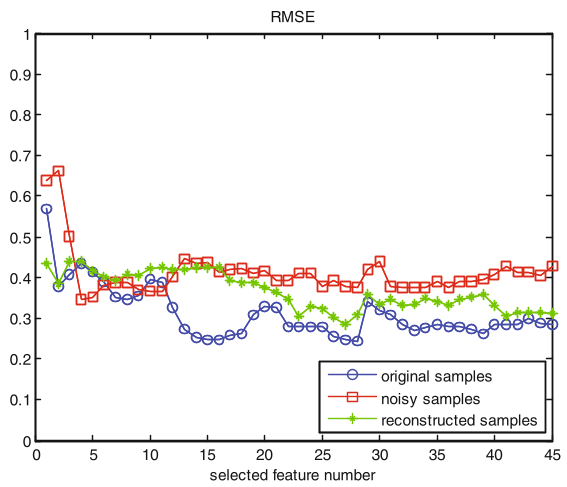
The results reveal a fascinating phenomenon: the reconstructed speech performed better than the original clean speech.
| Signal Type | Accuracy | RMSE |
|---|---|---|
| Original (Clean) | 80.8% | 0.299 |
| Noisy (20dB White Noise) | 71.2% | High |
| Reconstructed (CS) | 81.6% | Low |
Why does this happen?
The authors suggest that the CS reconstruction process creates a "much clearer boundary between voiced and unvoiced speech." Since most emotional features are derived from voiced segments, this "cleaning" effect actually helps the SVM delineate complex emotions like Sad vs. Fear more effectively.
Critical Insight & Limitations
While the CS-based approach is powerful for noise reduction, the paper notes a persistent challenge: Emotional Confusion. Specifically, Fear and Sadness are frequently misclassified even after reconstruction. This is likely because these emotions share similar low-intensity prosodic profiles (low energy, slower tempo), which the current acoustic feature set cannot fully disentangle.
Conclusion
This work demonstrates that Compressed Sensing is not just for data compression—it is a robust tool for signal purification. By focusing on the structural sparsity of speech, we can build SER systems that are more resilient to the "messiness" of the real world. For future work, exploring hybrid models that combine CS-preprocessed signals with Deep Learning (like CNNs for spectrogram analysis) could solve the remaining emotional confusion bottlenecks.