
Bayesian Deep Learning: Capturing the "Uncertainty" of Musical Emotion
Emotion Recognition in Songs via Bayesian Deep Learning
This paper introduces a novel approach for Music Emotion Recognition (MER) using Bayesian Deep Learning. By utilizing spectrograms as input to a Bayesian Convolutional Neural Network (CNN) with Monte Carlo Dropout, the method achieves a state-of-the-art accuracy of up to 83.8% on the 1000-songs benchmark dataset.
TL;DR
Music is inherently subjective—a song might feel "somewhat sad" to one listener and "peaceful" to another. This paper addresses this subjectivity by being the first to apply Bayesian Deep Learning to Music Emotion Recognition (MER). By treating model weights as probability distributions rather than fixed points, the authors achieve a significant performance leap, reaching 83.8% accuracy on benchmark datasets while providing a measure of how "sure" the AI is about its emotional label.
The Core Problem: Why Handcrafted Features Fail
For years, the MER field was dominated by "Feature Engineering." Researchers painstakingly extracted low-level acoustic properties like Zero Crossing Rate, RMS energy, and Mel-Frequency Cepstral Coefficients (MFCCs).
The limitations were twofold:
- Complexity: Hand-selected features often miss high-level semantic patterns in the music.
- Determinism: Traditional models (SVMs, standard CNNs) output a single label with 100% "confidence" (in a mathematical sense), ignoring the fact that emotional boundaries in Thayer's Valence-Arousal space are often blurry.
Methodology: Bayesian CNNs and Spectrograms
The authors shift the paradigm by treating the emotion recognition task as a computer vision problem, but with a probabilistic twist.
1. The Input: 5-Second Spectrograms
Instead of raw audio, the model processes spectrograms—visual representations of frequency over time. To augment the data and provide more granular analysis, each 45-second song is split into 5-second segments.
2. The Architecture: Bayesian Inference via Dropout
The "Bayesian" part is achieved through a clever mathematical shortcut: MC Dropout. Instead of purely using Dropout for regularization during training, the authors keep Dropout active during inference. By running the same audio sample through the network multiple times ( iterations), they can sample from the predictive distribution.
Mathematically, the predictive distribution is approximated as: This allows the model to report both a mean accuracy () and a variance (), the latter representing the model uncertainty.
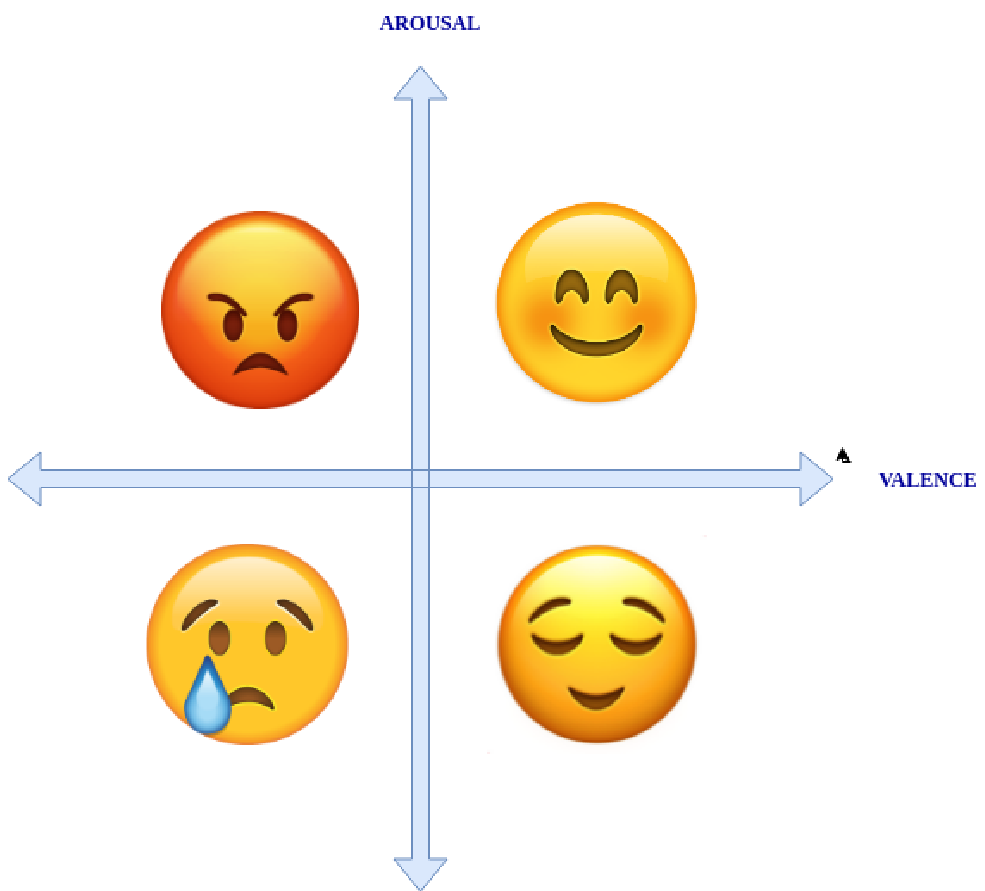 Figure 1: Mapping Valence and Arousal into discrete emotional quadrants (Happy, Angry, Sad, Peaceful).
Experimental Results: Scaling Depth
The study demonstrates that as the underlying CNN architecture becomes more sophisticated, the benefits of the Bayesian approach scale accordingly.
| Architecture | Accuracy (%) |
|---|---|
| SVM (Traditional) | 38.5% |
| Baseline CNN (Liu et al.) | 72.4% |
| Ours (ResNet-152 Bayesian) | 83.8% |
The jump from a basic VGG-like structure to ResNet-152 resulted in an 11% accuracy gain over previous benchmarks. More importantly, the authors performed a Nemenyi test, a rigorous statistical analysis to prove that their improvements weren't just due to "lucky" data splits but were statistically significant.
 Figure 2: Critical Difference (CD) diagram confirming the proposed model's superiority.
Critical Insight: Why Does This Matter?
The real value of this research isn't just the higher percentage on a leaderboard. It’s the shift toward Robust AI. In real-world applications—like a music streaming service generating "mood-based" playlists—it is a feature, not a bug, for a model to say: "I am 60% sure this song is 'Sad' but 40% sure it is 'Peaceful'."
Limitations & Future Work
- Temporal Dynamics: While the paper uses 5-second windows, emotions in music often evolve over minutes. Future work could integrate Recurrent Neural Networks (RNNs) or Transformers with Bayesian layers to capture this "emotional arc."
- Computational Cost: Running passes for every song to get uncertainty estimates increases inference time, which might be a bottleneck for real-time mobile applications.
Conclusion
By marrying the structural power of ResNets with the probabilistic rigor of Bayesian inference, Nayal et al. have set a new standard for how we should approach subjective media classification. It is a compelling reminder that in the realm of human emotion, being "uncertain" is often the most accurate path to the truth.