
Enhancing Speech Emotion Recognition: From Traditional MFCC to Deep Kernel Learning
Emotion recognition in speech using MFCC with SVM, DSVM and auto-encoder
This paper presents a two-stage speech emotion recognition (SER) framework utilizing MFCC features and various classification architectures. By benchmarking standard SVMs against Deep Support Vector Machines (DSVM) and Auto-encoders on the SAVEE database, the authors achieve a peak classification accuracy of 73.01% using an Auto-encoder integration.
TL;DR
This research tackles the complexity of human emotion within speech by evolving traditional Mel-frequency Cepstral Coefficients (MFCC) pipelines. By transitioning from standard Support Vector Machines (SVM) to Deep SVM (DSVM) and Auto-encoders, the authors achieved a significant performance jump from 51% (previous SOTA on SAVEE) to 73.01%.
Background & Motivation
Identifying emotion in a signal is fundamentally harder than identifying words. While "what" is said is encoded in phonemes, "how" it is said—the emotion—is hidden in prosody, spectral envelopes, and micro-variations of pitch.
Traditional approaches like Gaussian Mixture Models (GMM) often fail to capture the high-dimensional dependencies of these features. The authors identify a critical gap: standard SVMs are limited by their kernel depth, and traditional MFCCs need better non-linear representations to distinguish between subtle emotions like "sadness" versus "disgust."
Methodology: The Architecture of Feeling
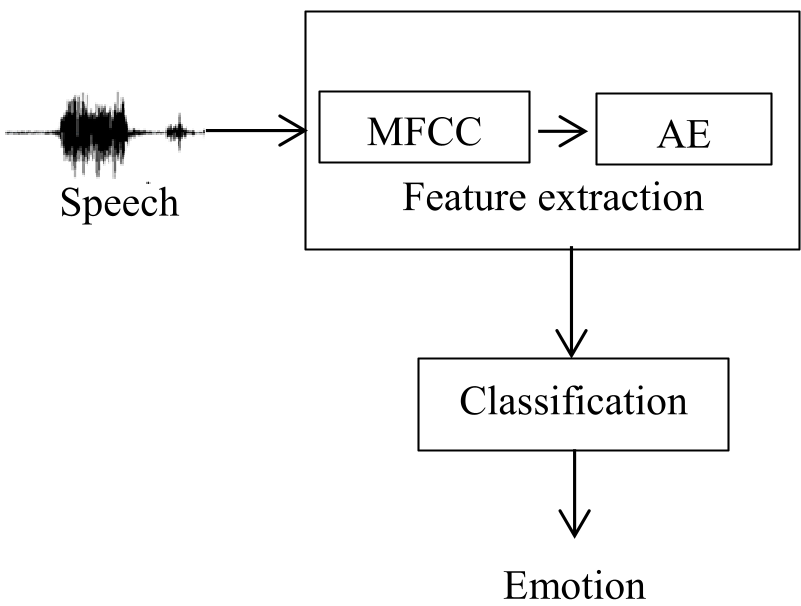
The proposed system follows a rigorous two-stage approach: Feature Extraction and Classification.
1. Feature Engineering
The paper explores two specific configurations:
- 39 MFCCs: 12 coefficients + energy, plus their first and second-order derivatives (Delta and Delta-Delta).
- 65 MFCCs: A more expansive set involving mean, median, standard deviation, and extrema of 13 coefficients.
2. The Classification Engines
The study introduces a hierarchy of complexity:
- Standard SVM: Using RBF, Linear, and Polynomial kernels.
- Deep SVM (DSVM): An -level architecture that uses kernel activations of support vectors as inputs for subsequent layers.
- Auto-encoders (AE): Used for non-linear dimensionality reduction, compressing features into a 30-unit hidden layer to discard noise.
Experimental Results & Insights
The experiments were conducted on the SAVEE (Surrey Audio-Visual Emotional Expressive) database.
Key Findings:
- The Power of Depth: Using DSVM on 39 MFCCs improved the global recognition rate significantly compared to standard SVM.
- Auto-encoder Supremacy: The Auto-encoder + SVM pipeline proved to be the most robust, achieving 73.01% accuracy.
- Kernel Sensitivity: The RBF kernel consistently outperformed Linear kernels, proving that emotional boundaries in speech are non-linear.
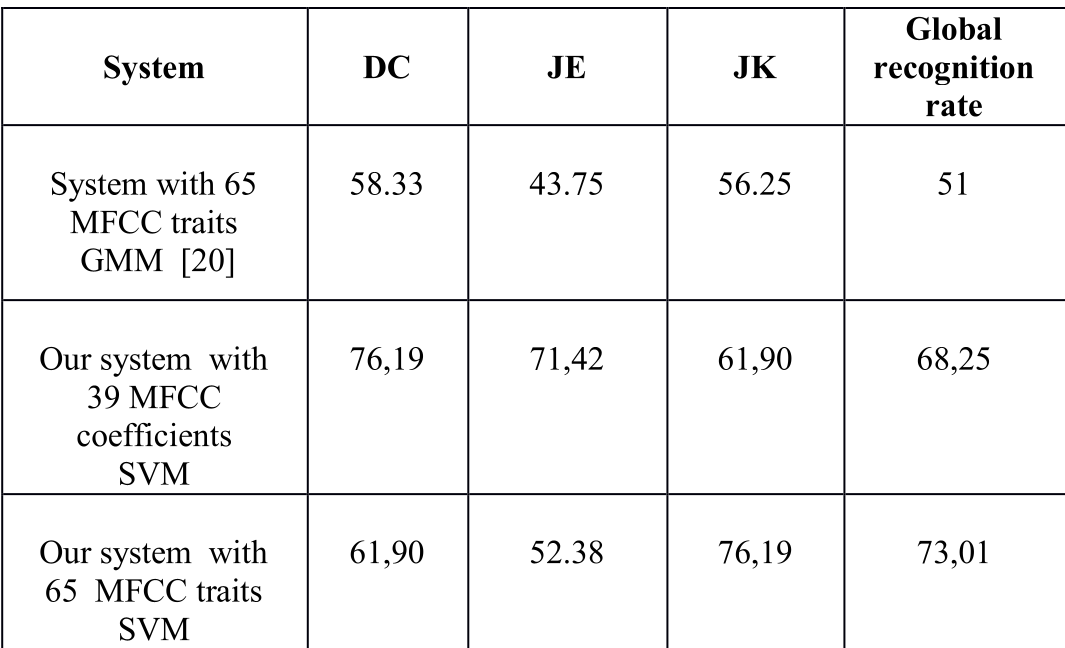
When looking at specific emotions, the Basic Auto-encoder achieved a perfect 100% recognition for "Angry" speech, though it struggled more with "Sad" and "Surprise" compared to the Stacked Auto-encoder.
Critical Analysis & Conclusion
The value of this work lies in its validation of Deep Kernel Learning. While many modern researchers jump straight to End-to-End Deep Learning (like CNNs or Transformers), this paper shows that hybridizing classical feature engineering (MFCC) with deep architectural constraints (DSVM/AE) can yield impressive results on smaller, specialized datasets where massive models might overfit.
Limitations: The system was tested on a relatively small number of speakers (DC, JE, JK, KL). Future work should focus on Speaker-Independent testing to ensure the model isn't just learning the unique vocal characteristics of the four subjects in the SAVEE database.
Takeaway: If you are working on real-time signal processing where computational resources are limited, using an Auto-encoder to "clean" your MFCCs before feeding them into a kernel-based classifier remains a highly efficient and potent strategy.