
Beyond Words: The Technical Evolution and Social Impact of Speech Emotion Recognition
Techniques and applications of emotion recognition in speech
This paper provides a comprehensive review of Speech Emotion Recognition (SER) techniques and their diverse applications in Affective Computing. It evaluates acoustic and linguistic feature extraction methods paired with machine learning classifiers such as SVM, HMM, and ANN to achieve cross-disciplinary integration in Human-Computer Interaction (HCI).
TL;DR
While textual information conveys the "what," the "how" defines human communication. This paper explores the transition of machines from mere "calculators" to "affective agents" capable of decoding human vocal intonation with up to 95% accuracy, outperforming human observers and opening new frontiers in healthcare, law, and corporate management.
Background Positioning: The Socio-Technical Bridge
This work acts as a high-level cartography of Affective Computing, positioning Speech Emotion Recognition (SER) not just as a signal processing task, but as a fundamental component of Socio-Technical Systems. It bridges the gap between Minsky’s "The Emotion Machine" theories and practical Machine Learning applications.
The Core Challenge: The 38% Rule
Research in non-verbal communication suggests that voice intonation accounts for 38% of message perception, yet traditional computers are "emotion-blind."
The authors identify two primary hurdles:
- Complexity of Expression: Emotions are mental states arising spontaneously from stimuli, influenced by culture and context.
- Machine Limitations: Moving from deterministic, Turing-style programming to "Non-Turing computing" that can handle the non-deterministic nature of human affect.
Methodology: The Anatomy of an Emotion-Aware System
The paper outlines a generic architecture for SER, which can be broken down into three critical phases:
1. Data Acquisition & The "Acted" vs. "Natural" Debate
Input data is the lifeblood of SER. The authors highlight the transition from Primary Inputs (recordings of actors in databases like the Berlin Emotional Speech Database) to Natural Scenarios (baby voices, movie sequences, or real-time call center recordings).
2. Feature Extraction: The Acoustic-Linguistic Dualism
- Acoustic Features: These include Pitch, Intensity, Formants, and Mel-frequency Cepstral Coefficients (MFCC). These are the "physical" signals of emotion.
- Linguistic/Paralinguistic Features: These involve word choice (linguistic), sighs/laughter (paralinguistic), and pauses (disfluencies).
3. The Classifier: Giving Meaning to Data
The machine learning "brain" uses various statistical models to find relationships between features and emotional states:
- Statistical Models: Hidden Markov Models (HMM) and Gaussian Mixture Models (GMM).
- Discriminative Classifiers: Support Vector Machines (SVM) and Artificial Neural Networks (ANN).
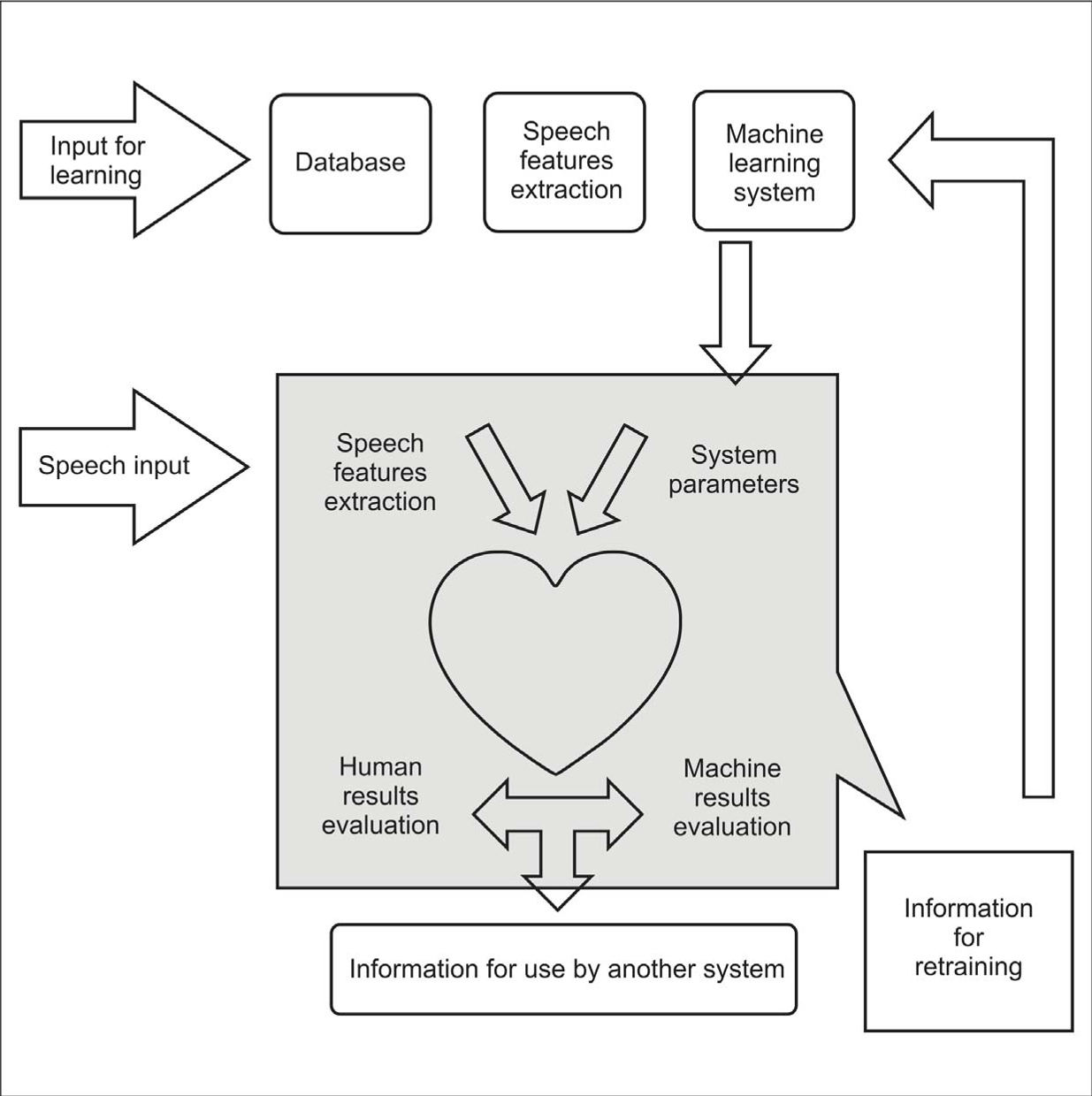 Figure 1: Abstract conceptual architecture scheme for automated recognition of emotions in speech.
Experimental Results: Machines vs. Humans
A striking insight from the review is the performance gap. While humans achieve approximately 60% accuracy in identifying emotions from unknown speakers, fuzzy rule-based machine systems have reached rates between 55% and 95%.
Key applications highlighted include:
- Healthcare: Detecting baby distress via frequency analysis.
- Public Safety: Distinguishing deceptive speech from truthful reports using MFCC analysis.
- Commerce: Call centers detecting "high anger" to trigger immediate supervisor intervention.
Critical Insight: The Ethical "Black Box"
The paper concludes with a profound discussion on the Socio-Technical impact. The authors propose placing "small black boxes" in corporate boardrooms or parliaments to monitor emotional honesty and satisfaction.
While technically feasible, this raises significant Ethical Impact Assessment (EIA) questions:
- Who owns the emotional data?
- Can these systems be used to "artificially influence" mental states for performance?
- Is there a risk of creating "Emotional Panopticons" in the workplace?
Final Takeaway
Speech Emotion Recognition is no longer a futuristic concept but a high-performing reality. As we integrate these tools into our social fabric, the challenge shifts from "Can we detect emotions?" to "Should we, and under what ethical constraints?" This paper serves as both a roadmap for the technology and a warning for its implementation in the "languaging community" of the future.