
Multi-Modal Emotion Recognition: Leveraging Audio-Visual Synergy via Deep CNNs
Emotion Recognition System from Speech and Visual Information based on Convolutional Neural Networks
This paper proposes a multimodal emotion recognition system that integrates visual facial expressions and speech information using a multi-branch Convolutional Neural Network (CNN). The system achieves superior performance on the CREMA-D dataset by processing image sequences and STFT-based audio spectrograms simultaneously.
TL;DR
This research presents a robust system for real-time emotion recognition by fusing visual facial cues with vocal signals. By converting speech into 2D spectrograms and processing video frames through a dual-branch CNN, the system achieves a 69.42% accuracy on the CREMA-D dataset, significantly outperforming both single-modality models and human-level performance.
Executive Summary
In the realm of Human-Computer Interaction (HCI), recognizing "natural" human emotion remains a holy grail. While facial expressions are the primary signal, they are often insufficient alone. This paper positions itself as a practical, high-performance solution that combines Facial Action Units (FAUs) logic with Spectrogram-based audio processing. By treating both sound and vision as spatial patterns, it creates a unified deep learning framework that stabilizes predictions across diverse emotional states.
1. Problem & Motivation: The Single-Modality Bottleneck
Most existing emotion recognition systems suffer from a high sensitivity to "noise"—not just acoustic noise, but visual noise like lighting changes, occlusions, and varying head poses.
The Insight: Humans don't just "see" an emotion; we "hear" the tone and "feel" the timing. The authors argue that while happiness is easily spotted visually, emotions like anger or sadness often carry distinct vocal signatures that can resolve visual ambiguity. The lack of standardized multimodal datasets has been a barrier, which this paper addresses by focusing on the CREMA-D (Crowd-sourced Emotional Multimodal Actors) dataset.
2. Methodology: The Dual-Branch Architecture
The proposed architecture is elegantly divided into three functional blocks:
A. The Visual Branch
The system samples equally distanced frames from a video sequence. After face detection and resizing, these frames are fed into a CNN designed to capture the spatial orientation of eyebrows, eyes, and mouth—the physical correlates of Facial Action Units.
B. The Audio Branch (Spectrograms)
Instead of raw 1D waveforms, the authors convert audio into 2D Spectrograms using the Short-Time Fourier Transform (STFT): This transformation allows the model to treat speech as a "visual" pattern of frequencies over time, enabling the use of 2D convolutional kernels to extract auditory features.
C. Feature Fusion
The most critical design choice is the weighted feature concatenation. The visual and audio feature vectors are combined in a 4:1 ratio. This weighting acknowledges an inductive bias: visual data typically contains more dense morphological information essential for emotion recognition than audio alone.
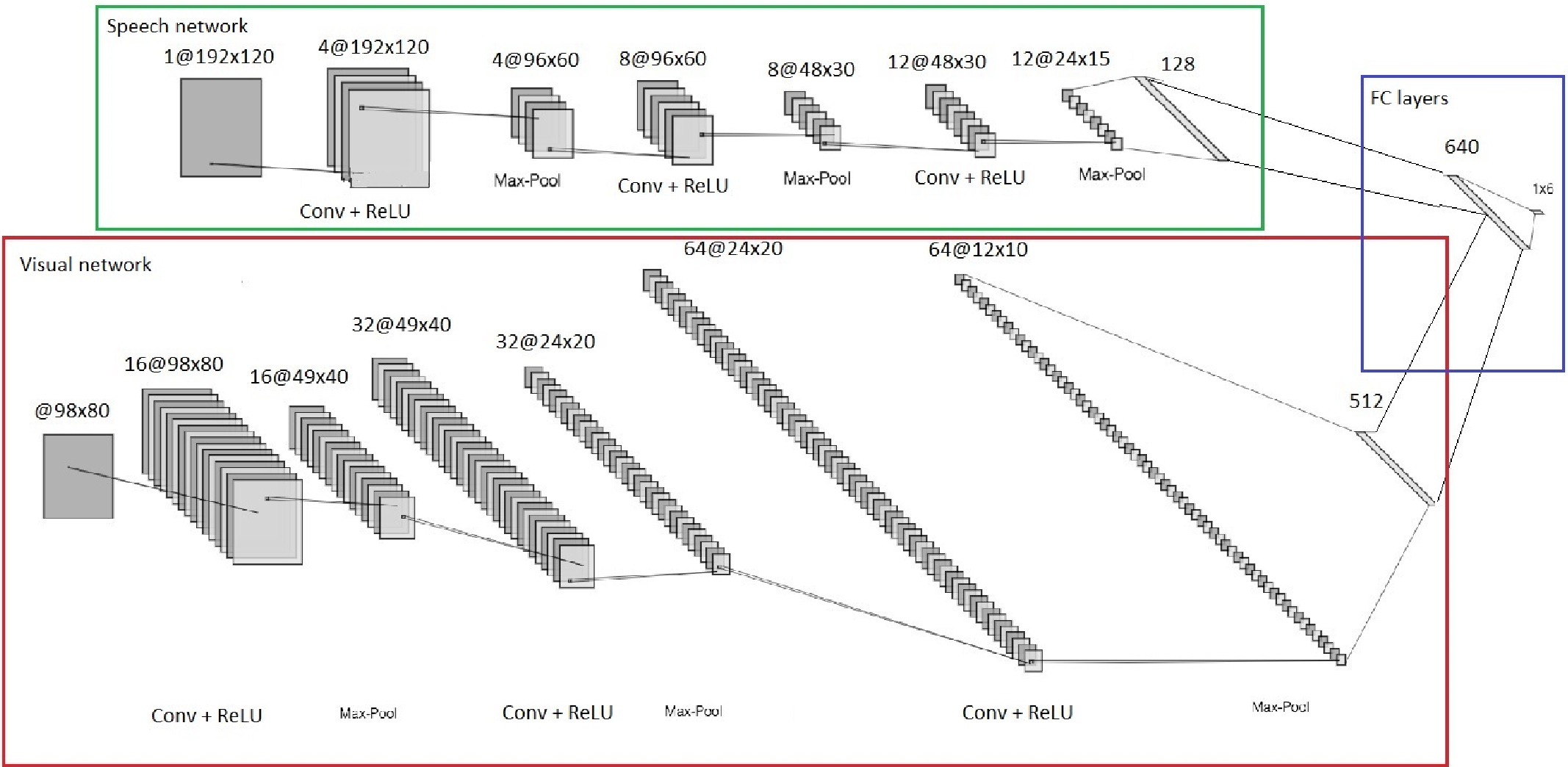 Fig: The proposed dual-branch CNN schema showing the visual (lower) and audio (upper) processing pipelines leading to a fused SoftMax classifier.
3. Experimental Results: Outperforming the Human Baseline
The authors employed a rigorous Leave-One-Actor-Out testing strategy across 91 actors to ensure the model generalizes to unseen faces and voices.
Performance Highlights:
- Multimodal Boost: Moving from Video-only to Audio+Video improved accuracy from 62.84% to 69.42%.
- Surpassing Humans: The model outperformed the human accuracy reported for the CREMA-D dataset (63.6%) by nearly 6%.
- Stability: The standard deviation of predictions dropped when audio was added, suggesting the model becomes more confident and consistent when multi-sensory data is available.
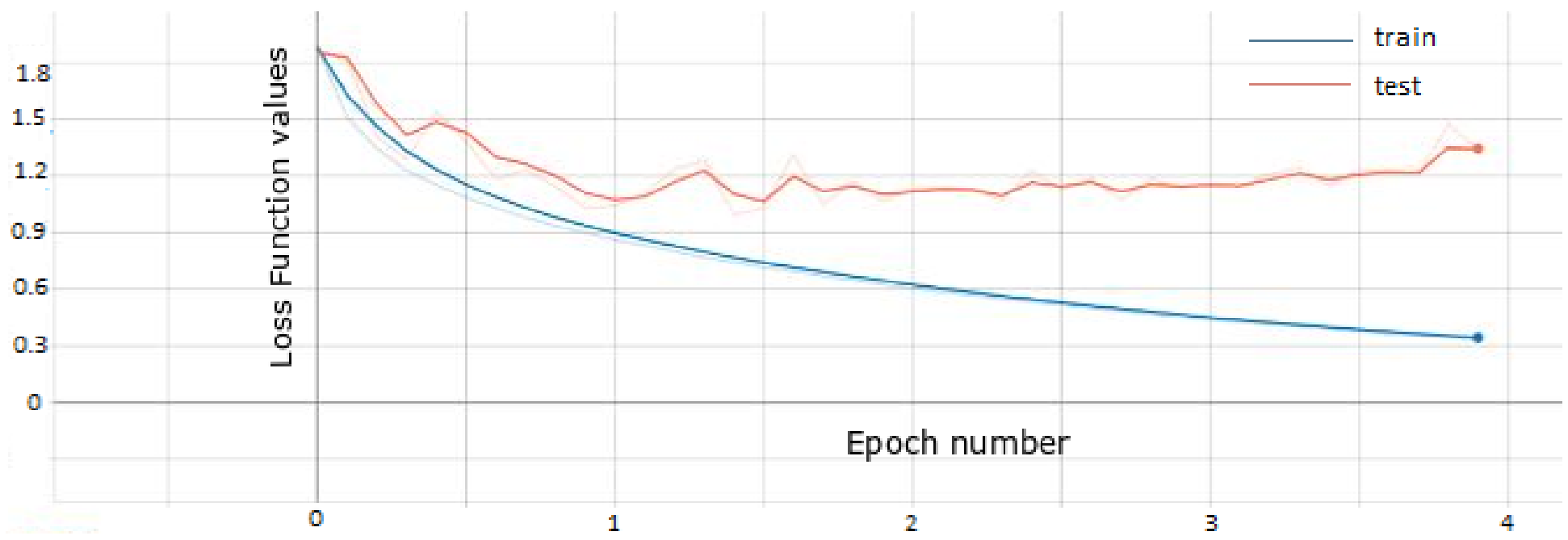 Fig: Training vs. Validation Loss. The rapid convergence in the first few epochs demonstrates the efficiency of the CNN-based feature extraction.
4. Critical Analysis & Future Outlook
The success of this method hinges on the time-frequency representation of audio. By treating spectrograms as images, the authors leverage the immense power of CNNs without needing specialized audio architectures.
Limitations:
- Fixed Sampling: The model uses static frame sampling, which might miss micro-expressions occurring between samples.
- Overfitting: As noted by the authors, CRFMA-D is relatively small for deep networks, requiring heavy data augmentation.
The Road Ahead: The next logical step is the integration of Temporal Dynamics through LSTMs or Transformers to better model how an emotion "unfolds" over time. Furthermore, investigating alternative time-frequency transforms like the Wigner-Ville distribution could provide even higher resolution features for the audio branch.
Conclusion
This paper provides a blueprint for practical multimodal AI. By acknowledging that visual data is "king" but audio is the "essential advisor," the authors have built a system that is not only mathematically sound but also surpasses human capability in identifying the nuances of our emotional states.