
Beyond Utility: How Discrete Emotions and Trust Shape Our Social Media Life
Effects of Emotion and Trust on Online Social Network Adoption toward Individual Benefits: Moderating Impacts of Gender and Involvement
This study investigates the precursors of Online Social Network (OSN) adoption, specifically focusing on the roles of ten distinct emotions and trust. Using the I-PANAS-SF scale and Structural Equation Modeling (SEM) on 522 participants, the paper demonstrates how these factors influence individual benefits such as relationship maintenance and information sharing.
TL;DR
Why do we keep scrolling? It isn’t just about "perceived usefulness." This research uncovers that our specific emotional states—from feeling "active" to feeling "ashamed"—combined with our level of trust, dictate how we adopt Online Social Networks (OSNs) and the actual benefits we reap from them. The study breaks down user behavior into two camps: the Positive Emotion (PE) group and the Negative Emotion (NE) group, revealing that men and women use these platforms for very different psychological reasons.
The "Why" Behind the Scroll: Moving Past TAM
For years, the Technology Acceptance Model (TAM) has been the gold standard for explaining why we use apps. It suggests a simple logic: if it's easy and useful, we use it. However, humans aren't robots. We are emotional creatures.
The authors argue that prior work has missed the "affective" layer. Why does an "active" person use Facebook differently than an "upset" person? This paper fills that gap by looking at 10 specific emotions and the moderating roles of Gender and Involvement (experience).
The Analytical Framework
The researchers split their 522-person sample into two distinct models to see how different "vibes" impact adoption:
- Model 1 (Positive Emotions): Alert, Inspired, Determined, Attentive, and Active.
- Model 2 (Negative Emotions): Upset, Hostile, Ashamed, Nervous, and Afraid.
Both models funnel through Trust and OSN Adoption to reach a final destination: Individual Benefits (IB), which include relationship maintenance, knowledge sharing, and use satisfaction.
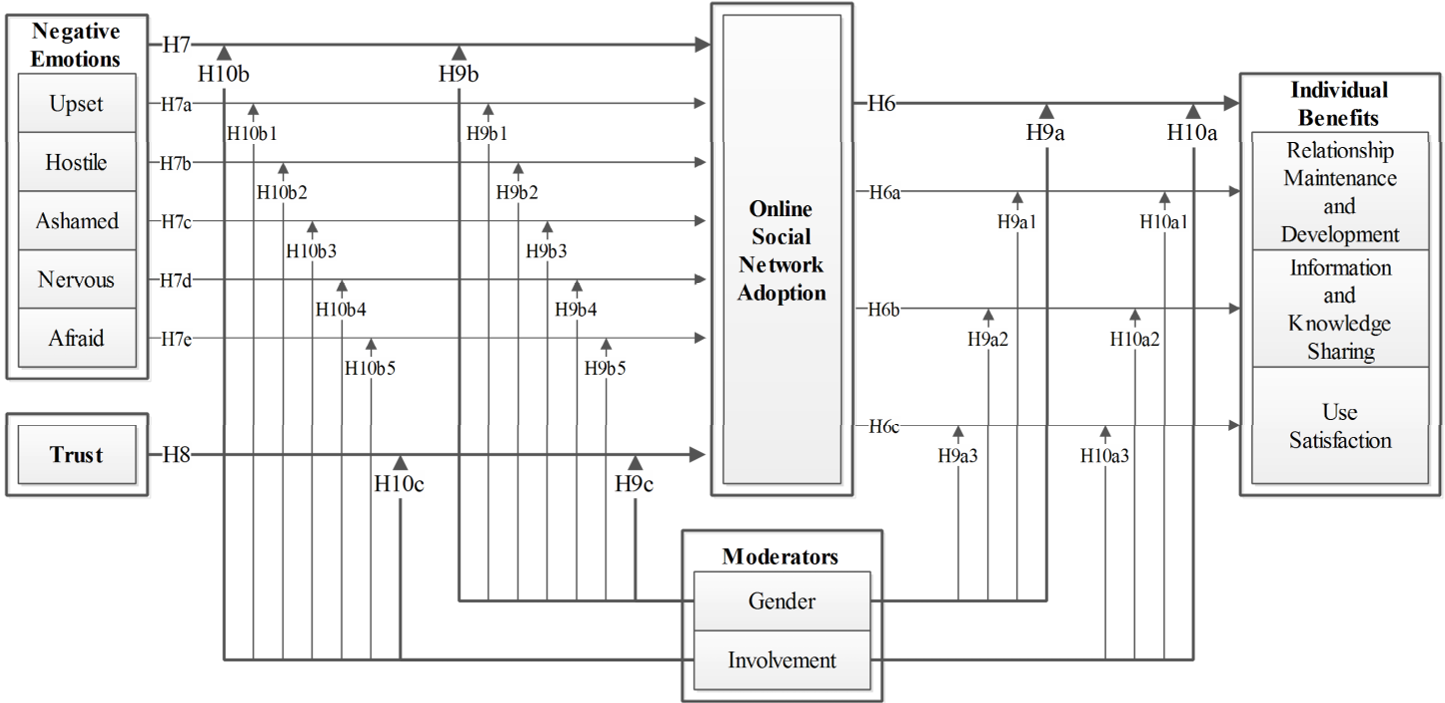
Key Insights: Emotions as Adoption Drivers
The study’s Path Analysis (SEM) produced several counter-intuitive findings:
- The Power of Being "Active" and "Attentive": For the positive group, these were the only two emotions that directly predicted adoption. This suggests that OSNs are best suited for those looking to be proactive in their social circles.
- The "Shame" Factor: In the negative emotion group, "Ashamed" was the surprising significant driver. This might point to a "social compensation" effect, where individuals feeling low in the offline world turn to OSNs to rebuild their image or find support.
- Trust is Universal: Regardless of whether you are in a good or bad mood, Trust is the bedrock. In both models, trust significantly influenced (Beta ≈ 0.25 to 0.38) how much a person was willing to adopt the platform.
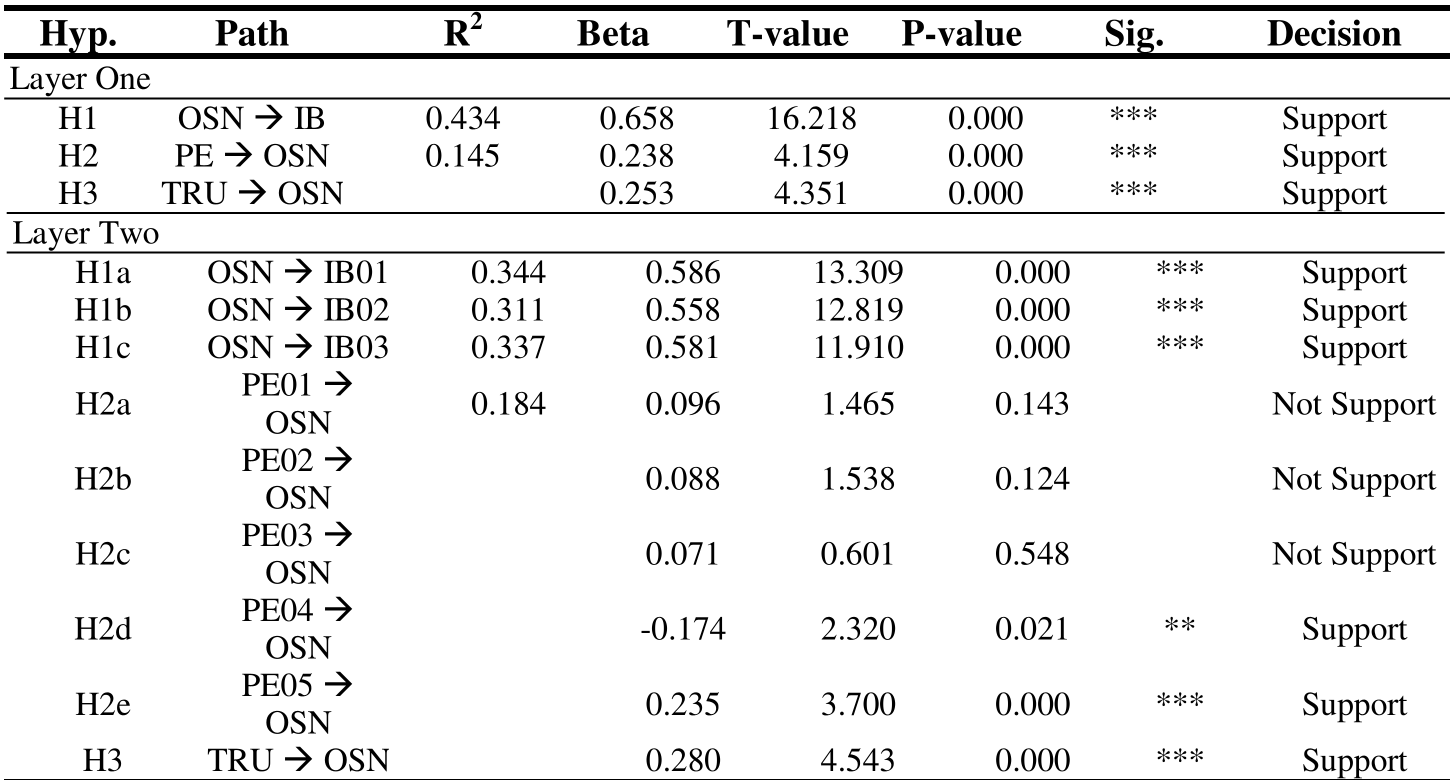
Gender and Involvement: The Great Moderators
The study highlights that "one size does not fit all" in social media design:
- Gender Differences: For Positive Emotions, females showed a significant link between being "Attentive/Alert" and adoption, while males were more driven by the general "Active" state. In the Negative camp, "Upset" females were more likely to adopt OSNs (perhaps seeking emotional labor/support), whereas "Ashamed" males showed higher adoption.
- Involvement (Experience): "High involvement" users (those using OSNs for >5 years) were significantly driven by feelings of being "Attentive," whereas "Low involvement" users were driven by "Inspiration."
Critical Analysis & Conclusion
This paper provides a robust statistical foundation for what many of us feel intuitively: our mood dictates our digital habits.
Takeaways for the Industry:
- Contextual UI: Platforms could benefit from "emotion-aware" interfaces. If the system detects a user is "Inspired" (High Involvement), it should surface more "Information and Knowledge Sharing" features.
- Trust as a Product Feature: Since Trust is a universal prerequisite for Adoption, privacy and security aren't just "compliance" issues—they are core "individual benefit" drivers.
Limitations: The study relies on self-reported Likert scales, which can be subject to social desirability bias. Furthermore, as the OSN landscape shifts toward short-form video (TikTok/Reels), the "Individual Benefits" may shift from "Relationship Maintenance" to pure "Entertainment," requiring a refresh of the IB construct.