
Agents with Emotions: Bridging Cognitive Science and Behavioral Animation
Agents with emotions in behavioral animation
The paper introduces a "Reactive Emotional Response Architecture" for behavioral animation, featuring agents that integrate cognitive emotional states with reactive movement. By utilizing a hybrid agent structure, it successfully demonstrates autonomous characters—such as a "KID" avoiding toys and panicking at mice—producing more vivid and convincing animations than traditional linear methods.
TL;DR
This seminal work proposes a hybrid, reactive architecture for virtual characters that integrates emotional states directly into the behavioral loop. Moving away from rigid, pre-programmed paths, the authors use "Automatic Procedures" inspired by cognitive science to allow characters to feel and react—such as a virtual child experiencing panic upon seeing a mouse—resulting in more natural and dynamic computer animations.
The "Mindless" Intelligence: Solving the Planning Trap
In the mid-90s, behavioral animation faced a crossroads. Traditional AI relied on "Deliberative Architectures"—logical engines that required a perfect, symbolic model of the world. The problem? The real world (and even complex virtual ones) is full of surprises. If a character is just following a logical script, it can't "feel" the environment or react to sudden changes.
The authors argue for Situatedness and Emergence. Drawing from Rodney Brooks’ robotics research, they suggest that a character’s intelligence is not in its "brain," but in its interaction with the world.
Methodology: The Hybrid Cognition Center
The core of this paper is the Reactive Agent Structure. Unlike a single block of code, the agent is a hierarchy of sub-agents (recursive structure).
1. Dual-Process Cognition
The Cognition Center is split into two distinct types of procedures:
- Controlled Procedures: Deep, conscious-like logic used for general path-planning.
- Automatic Procedures: Compiled, stimulus-response programs that drive emotions and reflexes.
2. The Emotional Trigger
In this model, emotions are not "thought about"; they are "triggered." When a sensor (Vision/Touch) detects a specific stimulus (like a mouse), it asserts an Emotional Fact into the Large Term Memory (LTM).
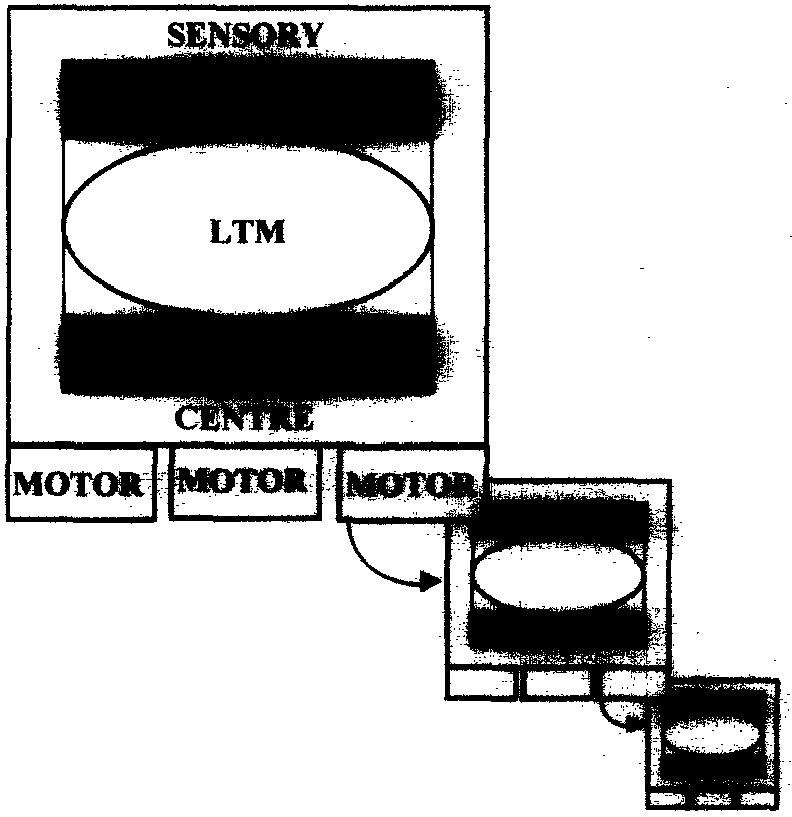 Fig 1: The structural breakdown of a reactive agent, highlighting the Sensory and Cognition centers.
Experiments: Panic in the Virtual House
The researchers tested their architecture with a character named "KID."
- Normal State: The KID uses logical procedures to navigate a house, gracefully detouring around a toy on the floor using its vision sensors.
- Emotional State: Once a mouse is introduced, the Emotion Generator triggers a "Panic" state.
The transition is seamless: the "Panic" fact in the LTM overrides standard walking speeds and path preferences. The KID begins to move faster and takes an "escapade" route.
 Fig 2: The KID agent demonstrating emergent avoidance behavior.
Critical Insight & Industry Value
The genius of this approach lies in its computational efficiency. By treating emotions as "Automatic Procedures" rather than complex logical deductions, the system can run in real-time without the overhead of traditional expert systems.
Key Takeaways for Modern AI:
- Modularity: Using a recursive agent structure allows for high "reuse" of behaviors (e.g., a "turn" agent can be used by both a human character and a car).
- Cognitive Realism: Emulating the human mind's split between "Fast" automatic response and "Slow" logical planning (similar to Daniel Kahneman's later popularized theories) is the key to believable NPCs.
Limitations and The Path Ahead
While the 1996 prototype used a simple mechanism for asserting/deleting facts, the paper envisions a Propositional Network for memory—where activations decay over time. Modern Large Language Models (LLMs) and Vector Databases are essentially the high-tech realization of the "LTM" and "Associative Memory" discussed here.
The authors correctly predicted that the future of animation lies in Parallel Processing and Agent Languages, paved the way for the complex AI behaviors we see in modern gaming engines like Unreal or Unity.