
It’s Alive! Personifying the Flexible Smartphone through Emotional Deformation
Emotional Interaction and Nofitication of Flexible Handheld Devices
This paper explores the "personification" of flexible handheld devices through self-actuated shape deformations. Using 3D-modeled prototypes and a user study with 60 participants, the authors establish a mapping between specific bending gestures and human emotional states, successfully demonstrating that flexible displays can intuitively communicate notifications to users.
TL;DR
Researchers from Yonsei University have moved beyond the "rigid box" paradigm of smartphones. By treating flexible displays as personified entities capable of "body language," they demonstrated that specific bending gestures—like an angry curve or a sleepy droop—can communicate the nature of incoming notifications more intuitively than traditional vibrations or ringtones.
Background: Breaking the Stiff Interface
Current handheld devices are trapped in a "glass slab" era. Despite advances in software, the hardware remains rigid and emotionally disconnected. The authors argue that for a Natural User Interface (NUI) to succeed, it must fulfill the human demand for emotional interaction. By applying Uncertainty Reduction Theory, the paper suggests that if a phone mimics biological characteristics (posture and movement), users will form a more familiar and effective relationship with the technology.
Methodology: Mapping Math to Emotion
The core of this research is the mapping of hardware deformation to the Circumplex Model of Emotion, which plots states along two axes: Valance (Pleasant to Unpleasant) and Arousal (Mild to Intense).
The Design Space
The authors created 10 distinct 3D models (labeled A through J) using Rhino 3D, based on the iPhone 5s form factor. Each model represented a unique physical "posture":
- Device A: Straight (Neutral/Calm).
- Device D: Top corner bent sharply (Aggression/Anger).
- Device G/I: Drooping or forward-leaning (Sadness/Sleepiness).

Experimental Insights
The study involved 60 participants who performed two primary tasks: matching shapes to emotions and matching shapes to specific notification types (e.g., Spam vs. Family Call).
1. The Emotional Consensus
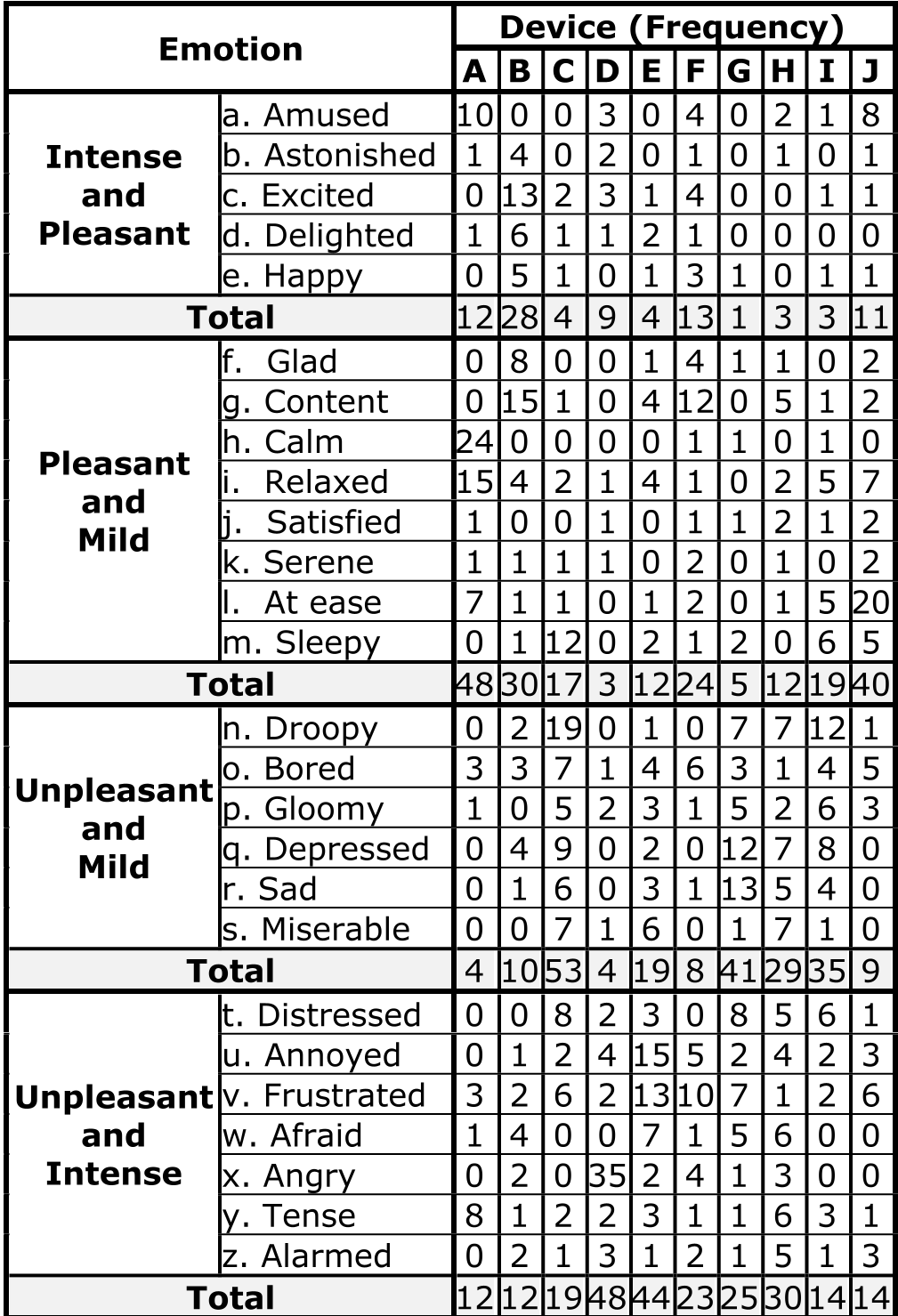
The results were remarkably consistent. As shown in the "Circumplex Mapping" results, users didn't just guess; they felt a shared perception of the device's "mood."
- Anger (Device D): 92% of participants placed it in the "Unpleasant and Intense" quadrant.
- Contentment (Device F): A slight twist or mild bend was perceived as pleasant.
- Droopy/Bored (Device C/G): Downward bends were universally seen as negative and low-energy.
2. Intuitive Notifications
When applied to real-world scenarios, the "personification" proved its utility:
- Spam calls/texts were overwhelmingly matched with "Angry" or "Distressed" shapes (Devices D and E).
- Low Battery warnings were intuitively linked to "Droopy" shapes (Device C), mimicking exhaustion.
- Family Communications were associated with straight, calm, or slightly "happy" curvatures.
Critical Analysis & Future Outlook
While the study provides a robust proof-of-concept for Standardized Emotional Movement, it faces limitations. The current research uses static 3D renders rather than physical prototypes. The "uncanny valley" of device movement remains unexplored—could a phone that moves too much become distracting or creepy?
Key Takeaways for the Industry:
- Beyond Visuals: Flexible displays shouldn't just be about "bigger screens in smaller pockets"; they are a new medium for non-verbal communication.
- Contextual Awareness: A device that "looks tired" when its battery is low is more intuitive than a percentage icon.
- Product Future: Future UX design for foldables should include a "Gesture Library" for developers to signal urgency and emotion.
The next phase of this research will likely involve physical prototypes where the speed and amplitude of the bend are tested, bringing us one step closer to a smartphone that truly "feels" alive.