
EM-RL: Giving Agents "Individuality" Through Brain-Inspired Emotional Models
An emotional model embedded reinforcement learning system
The paper introduces an Emotional Model Embedded Reinforcement Learning (RL) system that integrates a computational brain-inspired emotion model with Q-learning. By utilizing a hierarchical architecture involving the Amygdala and Orbitofrontal Cortex, the system enables agents to solve complex pathfinding tasks with dilemmas that conventional RL fail to address.
TL;DR
Researchers have developed a hierarchical Reinforcement Learning (RL) system that mimics the human brain's emotional pathways. By embedding an "Emotional State" derived from Amygdala-like models into the Q-learning process, agents are now able to solve complex dilemmas—such as choosing between safety, food collection, and target reaching—that stump traditional algorithms. This approach essentially creates "individuality" in AI agents by tuning internal emotional sensitivity.
The "Logic Only" Trap in Reinforcement Learning
Standard Reinforcement Learning (RL), specifically Q-learning, mimics the basal ganglia's role in the brain: learning from trial and error. However, a major bottleneck in traditional RL is its reliance on purely external environmental states. Humans don't just react to what they see (); they react based on how they feel about what they see ().
Without an internal state, an agent faced with a complex environment—like a maze with hazardous zones, food, and a locked door requiring a remote switch—often gets stuck. The conventional Q-learner fails because it cannot easily distinguish the "value" of a cell before and after a switch is flipped, leading to a failure to converge.
Methodology: The Hierarchical Emotional Architecture
The proposed system bridges the gap between biological psychology and machine learning through a three-tier architecture:
- Lower Layer (Amygdala & Orbitofrontal Cortex): Using the Morén emotional model, this layer processes sensory stimuli () and rewards () to calculate emotional arousal. It uses synaptic weights () to simulate emotional memory.
- Middle Layer (The Circumplex Model): Based on Russel’s 2D emotional model (Pleasure vs. Activity), this layer categorizes the raw signals from the lower layer into four distinct emotional states ( to ).
- Upper Layer (Extended Q-learning): The Q-table is expanded to . The action selection is now conditioned not just on position (), but also on the agent's current "mood" ().
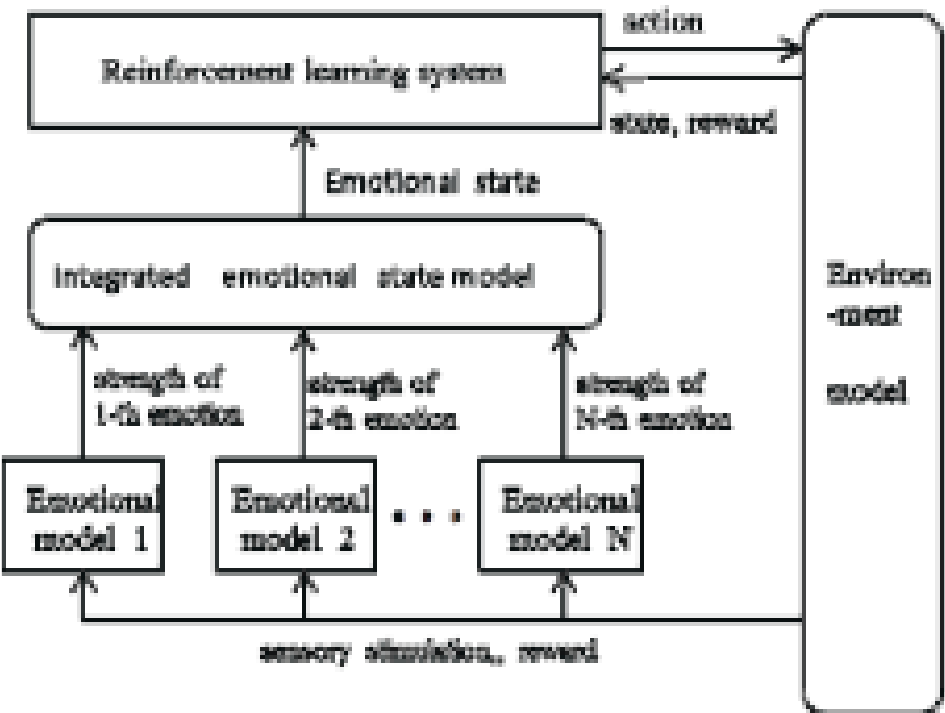 Figure 1: The proposed hierarchical system integrating emotional models into the RL loop.
Designing Personality: The Experiment
The authors tested the agent in a sophisticated grid world containing:
- Blue/Red Foods: Positive rewards with different values.
- Hazardous Areas: Negative rewards (Yellow/Purple zones).
- The Switch/Lock Dilemma: A yellow switch must be hit to unlock a door to reach the final goal.
The researchers created different "personalities" by adjusting (learning rate of emotion):
- Q+AE1 (The Focused Agent): Low pleasure sensitivity. It Ignores food and heads straight for the goal.
- Q+AE2 (The Hedonistic Agent): High pleasure sensitivity. It deviates from the shortest path to collect all food items before finally clearing the goal.
Results: Breaking the Deadlock
The results were conclusive: The conventional agent failed 100% of the time in the 2000-step limit. In contrast, the emotional agents (Q+E, Q+AE1, Q+AE2) achieved a 100% success rate.
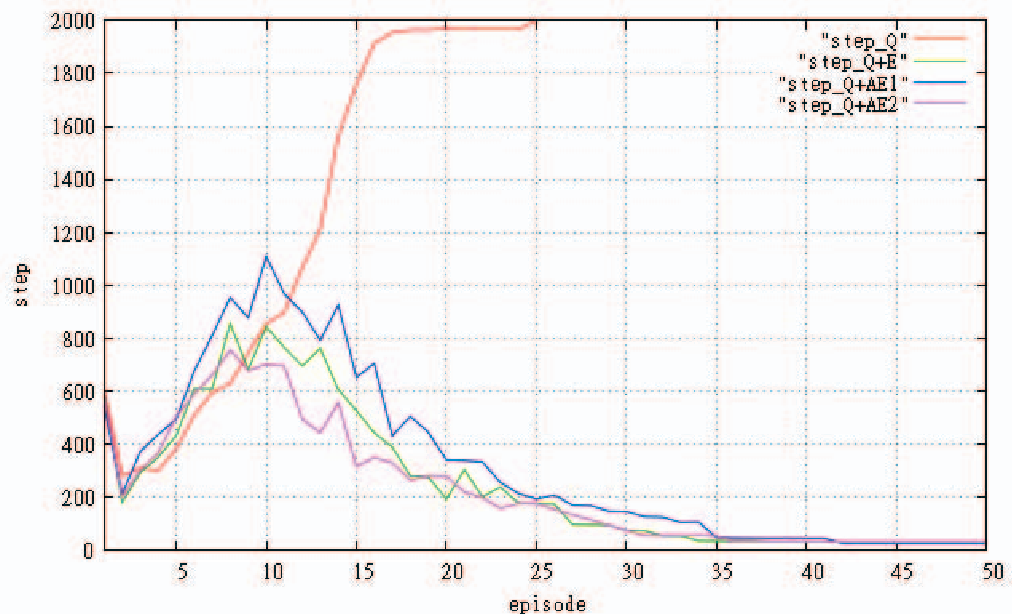 Figure 2: Performance comparison showing conventional Q-learning failing to reach the goal compared to emotional variants.
As seen in the emotional transition diagrams, the successful agents "felt" a shift in state after hitting the switch (moving from state to ), which technically allowed the agent to "know" the environment had changed, even if the spatial coordinates remained the same.
Critical Insight: Beyond Just State-Space Expansion
One might argue that adding an "Emotional State" is just adding another feature to the state vector. While mathematically true, the bio-plausibility of this approach is where the value lies. Instead of manual feature engineering, the emotional model provides a self-modulating internal state that responds to history (via the Amygdala's learning rates).
Limitations & Future Work
While the single-agent results are promising, the environment remains a discrete grid world. The transition to continuous, high-dimensional spaces (Deep RL) remains a challenge. The authors also suggest that the next frontier is multi-agent systems, where "emotional individuality" could lead to complex social dynamics like cooperation or competition.
Conclusion
By embedding an emotional model, this research proves that AI doesn't just need more data—it needs a better way to internalize experience. Adding a layer of "feeling" allows agents to navigate dilemmas that purely "logical" agents cannot compute, marking a significant step toward creating autonomous systems with distinct, human-like behaviors.