
The Rhythm of the Soul: Building a Recommender That Understands Your Mood
An Emotional Recommender System for Music
This paper presents a novel emotional music recommender system that leverages the Big Five personality model (OCEAN) and real-time mood detection. By combining social media behavioral analysis with audio content-based filtering, the system maps both users and songs into the Pleasure-Arousal-Dominance (PAD) emotional space to provide dynamic, personalized suggestions.
TL;DR
Music is rarely a rational choice—it’s an emotional one. This paper introduces an Emotional Recommender System that moves beyond simple history-based suggestions. By analyzing your social media behavior (posts and photos) to determine your Big Five personality traits and monitoring your real-time mood swings via audio analysis, the system predicts what you want to hear with a precision that doubles that of traditional collaborative filtering methods.
The Motivation: Why Ratings Aren't Enough
Most recommendation engines (like early versions of Spotify or Amazon) work on two principles:
- Content-Based Filtering (CBF): "You liked Rock, here is more Rock."
- Collaborative Filtering (CF): "Users like you also liked this."
The flaw? These systems are emotionally blind. They don't know that you listen to Brahms when you're reflective or pop-punk when you're at the gym. They also struggle with the "Cold Start" problem—if you are a new user, the system has no data to work with. The authors argue that your personality is the missing link that provides a stable anchor for preferences, while your current mood provides the necessary dynamic context.
Methodology: From Social Media to Sound Waves
The framework operates in three sophisticated stages:
1. Personality Recognition (The "Who")
The system extracts data from Social Media (OSNs) to map users to the Big Five (OCEAN) traits: Openness, Conscientiousness, Extraversion, Agreeableness, and Neuroticism.
- Textual Analysis: NLP pipelines analyze status updates for sentiment and psycholinguistic properties.
- Visual Analysis: CNNs analyze posted images (style, colors, content) to predict personality.
- The Formula: A weighted combination of Machine Learning (on text) and Deep Learning (on images) produces the final OCEAN score.
2. Mood Detection & Dynamics (The "How You Feel Now")
Personality provides the baseline, but mood changes. The system maps personality into the PAD (Pleasure-Arousal-Dominance) space.
- It analyzes the Mel-Spectrograms of your recently played songs using a VGG-net architecture to estimate the "Valence" (Pleasure) and "Arousal" of the music.
- A time-series formula then updates your current mood based on the history of what you've just heard.
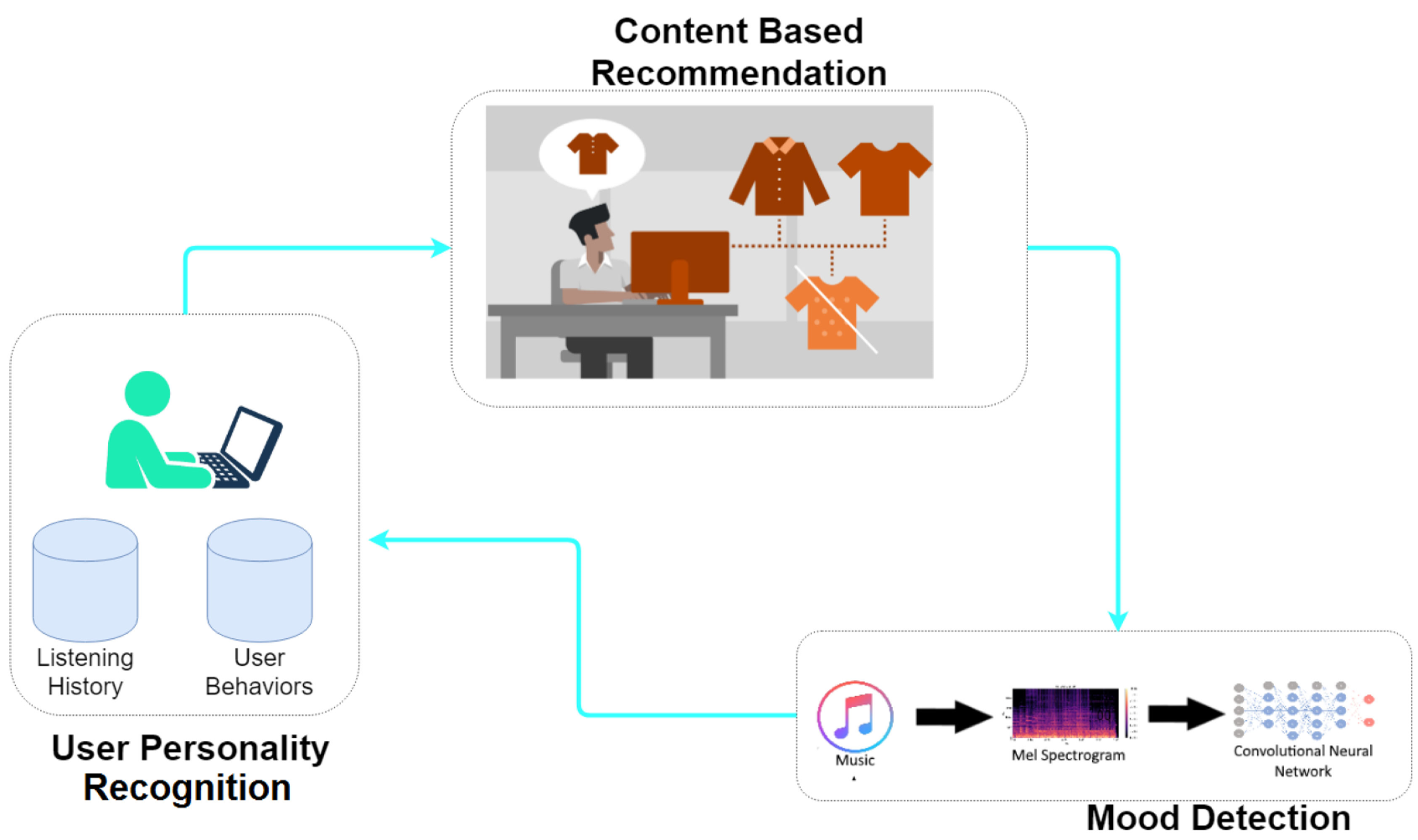
3. The Recommendation Engine
The final step uses a Ball-Tree data structure to organize a massive library of songs based on their PAD coordinates. The system performs a "Nearest Neighbor" search to find tracks that represent the shortest Euclidean distance to your current emotional state.
Experimental Results: Proving the Emotional Edge
The authors tested their system against standard industrial baselines (Upper/Item-based Pearson Correlation Coefficient).
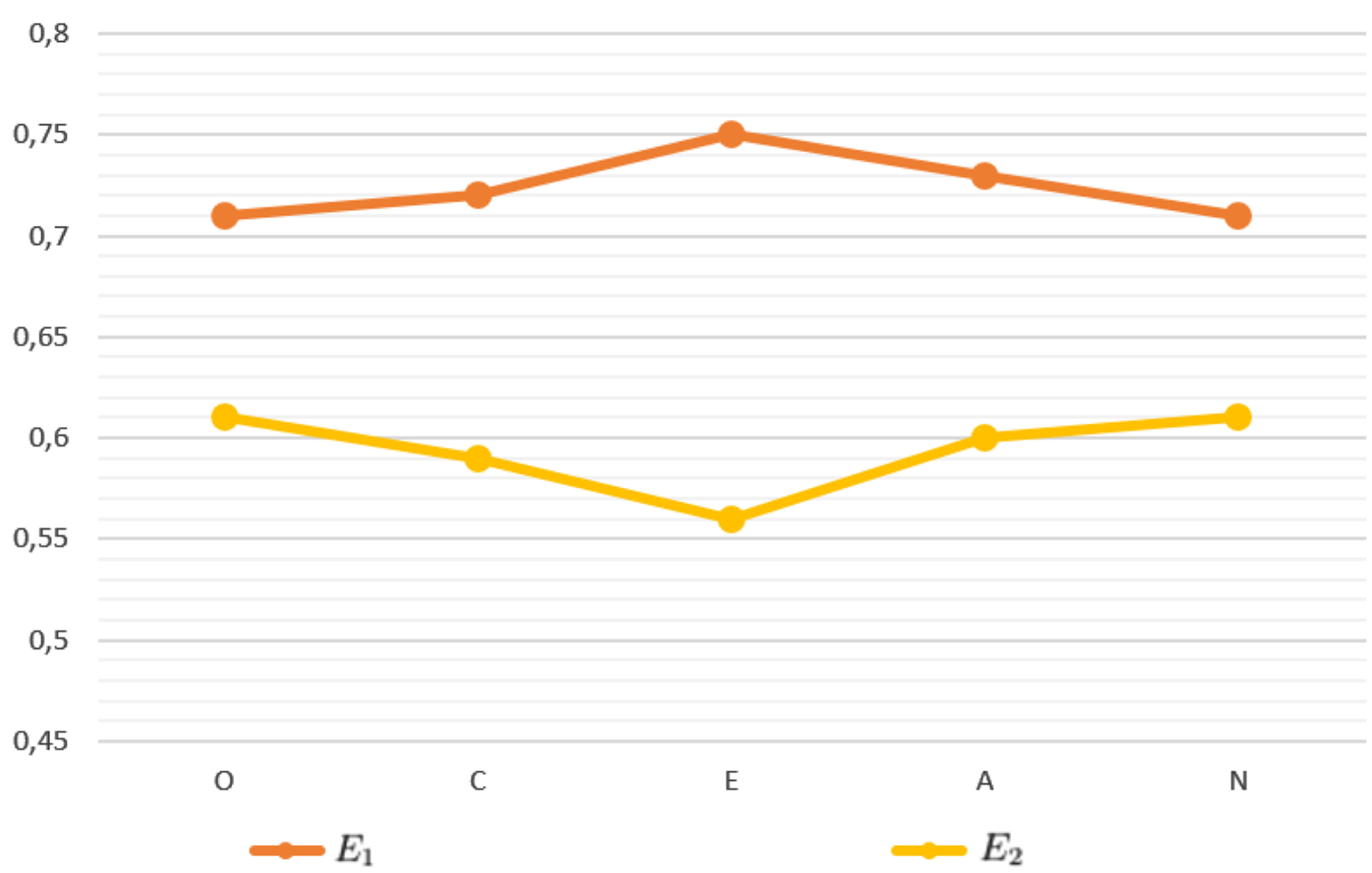
- Personality Accuracy: Their multi-modal approach (text + images) significantly outperformed the baseline research (Segalin et al.), particularly in "Extroversion" and "Agreeableness."
- Recommendation Recall: In a user study with 50 participants, the emotional system achieved a Recall@70 of 0.94, while traditional Collaborative Filtering struggled around 0.50. This suggests that "emotional matching" is nearly twice as effective as "rating matching."
Critical Insight: The "Why" Behind the Success
The secret sauce here is the Mapping Logic. By converting abstract social behavior and raw audio signals into a unified PAD Emotional Space, the researchers created a common language between the user and the item.
However, the study notes a few limitations:
- Data Dependency: It requires access to social media logs, which raises privacy concerns and "access" hurdles for some apps.
- Complexity: Training five separate classifiers for personality and multiple VGG nets for audio is computationally expensive compared to simple matrix factorization.
Conclusion
This work proves that the future of UI/UX in music streaming isn't just about "matching tags"—it's about empathy. By integrating psychological models like OCEAN and PAD into the core algorithm, we can build systems that feel less like software and more like a friend who knows exactly what you need to hear, even when you haven't said a word.
Future Outlook: Expect these techniques to migrate into video platforms (YouTube/TikTok) and even e-commerce, where "shopping therapy" is a real emotional driver.