
Decoding Affect: Tracking the Trajectory of Human Emotion via EEG and Manifold Learning
Emotional state classification from EEG data using machine learning approach
This paper presents a systematic machine learning framework for classifying positive and negative emotional states using EEG data. By comparing power spectrum, wavelet, and nonlinear features, the authors demonstrate that power spectrum features combined with a Linear Dynamic System (LDS) for smoothing achieve superior performance in emotion recognition and trajectory tracking.
Executive Summary
TL;DR: This study pioneers a robust framework for EEG-based emotion classification by addressing the signal-to-noise gap in neuroimaging. Using a combination of Power Spectrum analysis, Linear Dynamic System (LDS) smoothing, and Isomap manifold learning, the researchers achieved over 91% accuracy in distinguishing positive vs. negative emotions and successfully visualized the continuous "flow" of human feeling.
Academic Context: Published in Neurocomputing, this work sits at the intersection of Affective Computing and Brain-Computer Interface (BCI). It moves the field from static "snapshot" classification to a dynamic "trajectory" approach, establishing that high-frequency brain activity is the primary carrier of emotional information.
Problem & Motivation
The challenge with EEG (Electroencephalogram) data is its inherent volatility. EEG is an unsteady voltage signal that oscillates rapidly, yet human emotions are relatively stable and transition slowly. Standard machine learning models often struggle because:
- Noise Sensitivity: Raw EEG features include artifacts (eye blinks, muscle movement) that look like emotional spikes.
- Lack of Continuity: Most models treat each time-window as an isolated event, failing to capture the gradual shift from sadness to joy.
The authors' insight was to treat the emotional state as a latent variable hidden behind the noisy observation of the EEG signals, leading to the adoption of temporal smoothing.
Methodology: The Core Architecture
The proposed pipeline follows a sophisticated four-step process:
1. Feature Extraction & The Dominance of Power Spectrum
The study compared three feature types:
- Power Spectrum: FFT-based log-transformed power in Delta, Theta, Alpha, Beta, and Gamma bands.
- Wavelet Features: Daubechies wavelet (db4) to capture time-frequency entropy.
- Nonlinear Dynamics: Measuring complexity via Approximate Entropy and Hurst Exponent.
Results showed that the Power Spectrum (all bands combined) is the most robust feature for affective decoding.
2. LDS: Smoothing out the Noise
By applying a Linear Dynamic System (LDS), the researchers filtered the chaotic data points to reveal the underlying emotional trend.
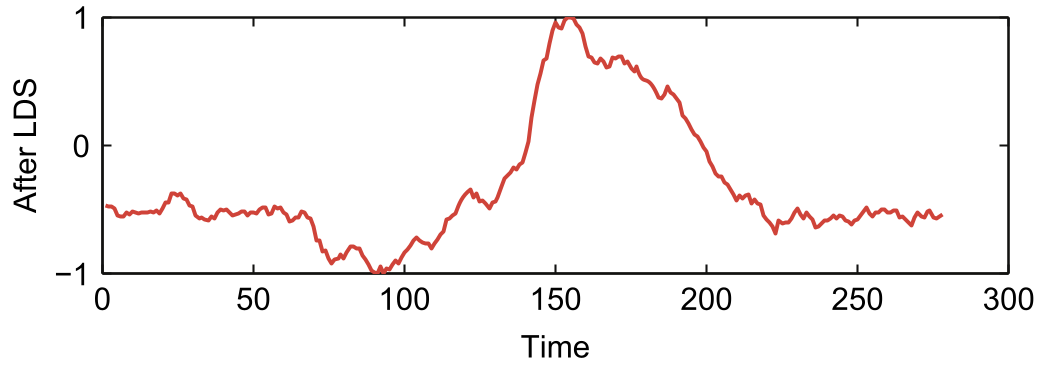 In the figure above, note how the "With LDS" (Bottom) line captures the macroscopic trend while ignoring the micro-fluctuations seen in the "Without LDS" (Top) plot.
3. Manifold Learning for Visualization
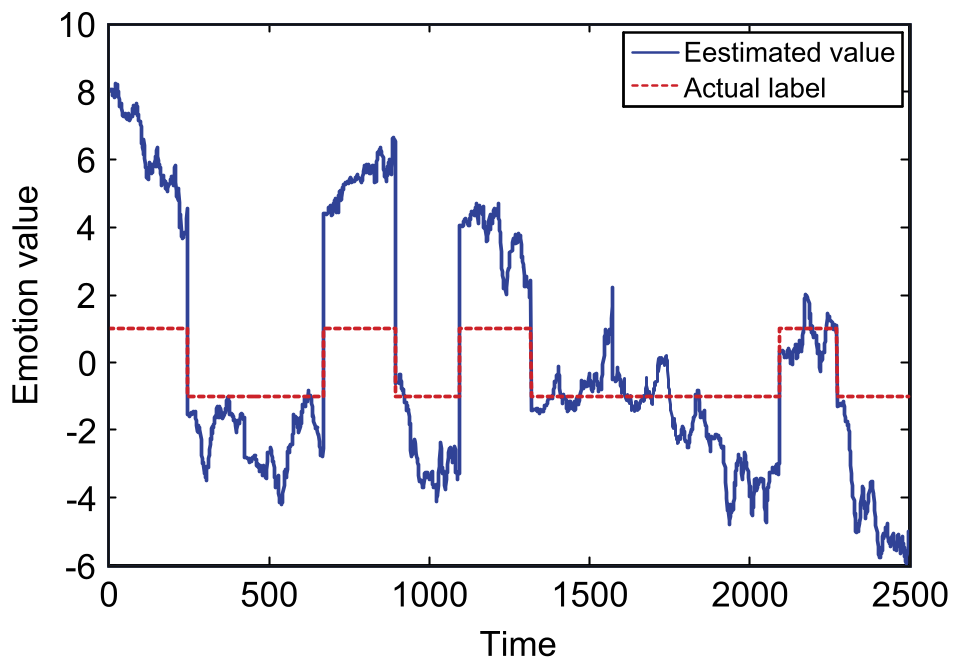
To track emotion as a journey, the authors used Isomap. By treating the high-dimensional EEG features as points on a non-linear manifold, they projects them down to a 1D curve. This curve represents the "flow" of the subject's internal state during movie viewing.
Experiments & Results
The team conducted movie induction experiments on six subjects, using clips from films like Titanic (Negative) and Nature Time Lapse (Positive).
High Frequency Matters
A key finding was the "Importance of Frequency." While some cognitive tasks rely on Alpha or Theta waves, high-frequency bands (Beta and Gamma) were significantly more accurate for emotion classification.
| Band | Linear SVM Accuracy (%) |
|---|---|
| Delta | 62.16% |
| Alpha | 85.53% |
| Gamma | 84.23% |
| All Bands Combined | 87.53% |
Dimensionality Reduction Success
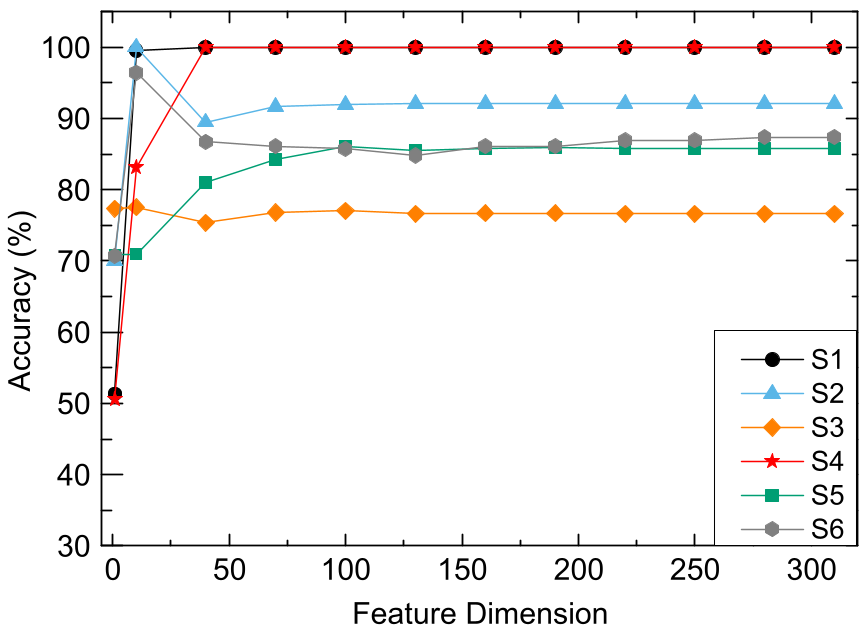
Using Linear Discriminant Analysis (LDA), the researchers found they could reduce the feature space to just 30 components while maintaining peak accuracy.
Critical Insight: The Emotion Roadmap
The most striking part of the research is the Emotion Trajectory. Using Isomap estimations (the blue line), they were able to track the actual session labels (red dashed line) with remarkable precision.
Conclusion & Future Impact
This paper provides a blueprint for real-time emotional monitoring. It proves that:
- LDS Smoothing is non-negotiable for reliable BCI.
- Subject-independent features exist, primarily located in the right occipital/parietal lobes (Alpha) and left frontal lobe (Gamma).
Limitations: The study used a small sample size (6 subjects). Future work must validate these subject-independent features across larger, more diverse populations to create a truly universal "plug-and-play" emotion sensor.