
Beyond the Average: Can Consumer EEG Truly Sense Your Emotions?
Analysing Emotional Video Using Consumer EEG Hardware
This study evaluates the effectiveness of the Myndplay Brainband, a low-cost consumer EEG device, in detecting emotional mental states induced by video stimuli. By analyzing average frequency power and eSense™ values alongside a novel peak detection method, the research identifies "spikes" in neural activity as a more sensitive marker for emotional reactions than static mean values.
TL;DR
Is a $100 headband enough to read your mind? This study suggests that while "average" brain activity tells us almost nothing about your emotional state, identifying transient peaks in frequency bands can successfully distinguish a stressful movie-watching experience from a relaxing one.
Background Positioning
In the hierarchy of neurotechnology, consumer-grade EEG (like Neurosky or Myndplay) is often dismissed by academics as "toy-like" due to having only a single sensor at the FP1 (forehead) position. However, this paper positions these devices as viable tools for Affective Human-Computer Interaction (HCI), specifically within the "STRESS" project, which aims to create virtual training scenarios that adapt to a user's mental state.
The Problem: The "Averaging" Trap
Most physiological studies look for a "sustained shift" in state—expecting a person's average heart rate or brain wave power to remain high while they are stressed. The author argues this is fundamentally flawed for EEG in passive tasks (like watching a video). Because emotional responses to media are often momentary (a jump scare, a weird sound), the "noise" of the rest of the video washes out the "signal" in the average.
Methodology: High-Frequency Insight
The study monitored 30 participants using the Myndplay Brainband.
- Stimuli: A sequence of 5 videos ranging from a "Beach" baseline to "Documentaries" and a high-stress "Horror/Thriller" clip.
- The Innovation: Instead of just using the proprietary eSense™ (Attention/Meditation) scores, the author performed peak detection on raw frequency bands (Delta, Theta, Alpha, Beta, Gamma). A "Peak" was defined as any value 4 standard deviations above the mean.
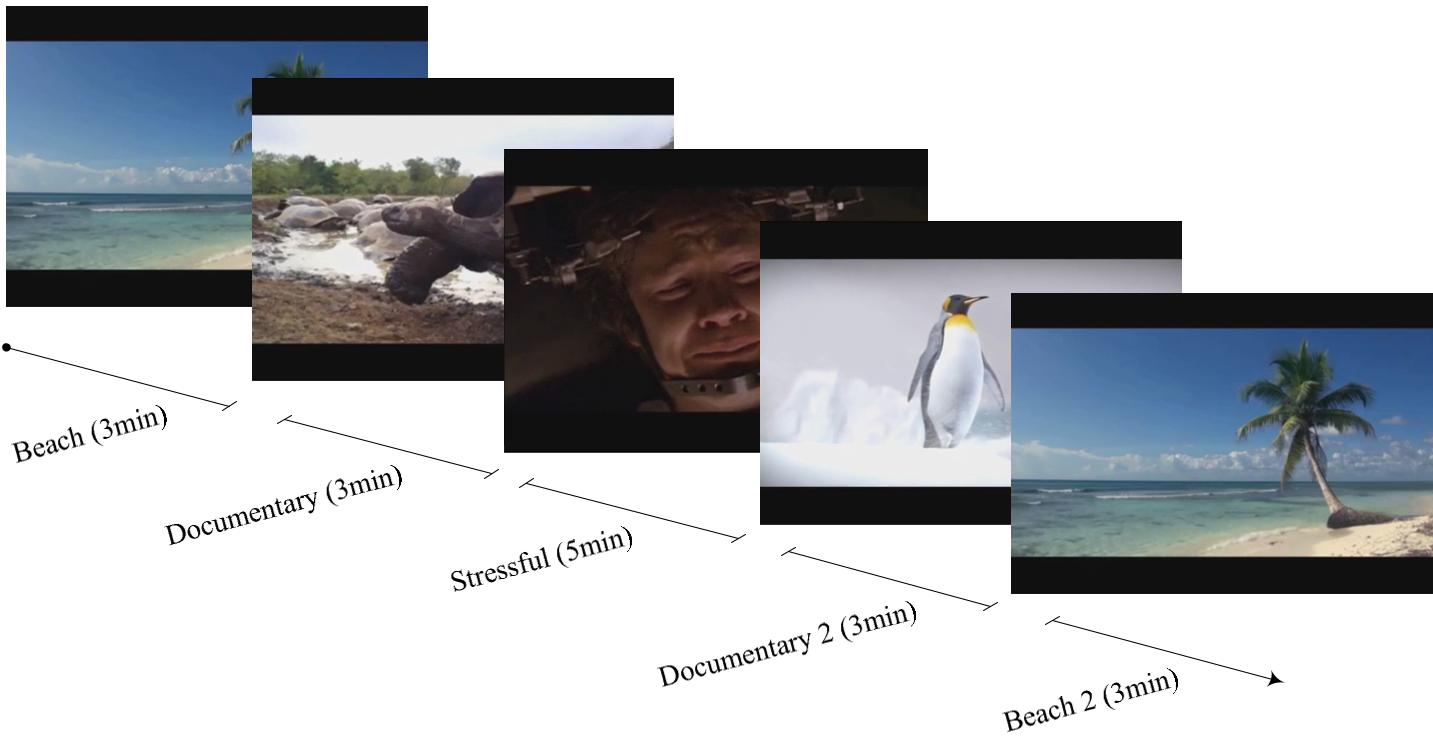
Experiments & Results: The "X" Marks the Spot
When looking at the Mean Activity, the results were underwhelming. There was no statistically significant difference between a relaxing beach and a stressful horror movie across most bands.
However, the Peak Analysis told a different story.
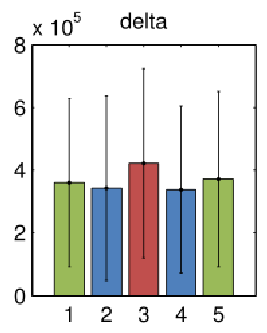 Fig 2: Note the massive standard deviations, showing why means are unreliable.
Key Findings from Peaks:
- Stress Density: The stressful movie produced a much higher density of peaks across multiple frequency bands simultaneously.
- The Delta Signature: Unique to the stressful video were peaks in the Delta band, which were virtually absent in the neutral or documentary clips.
- Content Correlation: Peaks often aligned perfectly with "fright moments," such as a snake jumping at the camera or the introduction of ominous music.
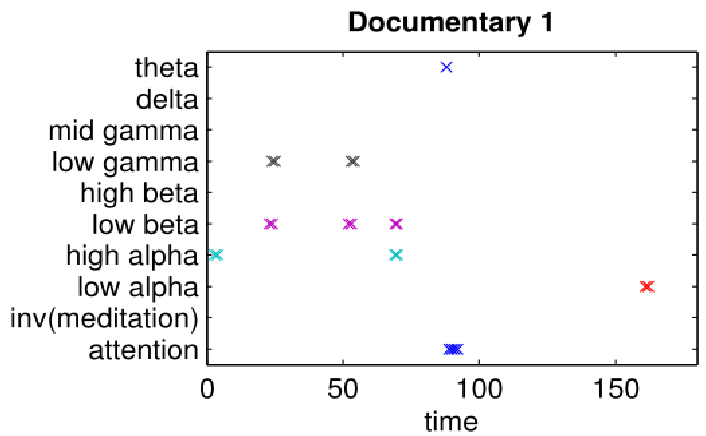 Fig 3: The visual disparity in peak density between the Stressful clip (top middle) and the Beach clip (bottom right) is striking.
Critical Analysis & Conclusion
Why eSense™ Failed
Interestingly, the proprietary eSense™ values (Attention/Meditation) showed almost no peaks. The author posits that because these are likely linked to prefrontal cortex activation (associated with active cognitive tasks), they are poorly suited for passive viewing, where the brain isn't "working" but is still "reacting."
Takeaway for Developers
If you are building an application using consumer EEG:
- Ignore the Average: Don't wait for the user's mean brainpower to change.
- Watch the Spikes: Look for simultaneous spikes across Alpha and Delta bands to detect "arousal events."
- Context Matters: Passive entertainment requires different algorithms than active "Brain Games."
Limitations
The study is limited by the single-sensor setup. Without more sensors, we cannot determine the spatial origin of these peaks, making it hard to distinguish between a "fright" and a physical "blink" or "muscle twitch," which also causes EEG spikes. Future work must bridge the gap between subjective feedback and these rhythmic neural bursts.