
EmotionPush: Empowering Chatbots with Emotional Intelligence and Temporal Awareness
EmotionPush: Emotion and Response Time Prediction Towards Human-Like Chatbots
This paper introduces EmotionPush, a novel private dialogue dataset comprising 162,031 Facebook Messenger logs integrated with unique "read event" timestamps. The authors leverage this data to establish SOTA baselines for two human-centric chatbot tasks: Emotion Classification and a first-of-its-kind Response Time Prediction.
TL;DR
To bridge the "uncanny valley" of robotic interactions, the EmotionPush project introduces a massive private dialogue dataset and two critical tasks: identifying user emotions and predicting the optimal response time. By analyzing 162k+ Facebook Messenger logs, the researchers demonstrate that chatbots can reach ~90% accuracy in understanding when and how to respond, provided they have access to personalized behavioral data.
The Missing Piece: Why Chatbots Feel "Artificial"
Most AI dialogue research focuses on the content aspect—generating a grammatically correct response. However, human conversation is governed by behavioral aspects often ignored by machines:
- Empathy: Recognizing that a user is sad or joyful and mirroring that sentiment.
- Timing: Knowing when a reply is urgent and when "silence is golden" or when a delay is socially acceptable.
Existing datasets like Twitter or Ubuntu are public and task-oriented; they lack the intimacy and temporal dynamics of a private 1v1 chat. EmotionPush addresses this by providing the first large-scale benchmark of private social dialogues with "Read Logs."
Methodology: High-Fidelity Personalization
The core innovation lies in treating response time not just as a text problem, but as a personalized behavioral problem.
1. The Architecture
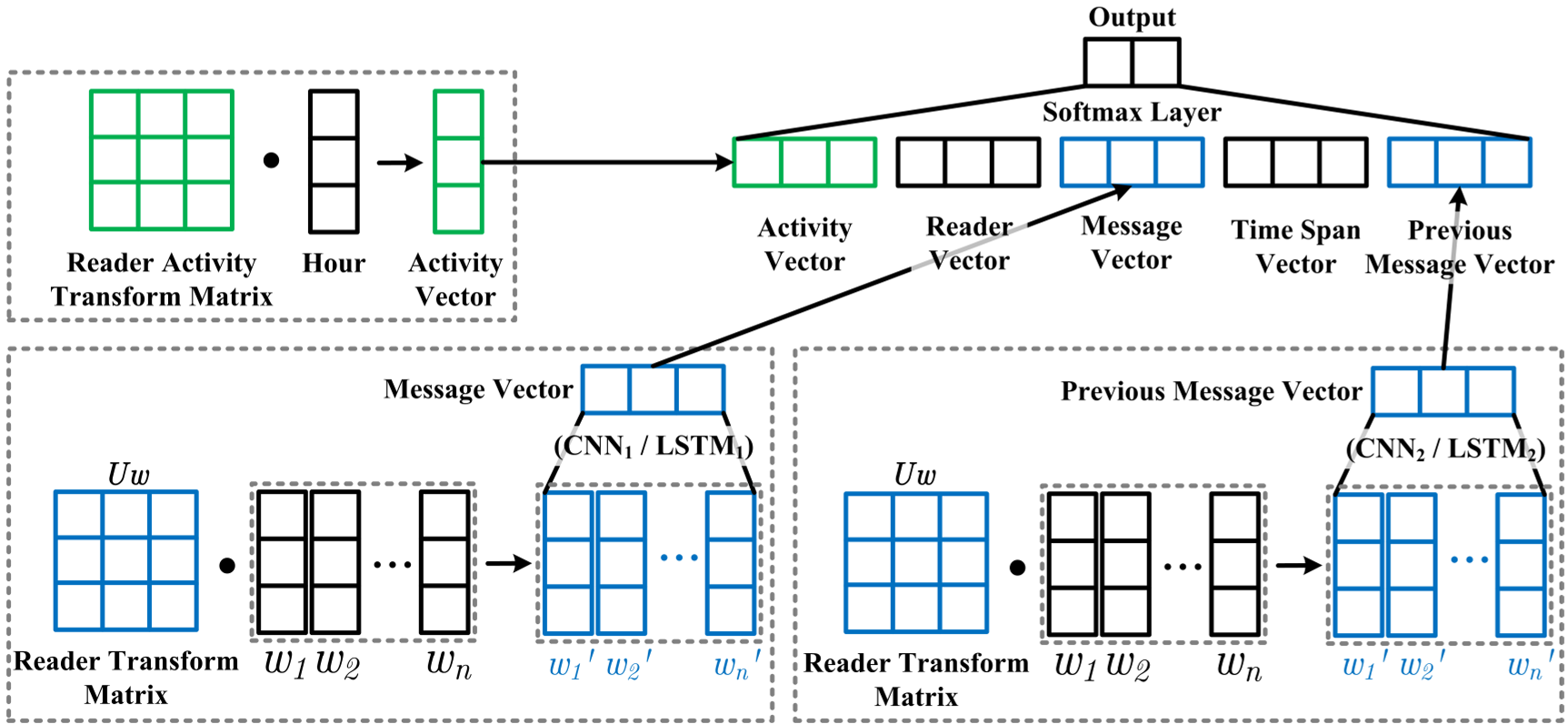
The authors propose a dual-stream neural network (CNN or LSTM) enhanced by an Adaptation Matrix (). This matrix adjusts standard word embeddings to fit a specific user's vocabulary and conversational style.
2. Multi-Dimensional Features
The model doesn't just "read" the message; it considers:
- Reader Activity: Normalized by the hour of the day (capturing if a user is typically "busy" or "active").
- Time Span: The interval between the current message and the previous one.
- Context: Concatenating multiple short messages into a single "block" to capture intent.
Performance: Beyond Textual Analysis
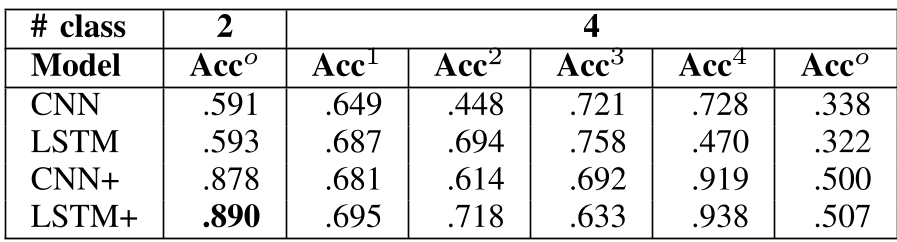
The results confirm a massive performance gap between "general" models and "personalized" models. In the Response Time Prediction task, adding user-dependent features (CNN+ and LSTM+) increased accuracy from ~59% to 89%.
For Emotion Classification, the study found that models trained on public blog data (LJ40K) performed poorly on private chats. However, when trained on the EmotionPush dataset, the accuracy for major emotions like Joy, Anger, and Sadness skyrocketed to over 90%.
Critical Insight: The Value of "Read" Events
The most unique attribute of this work is the Read Log. By knowing exactly when a user read a message versus when they replied, the model learns the "latent intent" of the user. For instance, a long gap between reading and replying might signal hesitation or lack of interest, a feature that task-oriented bots currently ignore.
Future Outlook and Limitations
While EmotionPush sets a strong baseline, it has limitations:
- Data Imbalance: Human conversations are overwhelmingly "Neutral," making it harder to train on rare emotions like "Fear" or "Tiredness."
- Privacy vs. Utility: Although masking is used, the use of private logs remains a sensitive area for commercial deployment.
The next frontier for this research involves integrating these "Human-Like" features into real-time messengers to see if providing "emotion cues" to users actually improves social well-being.
Conclusion
EmotionPush proves that for a chatbot to be a "companion" rather than just a "tool," it needs a clock and a heart as much as it needs a dictionary. By benchmarking response latency and emotional nuance, this work paves the way for a more empathetic generation of AI.