
EmotiveCouch: Turning Your Furniture into a Privacy-First Emotion Detector
The Emotive Couch - Learning Emotions by Capacitively Sensed
The paper introduces the "EmotiveCouch," a smart furniture system designed for privacy-aware affective computing. It utilizes eight invisibly integrated capacitive proximity sensors to detect human body motion and posture, achieving a 77.7% classification accuracy for a subset of emotions (Anxiety, Interest, and Relaxation) using Support Vector Machines (SVM).
TL;DR
Researchers have developed the EmotiveCouch, a smart sofa equipped with invisible capacitive sensors that can "feel" your emotional state through your body language. By tracking subtle shifts in posture and movement intensity, the system achieves up to 77.7% accuracy in detecting emotions like Anxiety and Interest—all without a single camera or wearable device.
Perspective: Moving Beyond the "All-Seeing Eye"
Most emotion recognition systems today suffer from a "Big Brother" problem. To know if you are stressed or happy, they usually require a camera pointed at your face or a watch strapped to your wrist. In our private living rooms, this is often unwelcome.
The EmotiveCouch shifts the paradigm toward Ambient Intelligence. Its creators leverage the physical intuition that our emotions are fundamentally "embodied"—Anxiety leads to muscle tension and quick movements, while Relaxation results in "opening up" and leaning back. By embedding the sensors inside the couch cushions, the furniture itself becomes the sensor.
Methodology: The Science of Proxemic Sensing
The core technology used is Capacitive Proximity Sensing (CPS). Unlike pressure sensors that require you to sit directly on them, CPS sensors detect changes in an electric field.
1. The Setup
The team integrated eight flexible sensor electrodes into the couch's fabric. These sensors are invisible to the user but highly sensitive to the presence and movement of conductive objects—specifically, the human body.
 Figure 1: The EmotiveCouch setup showing sensor integration and the living-room experimental environment.
2. Linking Motion to Emotion
The researchers used the Body Action and Posture (BAP) coding system to bridge the gap between "raw sensor data" and "human feeling."
- Anxiety: Characterized by active, short-duration movements.
- Interest: Marked by leaning forward and active engagement.
- Relaxation: Identified by leaning back and passive, slow movements.
Experimental Battleground: Acted vs. Elicited
The study involved 15 participants in a two-round experiment:
- Round 1 (Elicited): Users watched videos (e.g., funny babies for Joy, skyscraper stunts for Anxiety) to naturally evoke emotions.
- Round 2 (Acted): Users were asked to intentionally express those emotions through movement.
Performance Mastery
The team tested five different machine learning classifiers: C4.5, kNN, SVM, Naive Bayes, and Random Forest.
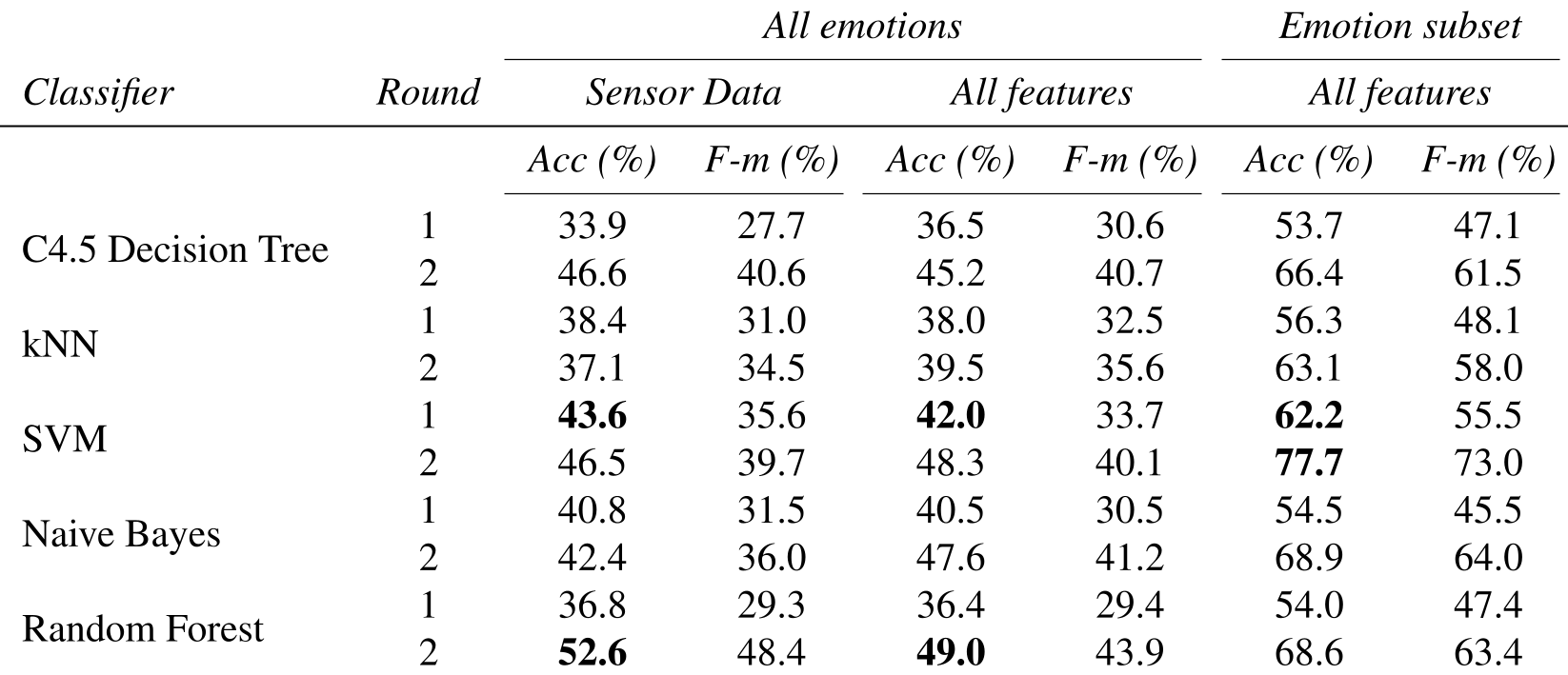 Table 1: Performance metrics across different classifiers and experimental rounds.
The SVM (Support Vector Machine) emerged as the strongest contender for the "Emotion Subset" (Anxiety, Interest, Relaxation), hitting that impressive 77.7% mark. Interestingly, "Joy" and "Sadness" were often confused with Anxiety, suggesting that the current sensor layout might need armrest sensors to capture the specific hand-clapping or head-dropping gestures associated with those states.
Critical Insight: Why This Matters
The breakthrough here isn't just the accuracy—it's the sparsity. Previous "smart chairs" used grids of over 2,000 sensors. The EmotiveCouch does it with eight. This reduction in complexity makes the technology commercially viable for mass-produced furniture.
Use Cases for the Future
- Adaptive Media: Your TV could automatically lower the volume or suggest a calming playlist if the couch detects high levels of anxiety.
- Health Monitoring: Long-term tracking of "posture-emotion" patterns could provide early warnings for depression or chronic stress without the stigma of medical monitoring.
- Smart Lighting: Integrating with IoT systems (like Philips Hue) to adjust ambient lighting to match or counteract your current mood.
Conclusion and Limitations
While the EmotiveCouch is a major step for privacy, it isn't perfect. The current design lacks head and arm tracking, which are critical for distinguishing complex emotions like Joy. However, as the authors suggest, moving these sensors into the headrests and armrests of an armchair could solve this, paving the way for furniture that truly "understands" how we feel.
Takeaway: The future of the smart home isn't just about voice commands; it's about subtle, invisible interaction where our environment responds to our unspoken emotional needs.