
empathi: Bridging the Semantic Gap in Hazard Crisis Management
Empathi: An Ontology for Emergency Managing and Planning About Hazard Crisis
The paper introduces empathi, a comprehensive ontology designed for Emergency Managing and PlAnning abouT Hazard crIses. Using Semantic Web technologies (OWL), it unifies diverse data sources—including social media, sensors, and satellite imagery—to enhance situational awareness during pre-hazard, in-hazard, and post-hazard phases.
TL;DR
Managing a disaster requires more than just data; it requires context. The empathi ontology provides a rigorous semantic framework to unify heterogeneous data—from satellite feeds to "human sensing" reports on Twitter—allowing emergency responders to navigate the chaos of Big Data with structured situational awareness. It delivers a massive schema of 423 classes and 338 relations, validated by experts and tested on 53 million tweets.
The "Broken" Information Pipeline in Emergencies
When a hurricane or earthquake strikes, social media overflows with data. However, for a relief agency, this data is often a "messy" haystack. Existing tools, such as the Humanitarian eXchange Language (HXL), primarily focus on rescue operations but often miss the broader context—like the health of the affected population, the status of a specific gas facility, or the subtle sentiment in "human prayer" messages.
The authors identified that current vocabularies are often taxonomies (simple lists) rather than ontologies (complex webs of logic). Without defined relations like needHelp or isLocationAt, machines cannot automatically "understand" the relationship between a displaced group of people and the nearest failing infrastructure.
Methodology: Building a Master Archetype
The development of empathi followed a "Legos-link" approach. Instead of reinventing the wheel, the team reused established standards:
- FOAF & SIOC: For modeling online communities and people.
- GeoNames: For precise geospatial referencing.
- LODE: Deployed to handle temporal and spatial event constraints.
The Core Architecture
The ontology is built around several "Super-classes" that define the disaster domain:
- Hazard Phase: Distinguishing between Prep, Action, and Recovery.
- Involved Actors: Organizations vs. Citizens.
- Impact: Quantifying severity, from infrastructure damage to financial crisis.
- Modality: Handling Text, Audio, Photo, and Video metadata.
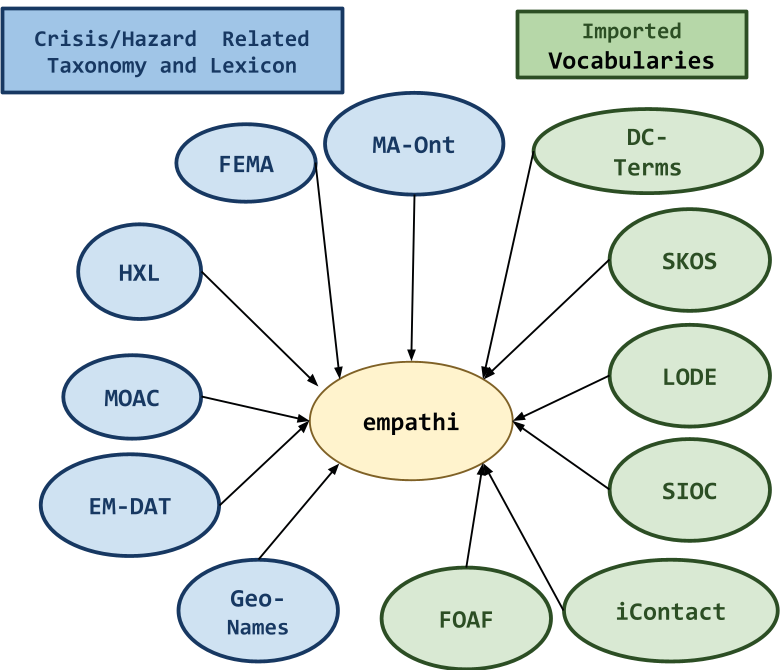 Figure 1: The integration strategy of empathi, showing the reuse of FOAF, SKOS, and Geonames.
Turning Tweets into Structured Knowledge
To prove empathi's utility, the authors performed a massive case study. They trained word embeddings on 53 million tweets and used cosine similarity to map n-grams within tweets to empathi classes.
For example, a tweet like "Chennai Floods: 188 killed, Airport closed..." is no longer just a string of text. Through the ontology:
- Chennai
Place - Floods
Hazard Type - 188 killed
Affected Population(sub-class ofImpact) - Airport closed
Infrastructure Damage
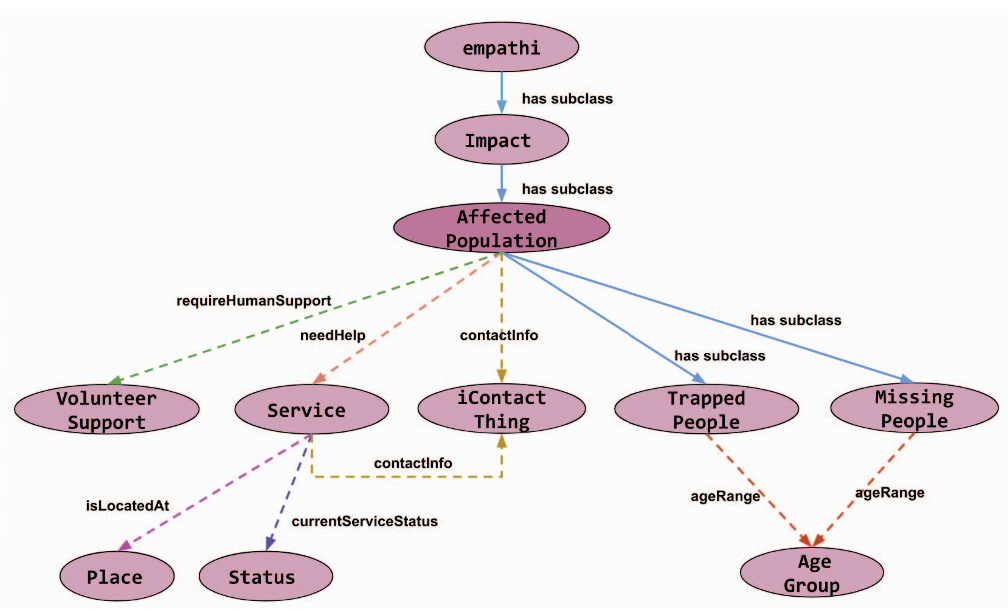 Figure 2: A partial view of semantic relations surrounding the "Affected Population" concept.
Expert Validation (Quality Control)
Quality was measured across three dimensions via a survey of disaster domain experts:
- Structural (84.5% Success): Does "Animal Loss" logically fall under "Impact"? (Yes).
- Semantic Relations (75.4% Success): Is the "needHelp" link between population and service correct?
- Lexical Clarity (78.8% Success): Are the definitions and synonyms (e.g., "praying", "temple" for a humanitarian event) unambiguous?
Critical Insight & Future Outlook
The true value of empathi (available at w3id.org/empathi/) lies in its ability to handle Inductive Bias in AI models. By providing a high-quality "anchor" of concepts, it helps supervised and unsupervised learning models classify crisis information with much higher precision than standard NLP techniques.
Future Work: The authors plan to integrate Internet of Things (IoT) concepts, allowing the ontology to pull live data directly from sensors (e.g., water level sensors during a tsunami) into the same semantic space as social media reports.
Final Conclusion
empathi isn't just a database; it’s a cognitive map for machines to help humans during their worst moments. By formalizing the "chaos" of hazards, it paves the way for automated, real-time response systems that are contextually aware and operationally effective.