
CNN vs. The Giants: Benchmarking Deep Learning in the High-Stakes World of Legal Discovery
Empirical Comparisons of CNN with Other Learning Algorithms for Text Classification in Legal Document Review
This empirical study evaluates the performance of Convolutional Neural Networks (CNN) against traditional machine learning algorithms (SVM, Logistic Regression, Random Forest) for text classification in legal "Predictive Coding." Using four real-world legal datasets, the research demonstrates that while CNN achieved the highest precision in 9 out of 16 experimental scenarios, no single algorithm universally dominates across varying document lengths and training sizes.
TL;DR
In the legal industry, "Predictive Coding" (or Technology Assisted Review) is the difference between a multi-million dollar manual review and an automated, efficient discovery process. This study moves beyond academic benchmarks to test CNNs, SVMs, Logistic Regression, and Random Forests on real-world legal data. The verdict? CNNs are powerful—even with small training sets—but classical methods remain surprisingly competitive.
The "Short Document" Bias in Academic NLP
Most breakthroughs in text classification are born on datasets like IMDB or AG News—collections of tidy, relatively short snippets of text. Legal document review is a different beast. A single "document" might be a two-word email or a 500-page technical manual.
The authors identify a critical gap: Does the architectural complexity of a CNN actually provide an edge when document lengths vary wildly, and more importantly, can it survive in the "low-data" environment of legal matters where human-labeled training sets are expensive to produce?
Methodology: Keep it Simple, Keep it Fast
Unlike the massive LLMs of 2026, this study focuses on a Practical CNN—a single-layer convolution designed for speed. In legal discovery, time-to-model is just as important as accuracy.
The Model Architecture
The team utilized an embedding layer followed by a 1D convolution layer with 64 filters. The secret sauce was the 1-max pooling strategy, which extracts the most significant feature across the entire sequence, effectively handling documents of varying lengths.
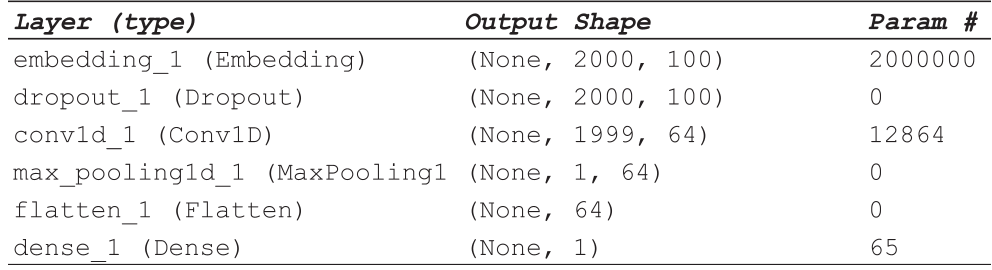 Table 1: The shallow CNN architecture used in the study, prioritizing inference speed and training efficiency.
Battle of the Algorithms: The Results
The researchers evaluated the models using Precision at 75% Recall, a standard metric in legal discovery (ensuring that 75% of relevant documents are found while measuring how much "noise" the attorney must still wade through).
Key Findings:
- CNNs are no longer "Data Hungry": Contrary to the authors' 2018 study, this updated approach found that CNNs performed remarkably well even with only 2,500 training samples.
- No Universal Winner: As shown in Table 3, the "best" algorithm shifted depending on the dataset and the training size.
- The Persistence of SVM: Traditional Support Vector Machines (SVM) and Logistic Regression remains the "old guards" of the industry—frequently tying with or narrowly trailing the CNN.
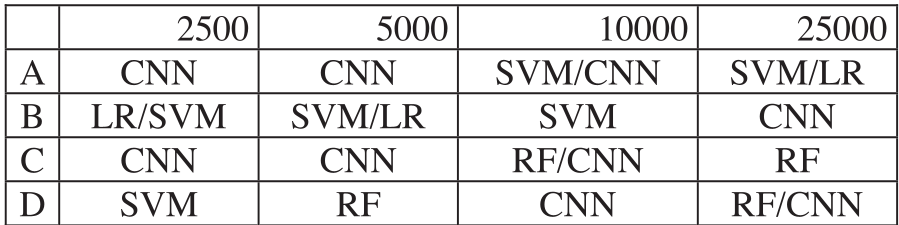 Table 3: The "Winning" algorithm across different datasets (A-D) and training sizes (2.5k - 25k).
Deep Insight: Why Doesn't CNN Dominate?
In many NLP tasks, CNNs (and later Transformers) dominate because they capture local patterns and semantic relationships that N-grams miss. However, in legal review, "responsiveness" is often triggered by specific keywords or technical phrases. In these cases, the Inductive Bias of a simpler Linear SVM or Logistic Regression—which treats features more independently—can be just as effective as a neural network that tries to model spatial context.
Critical Analysis & Conclusion
This paper serves as a vital reality check for "Deep Learning maximalism." While the CNN won the majority of the head-to-head battles (9/16), the margin of victory was often slim.
Takeaways for Practitioners:
- Don't dismiss CNNs for small tasks: They are more robust to low data counts than previously thought.
- Focus on Hyperparameters: The success of the CNN in this study was largely attributed to rigorous grid searching of dropout rates and epochs.
- Hybrid Approaches: The future likely belongs to ensemble methods that combine the semantic awareness of CNNs with the stable feature-weighting of SVMs.
Despite the rise of Large Language Models, this research proves that efficient, task-specific architectures like CNNs remain a formidable tool in the legal technologist's arsenal.