
Cultural Modeling: Why Penalizing Mistakes Unequally is the Key to Better Behavior Prediction
An empirical study of cost-sensitive learning in cultural modeling
This paper presents an extensive empirical study of cost-sensitive learning within the domain of cultural modeling, utilizing the MAROB benchmark datasets. The authors evaluate four representative cost-sensitive methods (Oversampling, Undersampling, MetaCost, and Threshold-moving) across six standard classifiers, ultimately proposing a novel algorithm, OESP (Oversampling Excluding Isolated Positives), which achieves superior performance in managing the extreme class imbalances typical of socio-cultural data.
TL;DR
In the high-stakes world of cultural modeling—predicting group behaviors like arson, assassinations, or political shifts—not all mistakes are created equal. This paper provides a comprehensive empirical roadmap for Cost-Sensitive Learning, proving that traditional "accuracy" is a dangerous metric. By introducing OESP (Oversampling Excluding Isolated Positives), the authors show how to handle extreme data scarcity without falling into the trap of overfitting.
Context: When "Accuracy" is a Lie
In cultural modeling, we often deal with "Rare Events." If 95% of a group's history is peaceful, a classifier that simply predicts "Peace" every time is 95% accurate but 100% useless—it fails to predict the 5% of critical events (the False Negatives) that matter most.
Current SOTA methods in cultural modeling (like CARA or CONVEX) often struggle with the "Non-Uniform Misclassification Cost" problem. The pain of missing an attack far outweighs the cost of a false alarm. This paper tackles the "Why" and "How" of making machines understand these stakes.
The Core Challenge: Sparse and High-Dimensional Data
Cultural datasets (like the MAROB benchmark used here) are notoriously "difficult":
- Small Samples: Often fewer than 100 instances.
- High Dimensionality: Over 100 features/attributes.
- Severe Imbalance: Positive cases can be as low as 7%.
Prior work often favored Undersampling, but in a dataset with only 50 points, throwing away data is a recipe for disaster. The authors argue we need methods that respect every bit of evidence.
Methodology: The Landscape of Cost-Sensitivity
The authors investigated four pillar strategies combined with six classifiers (NB, SVM, ANN, kNN, DT, RF):
- Oversampling: Replicating the minority class to force the model to pay attention.
- Undersampling: Removing majority samples (risky for small data).
- MetaCost: A "wrapper" that relabels data based on cost-minimization.
- Threshold-moving: Adjusting the "probability bar" for classification.
Innovation: OESP (Oversampling Excluding Isolated Positives)
The authors noticed that standard oversampling often replicates "Isolated Positives"—outliers that look more like their enemies than their peers. Relentlessly copying these leads to Overfitting.
OESP Logic:
- Identify positives that have no positive neighbors (Isolated).
- Replicate "normal" positives.
- Keep isolated ones as single instances to prevent the model from creating "artificial islands" of noise in the latent space.
Experimental Insights
The study utilized 15 MAROB datasets. Key findings include:
- Oversampling wins: Contrary to general ML consensus (where undersampling is often praised), for small-scale cultural data, oversampling provides the most stable cost reduction.
- The Classifier Matters: For hyper-imbalanced data, Naive Bayes (NB) remains the king due to its robustness against high dimensionality and small sample sizes.
- Method-Classifier Synergy: Threshold-moving fails with SVM because SVMs don't naturally produce well-calibrated probabilities.
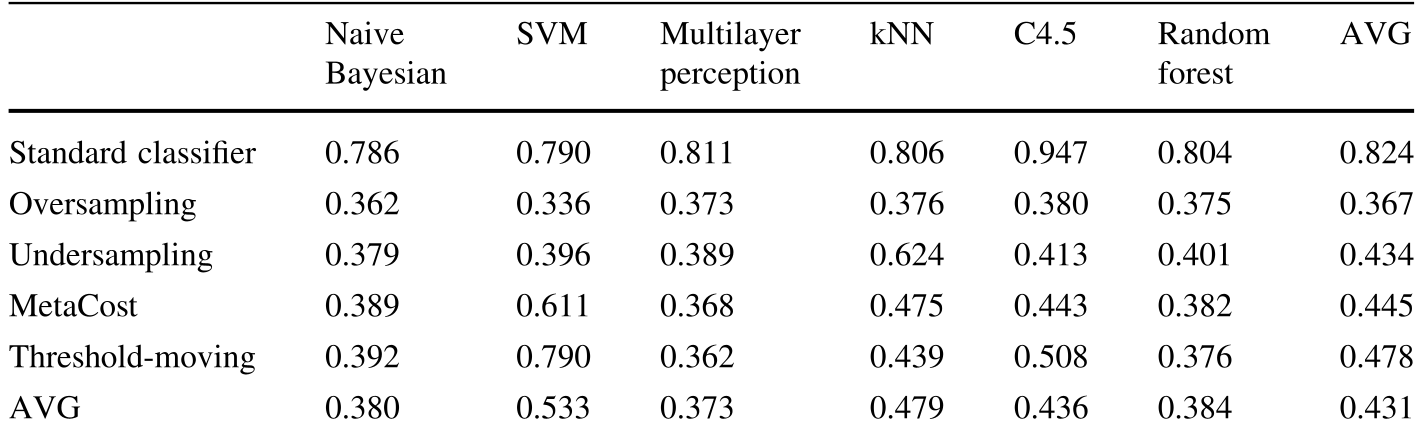 Table showing average EMC across different method-classifier pairs. Note how Oversampling consistently lowers the cost.
Conclusion & Depth Analysis
The real value of this paper isn't just the OESP algorithm, but the empirical dismantling of the uniform-cost assumption.
Takeaways for the Industry:
- Don't trash data: If your dataset is small, avoid undersampling.
- Check your neighbors: Before oversampling, use distance metrics to identify isolated samples. Treating them differently is the secret to generalization.
- Domain Expertise is Required: Cost matrices (setting the ratio of vs ) should be defined by domain experts, not just data scientists.
While OESP is powerful, its reliance on -Nearest Neighbors to define "isolation" means it may struggle in extremely high-dimensional spaces where the "curse of dimensionality" makes distance metrics less meaningful. Future work in this area will likely involve using Generative Adversarial Networks (GANs) or Synthetic Minority Over-sampling Technique (SMOTE) variations to create more nuanced minority samples.