
PWS: Harmonizing Personal Taste and Social Influence in Rating Prediction
An Empirical Study of Personal Factors and Social Effects on Rating Prediction
The paper introduces Personal factors with Weighted Social effects (PWS), a novel matrix factorization approach for rating prediction that integrates individual user tastes with weighted social influences from friends. It moves beyond the simple assumption of uniform friend similarity to capture the diversity of user preferences, achieving significant performance gains on Epinions, Flixster, and DouBan datasets.
TL;DR
Social recommendation systems often operate on the naive assumption that "your friends rate like you do." However, human behavior is more complex—our friends influence us, but we still maintain our unique, diverse tastes. This paper introduces PWS (Personal factors with Weighted Social effects), a Matrix Factorization (MF) variant that treats social influence as a weighted interaction rather than a rigid constraint. By modeling the interplay between personal latent factors and aggregated social interests, PWS achieves a massive 28% accuracy boost on diverse datasets like Epinions.
The "Friendship Paradox" in Recommendation
Most existing social-aware recommenders use Social Regularization. They penalize the model if your latent profile drifts too far from your friends. But as the authors point out, this ignores taste diversity.
Imagine two friends, Alice and Bob. They both love Sci-Fi movies (common interest), but Alice hates Horror while Bob loves it. Traditional models might force Alice's profile toward Bob's, leading to a poor prediction for Alice on Horror films. The core challenge is: how do we allow the model to learn when to listen to friends and when to rely on personal taste?
Methodology: Beyond Simple Regularization
The authors argue that a rating is not just a product of user and item features (), but is also affected by Weighted Social Effects.
1. Defining Social Interests
Instead of just looking at the social link, the model calculates a Latent Social Interest Vector (): This represents the collective "vibe" or taste of a user's social circle.
2. The PWS Formulation
The PWS model updates the standard MF prediction formula by adding an interaction term:
In this formula, the value acts as a "communication coefficient," representing the intensity of social influence. The beauty of the inner product is that it naturally awards more weight to friends with similar latent tastes, capturing the physical intuition that we are more likely to be influenced by friends who share our specific preferences.
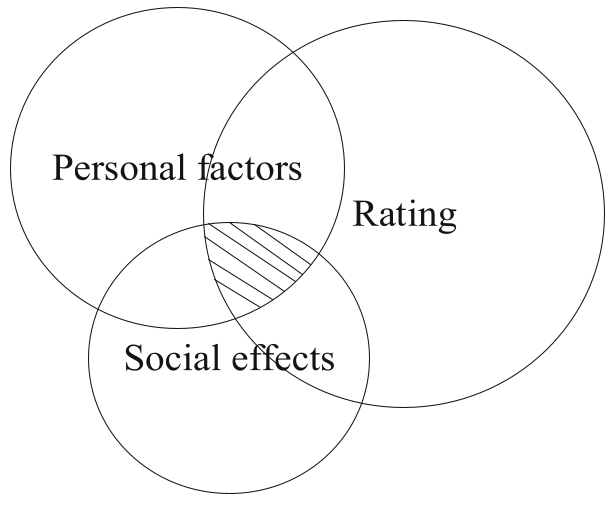 Figure 1: Illustration of how social links and personal preferences diverge and interact in a rating scenario.
Experiments and Insights
The researchers tested PWS against state-of-the-art methods like SR-MF (Social Regularization) and ASS-MF (Adaptive Social Similarity) on three major datasets: Epinions, Flixster, and DouBan.
The Power of the Weight 'w'
One of the most interesting findings is how the optimal social influence weight () varies by platform:
- Flixster (): High social influence, likely because movie discussions are frequent and viral.
- Epinions (): Moderate influence in a diverse consumer product space.
- DouBan (): Low social influence, which the authors attribute to different user interaction patterns on the platform.
Performance Comparison
PWS consistently outperformed other models, showing that directly modeling the interaction between personal factors and social effects is superior to using social information as a secondary constraint.
 Table 1: MAE and RMSE results across three datasets. PWS shows a clear dominance, especially in the Epinions dataset.
Critical Analysis & Conclusion
Takeaway
The PWS model successfully demonstrates that social context is a feature, not just a constraint. By using an inner product to weight social influence, the model respects the diversity of user tastes. It doesn't force you to be like your friends; it learns which parts of your friends' tastes are relevant to you.
Limitations & Future Work
The model currently uses a global weight () for all users within a single dataset. In reality, some users are "social butterflies" easily influenced by peers, while others are "independent thinkers." A future evolution of this work would be to learn individualized social weights, potentially using an attention mechanism to find the specific "opinion leaders" in a user's network.
Ultimately, PWS provides a robust framework for any developer looking to fuse social graph data into a recommendation engineering pipeline without sacrificing the nuance of individual user personality.