
The Cultural Divide of "Likes": Unveiling Facebook's Preference Landscape
An Empirical Study on Preference Distribution of Facebook Users
2016-07-01
Summary
Problem
Method
Results
Takeaways
Abstract
This paper presents an extensive empirical study on Facebook user preference distributions using a dataset of approximately 480,000 users across 11 preference types. The authors identify key structural characteristics of social media interests, revealing that Music, TV, and Movie are the most dominant categories and that preference popularity follows a strict Power Law distribution.
## TL;DR
By analyzing nearly half a million Facebook profiles, researchers have mapped the anatomy of human interests online. The study reveals that while we all love Music and Movies, our specific tastes are governed by two rigid laws: the **Power Law** (where a tiny fraction of content dominates) and the **Law of Localization** (where "popular" in one country means nothing in another).
## Problem & Motivation: Beyond the API
Most social media research is limited by what platforms allow researchers to see via official APIs. However, to truly understand human behavior, one needs a "human-eye" view of the data. The authors of this study overcame significant technical hurdles—including frequent HTML changes and IP blocking—to capture a snapshot of how 479,048 users express their identities through "Favorite" tags.
The motivation was simple: if we know what people like and where they like it, we can build better Content Delivery Networks (CDNs) and more accurate recommendation engines.
## Methodology: Measuring Digital Identity
The study breaks down preferences into 11 categories, from "Music" and "TV" to the more personal "People Who Inspire You."
### Data Highlights:
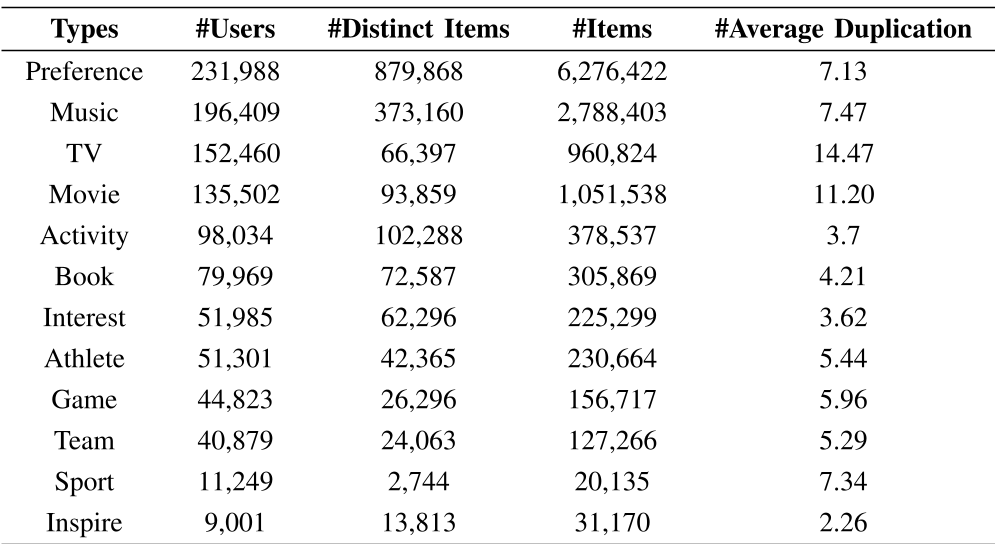
- **Dataset Scale**: 479,048 users; 879,868 distinct items; 6.2 million total preference entries.
- **Measuring Overlap**: The authors introduced **"Average Duplication"**, calculated as `Total Items / Distinct Items`. A high duplication rate (like in TV or Music) suggests a "consensus" type of preference where users easily find common ground.
## Core Insight 1: The Tyranny of the Power Law
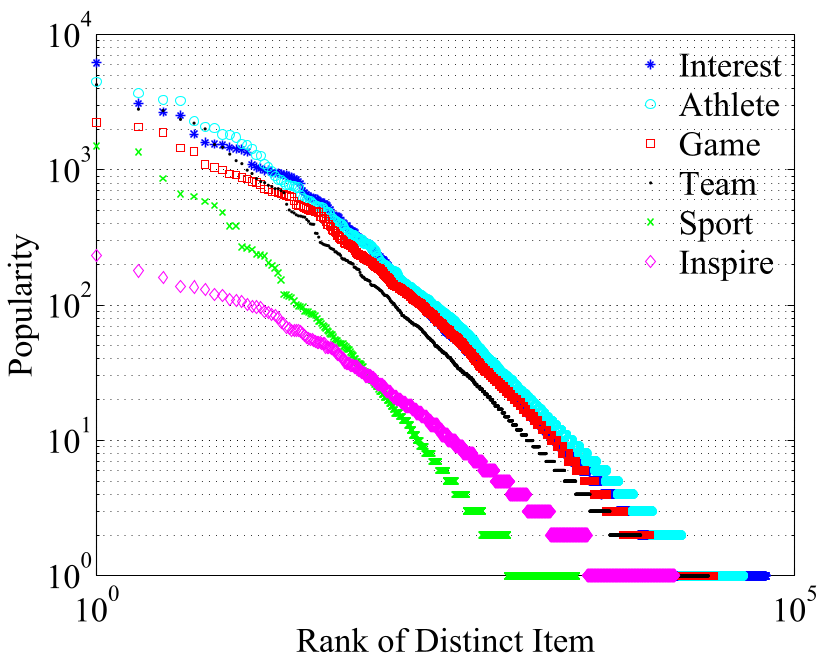
Does everyone like different things, or does everyone like the same thing? The answer is both. By plotting item popularity on a log-log scale, the researchers confirmed that Facebook preferences follow a **Power Law distribution**.
This means that a very small number of items (the "head") are liked by almost everyone, while a massive number of items (the "long tail") are liked by only a few people. For developers, this is a warning: recommending only the "popular" items might achieve high precision on paper but fails to satisfy the diverse needs of the actual user base.
## Core Insight 2: The Failure of Global Consensus
Perhaps the most striking finding is the **localization effect**. We often assume that in a globalized internet, "Top 10" lists would look similar across Western nations. The data says otherwise.
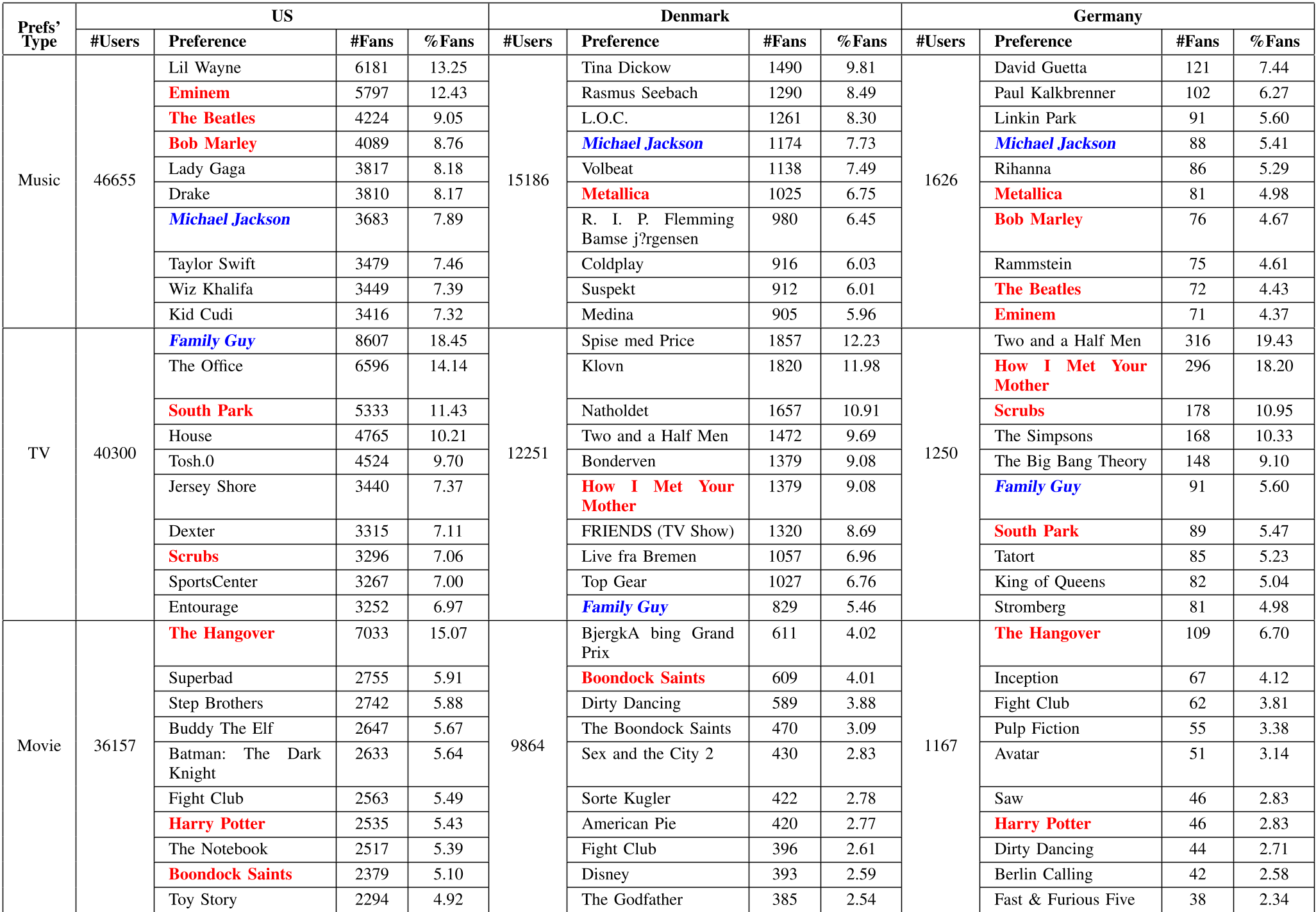
When comparing the US, Denmark, and Germany:
- **Music**: Only "Michael Jackson" made all three Top 10 lists.
- **TV**: Only "Family Guy" was a universal hit.
- **Movies**: **Zero** movies were shared across the top lists of all three countries.
This suggests that cultural boundaries remain incredibly strong online. A recommendation engine tuned for a US audience will likely fail in Germany, not because of language, but because of fundamentally different cultural "anchors."
## Critical Analysis & Future Outlook
### Value-First Takeaway
This research provides a quantitative backbone for why **Localization** and **Serendipity** are not just "nice-to-have" features but essential requirements for any global platform.
### Limitations
The study relies on *public* profiles, which may be subject to "social desirability bias"—users might list "The Great Gatsby" as a favorite book while actually reading tabloids. Furthermore, as the data was collected in 2012, it captures a "static" moment of Facebook before the pivot to algorithmic feeds dominated the user experience.
### Conclusion
The "Global Village" is more like a collection of highly specialized neighborhoods. To reach users effectively, algorithms must respect the geographic clusters of taste and the mathematical reality of the Long Tail.