
HiCH: Bridging the Gap Between Deep Learning and Real-Time IoT Healthcare
Empowering healthcare IoT systems with hierarchical edge-based deep learning
The paper introduces a hierarchical computing architecture (HiCH) that integrates Convolutional Neural Networks (CNN) into healthcare IoT systems. By partitioning the deep learning workflow between smart edge gateways and cloud servers, it achieves real-time ECG arrhythmia classification with high reliability even during network instability.
TL;DR
Healthcare IoT systems face a "Catch-22": they need the high accuracy of Deep Learning (which requires the Cloud) but also the ultra-low latency of the Edge (which lacks power). The HiCH architecture solves this by splitting the workload—training and model refinement happen in the cloud, while the actual life-saving detection runs locally on the gateway.
Problem & Motivation
In remote health monitoring, a delay is not just a nuisance—it’s a risk to life. Conventional systems are mostly Cloud-Centric, meaning if your 4G/3G connection drops, your heart monitor stops being "smart."
The authors identify two fatal flaws in existing set-ups:
- The Latency Trap: Cloud response times fluctuate wildly (from 40ms to 6 seconds!) based on signal quality.
- The Hardware Wall: While we want to run CNNs locally, smart gateways are too weak to handle continuous model training and high-frequency data processing alone.
The research intuition here is simple but powerful: Don't choose between Edge and Cloud; use both hierarchically.
Methodology: The Hierarchical Split
HiCH (Hierarchical computing architecture) partitions the system using an adapted MAPE-K (Monitor-Analyze-Plan-Execute-Knowledge) model.
1. The Cloud (Analyze)
The Cloud is the "Brain." It handles the heavy lifting: training a 3-layer CNN followed by a Multilayer Perceptron (MLP). It takes the big data and creates a Hypothesis Set (a trained model).
2. The Edge (Plan & Execute)
The Edge gateway is the "Reflexes." Once the cloud provides the lightweight classifier, the edge performs the local inference. If it detects an arrhythmia, it notifies the patient immediately, bypassing the need for a round-trip to the cloud server.
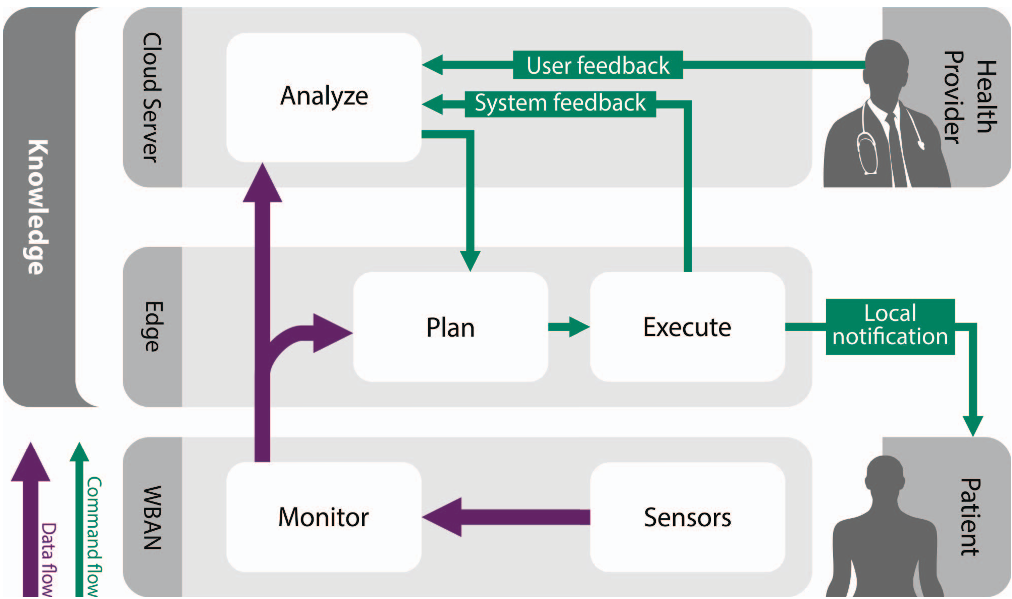 Figure 1: The HiCH architecture distributing MAPE-K components across the WBAN, Edge, and Cloud.
3. Deep Learning Backbone
The classifier uses a 1D-CNN with layers of 16, 32, and 64 neurons to extract features from raw ECG signals automatically, removing the need for manual feature engineering.
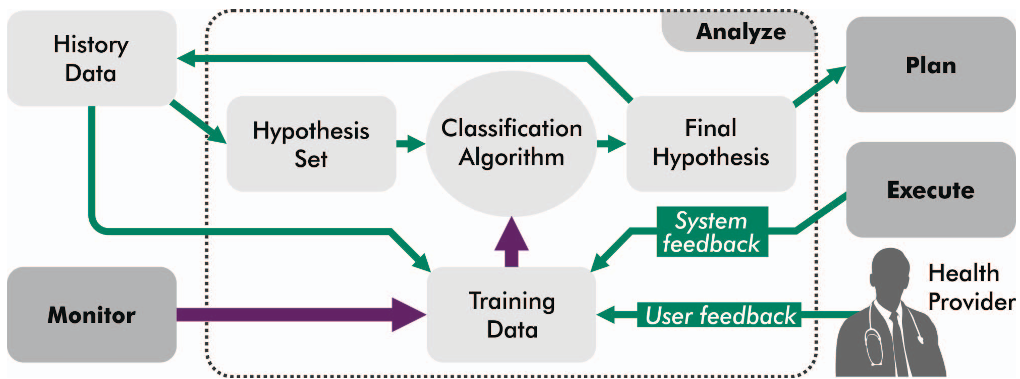 Figure 2: The CNN + MLP pipeline for ECG feature extraction and classification.
Experiments & Results
The authors tested the system using the MIT Arrhythmia database. The results confirm two massive wins:
Deterministic Response Times
Unlike cloud-only systems where response time is a "roll of the dice" based on internet speed, HiCH provides a flat, predictable response time determined solely by the local hardware's FLOPS (Floating Point Operations Per Second). Even on a modest Jetson TK1, the execution is reliable.
Personalization Boosts Accuracy
One of the most impressive findings is the benefit of Patient-Specific retraining. A general model (Inter-patient) starts with <90% accuracy. However, by feeding just 50 heartbeats from the specific patient back into the system (Intra-patient), the accuracy shoots up to 96%.
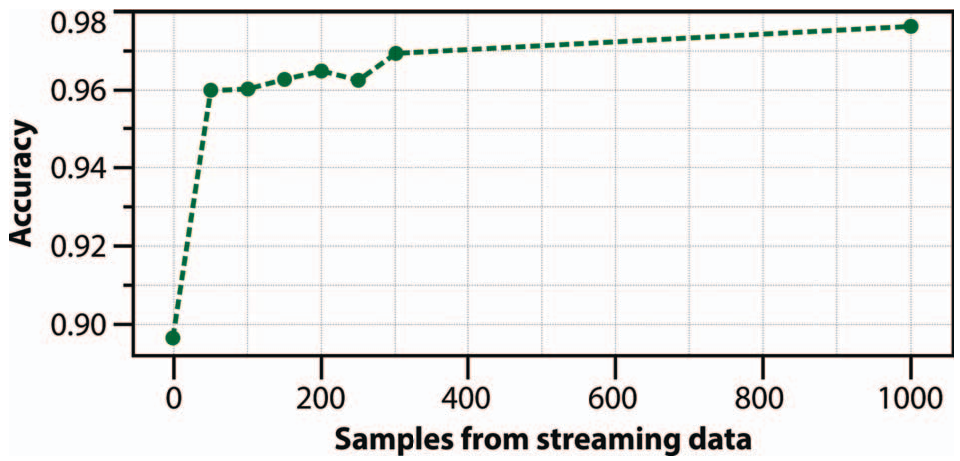 Figure 3: Dramatic accuracy gains as the model is retrained with patient-specific samples.
Critical Analysis & Conclusion
Takeaway: HiCH demonstrates that "Edge" doesn't mean "Standalone." By treating the edge as an execution arm of the cloud's intelligence, we can deploy SOTA deep learning in life-critical environments.
Limitations:
- Feedback Loop: The paper assumes a health provider provides "True Labels" for retraining. In a real-world scenario, getting these labels in real-time is a significant UX challenge.
- Energy Consumption: While execution time is measured, the energy overhead of running continuous CNN inference on battery-powered edge devices remains a concern for long-term wearability.
Future Outlook: This architecture paves the way for "Self-Adapting" medical devices that get smarter the longer you wear them, without ever risking your safety on a flaky WiFi signal.