
From the Lab to the Hotline: The Reality Gap in Speech Emotion Recognition
End-to-End Speech Emotion Recognition: Challenges of Real-Life Emergency Call Centers Data Recordings
This paper presents an end-to-end Speech Emotion Recognition (SER) system using a Temporal CNN-BiLSTM architecture, specifically evaluated on real-life French emergency call center data (CEMO) and the standard IEMOCAP corpus. The study achieves a state-of-the-art Unweighted Accuracy (UA) of 63% on IEMOCAP and 45.6% on the highly complex, imbalanced CEMO-4eCs dataset for 4-class classification.
TL;DR
Researchers from Paris-Saclay University have developed a lightweight Temporal CNN-BiLSTM architecture to tackle the messy reality of emergency call center recordings. While the system matches SOTA performance on the standard IEMOCAP dataset (63% UA), performance takes a significant hit when faced with real-life French emergency calls (CEMO), dropping to 45.6% for 4 classes. This highlights a critical "portability gap" in AI’s ability to understand human distress in the wild.
Background: The "Sanitized" World of Emotion AI
Most Speech Emotion Recognition (SER) breakthroughs happen in a vacuum. Datasets like IEMOCAP use professional actors to simulate anger or sadness in controlled environments. However, an emergency call center agent doesn't deal with actors; they deal with panic, background noise, poor phone signals, and "blended" emotions (e.g., relief mixed with fear).
The authors argue that the field needs to move beyond lab-grown data. They introduce CEMO, a corpus of 20 hours of real French medical emergency calls, characterized by:
- Massive Class Imbalance: Most segments (80%) are neutral.
- Short Durations: Average segments are only 1.7s compared to 4.4s in IEMOCAP.
- Complexity: Emotions are often subtle or "shaded" rather than theatrical.
Methodology: The Temporal CNN-BiLSTM
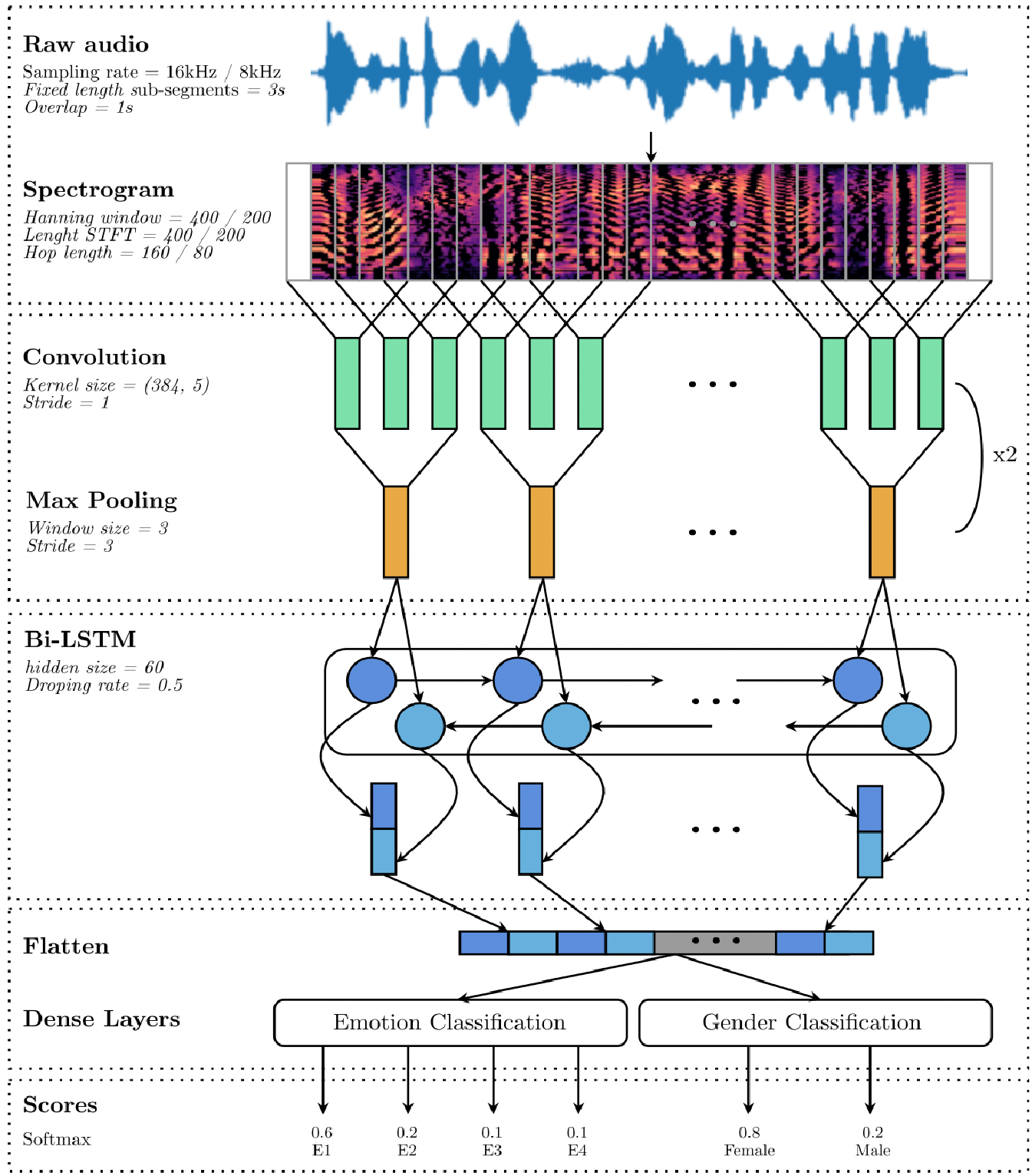
The paper proposes an end-to-end architecture designed to extract features directly from Mel-spectrograms without manual feature engineering.
1. Temporal vs. 2D Convolution
Instead of standard 2D convolutions (typically used in computer vision), the authors utilized Temporal Convolutions. By applying kernels primarily along the time axis, the model captures local acoustic variations more efficiently.
- Efficiency: The Temporal CNN-BiLSTM uses only ~200,000 parameters, compared to ~1.2 million for a 2D equivalent.
- Performance: It outperformed 2D CNNs on the IEMOCAP baseline.
2. Multi-Task Learning (MTL)
The architecture doesn't just predict emotion; it simultaneously predicts Gender. This auxiliary task acts as a regularizer, helping the model learn more robust speaker representations that indirectly benefit emotion classification.
Experimental Battleground: IEMOCAP vs. CEMO
The results reveal a stark contrast between "acted" and "real" data.
Performance Summary
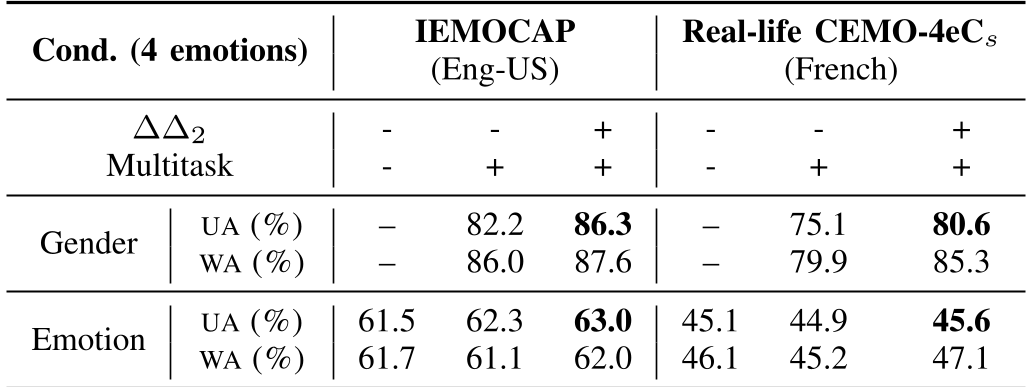
- IEMOCAP (4 Classes): 63.0% UA.
- CEMO (4 Classes: Fear, Anger, Positive, Neutral): 45.6% UA.
- CEMO (2 Classes: Anger vs. Neutral): 76.9% UA.
The "Positive" class in CEMO mostly consisted of relief, a nuanced emotion that is drastically different from the "Happiness" found in actor-based datasets.
Deep Insight: The Portability Problem
The most telling part of the study is the Cross-Corpus experiment. When the model was trained on IEMOCAP (English actors) and tested on CEMO (French real calls), the accuracy for Anger vs. Neutral dropped to 61.9%.
Why?
- Language/Culture: Prosodic expressions of anger vary between English and French.
- Acoustic Environment: Call center data is 8kHz (low fidelity) compared to the 16kHz used in labs.
- Intensity: Real-life fear or anger is often quieter, more compressed, or intertwined with pain, unlike the clear, high-energy "anger" of an actor.
Critical Analysis & Future Outlook
Takeaway: This research proves that while end-to-end deep learning is powerful, model architecture is only half the battle. The quality and representative nature of the training data are the primary bottlenecks for real-world applications like emergency dispatch dashboards.
Limitations: The system currently only uses the audio channel. In emergency calls, what is said (the linguistic channel) is just as important as how it is said. The authors admit that future iterations must include Multimodal Architecture—integrating ASR (Automatic Speech Recognition) to process the semantic content alongside the acoustic features.
Future Work: To bridge the gap, we must explore Unsupervised Domain Adaptation to allow models to learn from acted data but "fine-tune" their expectations for the messy, low-fidelity world of real-life telephony.