
EASDM: Balancing Social Influence and Battery Life in Delay-Tolerant Networks
Energy-Aware Social-Based Multicast in Delay-Tolerant Networks
2015-05-01
Summary
Problem
Method
Results
Takeaways
Abstract
This paper introduces EASDM (Energy-Aware Single-Data Multicast), a relay selection scheme for Delay-Tolerant Networks (DTNs) that integrates social centrality with residual battery life. It addresses the limitation of previous social-based routing by balancing delivery success with network longevity, outperforming the standard SDM baseline in sustained multicast operations.
## TL;DR
In the unpredictable world of Delay-Tolerant Networks (DTNs), "popular" nodes—those with high social centrality—are often worked to death. This paper proposes **EASDM**, a routing scheme that selectively "rests" influential nodes by considering their residual energy. By treating relay selection as a constrained optimization problem, the authors achieve a **27% increase in supported multicast sessions** compared to state-of-the-art social-only methods.
## The Popularity Trap: Why Social Routing Fails
Current DTN routing strategies, such as the Single-Data Multicast (SDM) scheme, typically rely on **Centrality**. Centrality measures a node's likelihood of encountering others (Cumulative Contact Probability - CCP).
The logic is sound: if a node meets many people, it is a great courier. However, this creates a **systemic bottleneck**. These high-centrality nodes are selected repeatedly across every multicast session. In energy-starved scenarios like disaster relief, these "social butterflies" run out of battery first, leaving the network fragmented and "dead" despite having many low-centrality nodes still active.
## Methodology: Greed is Good (When It’s Energetic)
The authors redefine relay selection not just as a search for the best path, but as a **Multi-Objective Optimization** problem.
### 1. The Optimization Goal
The goal is to minimize the number of relays ($k$) while maximizing the sum of their residual energy ($E_i$), subject to:
* Achieving a target delivery ratio ($p$).
* Ensuring every relay has energy above a minimum threshold ($e_0$).
### 2. The Heuristic: EASDM Algorithm
Since solving this NP-hard problem optimally in a resource-constrained DTN is impractical, the authors use a greedy approach:
* **Partitioning**: Nodes are split into High-Centrality and Low-Centrality sets.
* **Reservation Strategy**: A portion ($\alpha$) of the high-centrality nodes is intentionally **reserved** for future sessions, even if they are available now.
* **Energy-First Selection**: Within the active sets, nodes are sorted by residual energy rather than just their contact probability.
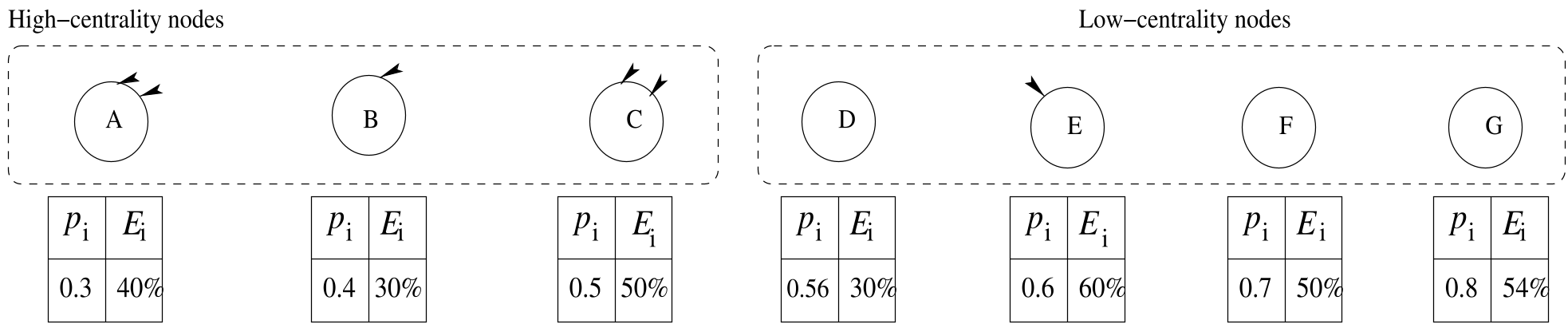
*Figure: Comparative relay selection between SDM (Pure Social) and EASDM (Energy-Aware).*
## Performance and Results
The researchers simulated a Bluetooth-based DTN (41 devices) with specific energy hardware profiles (432mW for TX, 425mW for RX).
* **Network Longevity**: EASDM consistently supported more multicast sessions. At high delivery requirements, EASDM maintained a 27% lead over SDM.
* **The Cost of Sustainability**: To achieve the same delivery ratio without exhausting high-centrality nodes, EASDM occasionally uses "sub-optimal" relays. This leads to a slight increase in total relay count (up to 11%), which is a small price to pay for a 14% higher survival rate of critical nodes.
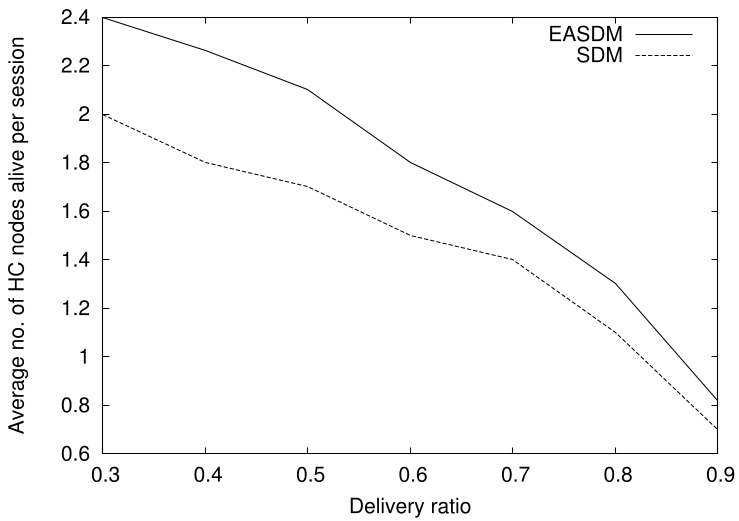
*Figure: Comparison of supported multicast sessions vs. required delivery ratio.*
## Critical Insights
The core "magic" of EASDM isn't just checking battery levels; it's the **Reservation Parameter ($\alpha$)**. By acknowledging that a high-centrality node is a precious resource that shouldn't be "spent" all at once, the algorithm introduces a form of **load-balancing** across time rather than just space.
### Limitations and Future Work
* **Dynamic Alpha**: Currently, $\alpha$ is a fixed fraction. In a real-world deployment, this should likely be dynamic, scaling with the urgency of the data.
* **Mobile Fairness**: The model assumes all nodes start with equal energy. Future studies should investigate how EASDM handles "rogue" nodes or nodes that start with significantly lower power.
## Conclusion
EASDM proves that in intermittent networks, **sustainability is a social contract**. By sharing the burden of data forwarding among energy-rich nodes—even those with lower social standing—the network as a whole remains functional for significantly longer periods.