
Balancing Privacy and Profit: An Efficient Protocol for Secured OSNs
A content privacy-preserving protocol for energy-efficient access to commercial online social networks
This paper introduces a privacy-preserving protocol for Online Social Networks (OSNs) that utilizes Unidirectional Proxy Re-Encryption (PRE) and Searchable Symmetric Encryption (SSE). The approach ensures content remains encrypted from the OSN provider while enabling efficient multi-user sharing and keyword-based advertising.
TL;DR
Social media privacy is often a "zero-sum" game: either users expose their data to providers for service, or they encrypt it and break the provider’s advertising business model. This paper proposes a dual-layer solution using unidirectional Proxy Re-Encryption (PRE) for efficient sharing and Searchable Symmetric Encryption (SSE) for privacy-safe advertising. The most striking contribution is a game-theoretic proof demonstrating that users will honestly share advertisement keywords if the OSN provider shares the resulting profits.
The Friction: Efficiency vs. Privacy
Most current privacy-preserving methods for OSNs fall into two traps:
- Computational Heaviness: Schemes like Attribute-Based Encryption (ABE) or Broadcast Encryption (BE) require mobile devices to do heavy lifting every time a friend is added or removed.
- Economic Resistance: If an OSN provider (like Meta or X) cannot see what you talk about, they cannot serve targeted ads, removing their incentive to host the service.
The authors identified that a viable system must be user-efficient (preserving battery life) and provider-friendly (preserving profit).
Methodology: The Cryptographic Bridge
The protocol relies on two sophisticated cryptographic primitives to decouple raw data access from functional utility.
1. Unidirectional Proxy Re-Encryption (PRE)
Instead of the user encrypting a photo 100 times for 100 friends, the user encrypts the data once and provides a re-encryption key to the OSN server. The server acts as a "proxy," transforming the ciphertext specifically for each authorized friend without ever seeing the underlying plaintext.
- Revocation Advantage: To remove a friend, the user simply tells the server to delete the re-encryption key. No new keys need to be re-distributed to the remaining 99 friends.
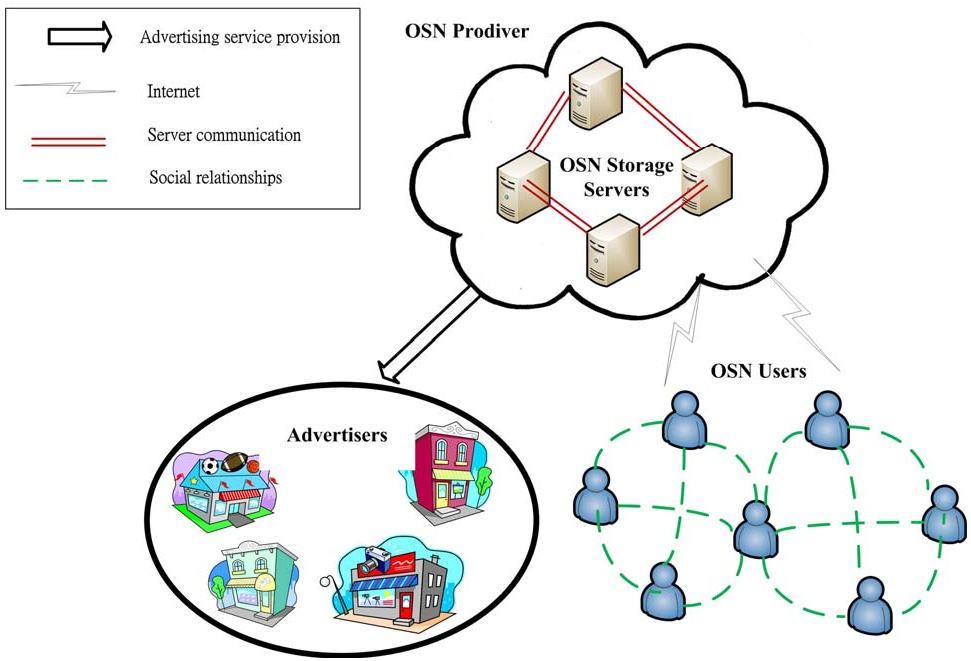 Fig 1: The OSN Model showing the interaction between Users, OSN Providers (Proxy), and Advertisers.
2. Searchable Symmetric Encryption (SSE)
To support advertising, the user generates a "secure index" of keywords. The server can search this index using "trapdoors" provided by the user. If a user talks about "travel," the server finds the match and serves a travel ad, but it doesn't know the context or the rest of the message content.
Experiments: Mobile-First Efficiency
A core claim of this work is energy efficiency for mobile devices. The authors compared their protocol against ABE and BE-based systems.
- Scalability: In BE-based schemes, the computation cost for headers grows linearly with the number of friends. In this paper's PRE scheme, the user's computation cost remains constant, shifting the heavy lifting to the server.
- Performance Comparison: The protocol was implemented using Java Pairing-Based Cryptography (JPBC).
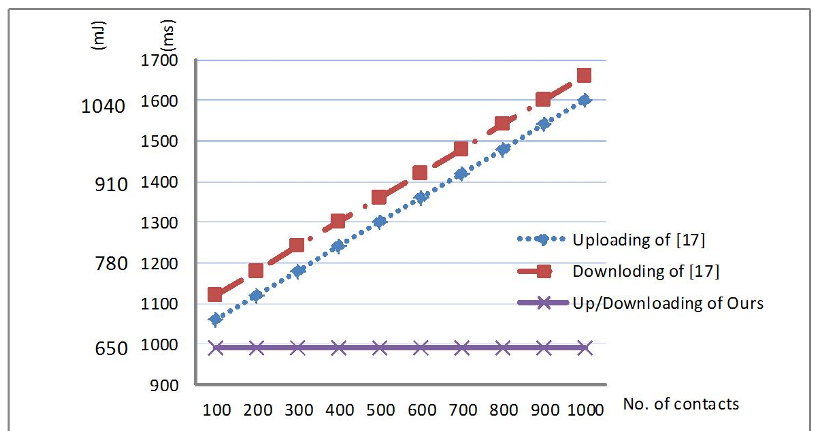 Fig 2: Comparison showing how the PRE scheme maintains constant cost while others grow with user/attribute count.
The "Honesty" Game: Why Users Won't Cheat
A common critique of searchable encryption is: Why would a user give the server a correct trapdoor for an ad?
The authors use the Nash Bargaining Solution to prove that if the provider shares a portion of the ad revenue with the user (e.g., small credits or premium features), the user’s "utility" is higher when being honest () than when being dishonest (). This aligns the financial incentives of both parties for the first time in academic OSN literature.
Critical Analysis & Conclusion
The protocol is a significant step toward practical "Web3-like" privacy on "Web2" infrastructure. Its reliance on Generic Cryptographic Components means as PRE and SSE become faster, this protocol automatically improves.
Limitations:
- Collusion: The security assumes the OSN provider and the social contacts do not collude to share keys.
- Keyword Leakage: While the content is hidden, the frequency of trapdoor use might reveal some user patterns to a curious provider.
Ultimately, the paper proves that content privacy doesn't have to be the enemy of commercial sustainability. By moving the heavy cryptographic math to the server and the financial surplus to the user, we can build social networks that respect both the person and the platform.