
Energy Efficient Transceiver Design in MIMO: Balancing Performance and Power
Energy Efficient Transceiver Design in MIMO Interference Channels: The Selfish, Unselfish, Worst-Case, and Robust Methods
This paper presents a comprehensive framework for maximizing Energy Efficiency (EE) in MIMO Interference Channels (MIMO-IC). It introduces four distinct transceiver design methods—Selfish, Unselfish, Worst-Case, and Robust—tailored for varying levels of coordination and channel knowledge, specifically addressing the non-convex nature of fractional optimization in multi-user settings.
TL;DR
As 5G and future 6G networks push for higher data rates, the environmental and economic cost of power consumption has become a critical bottleneck. This paper proposes a suite of algorithms—ranging from distributed "Selfish" designs to centralized "Robust" models—to maximize Energy Efficiency (EE) in MIMO Interference Channels (MIMO-IC), outperforming traditional spectral-efficiency-focused baselines while maintaining fairness and robustness against channel errors.
Problem & Motivation: The Green Communication Challenge
In modern wireless communication, Multiple-Input Multiple-Output (MIMO) is the gold standard for boosting Spectral Efficiency (SE). However, maximizing SE often involves "dumping" power into the channel, which leads to diminishing returns in terms of bits-per-joule.
The core difficulty lies in the MIMO Interference Channel (MIMO-IC) mission:
- Interference Coupling: One user's signal is another's noise.
- Fractional Non-Convexity: Energy Efficiency is defined as a ratio (Rate/Power). Optimizing a ratio of non-convex functions is notoriously difficult.
- Real-world Constraints: Transmitters have power limits, and we rarely have "perfect" knowledge of the channel (CSI).
Methodology: From Ratios to Subtractions
The authors' "Secret Sauce" is the application of the Majorization-Minimization (MaMi) technique. By creating a surrogate "minorizer" function that is easier to optimize, they convert the complex fractional problem into a subtractive form: Rate - η(Power).
The Four-Tiered Approach
- Selfish Method: Each user maximizes their own EE (Distributed). It solves a Quadratically Constrained Quadratic Program (QCQP) using a semi-closed-form solution.
- Unselfish Method: Aimed at maximizing the weighted sum-EE of the whole network. It uses coordination to ensure one user's gain doesn't wreck another's efficiency.
- Worst-Case Method: Focuses on Fairness. It maximizes the EE of the user with the worst connection, implemented via Second-Order Cone Programming (SOCP).
- Robust Method: Specifically designed for "dirty" channels with estimation errors. It uses Semi-Definite Programming (SDP) to ensure the system remains efficient even when the CSI is inaccurate.
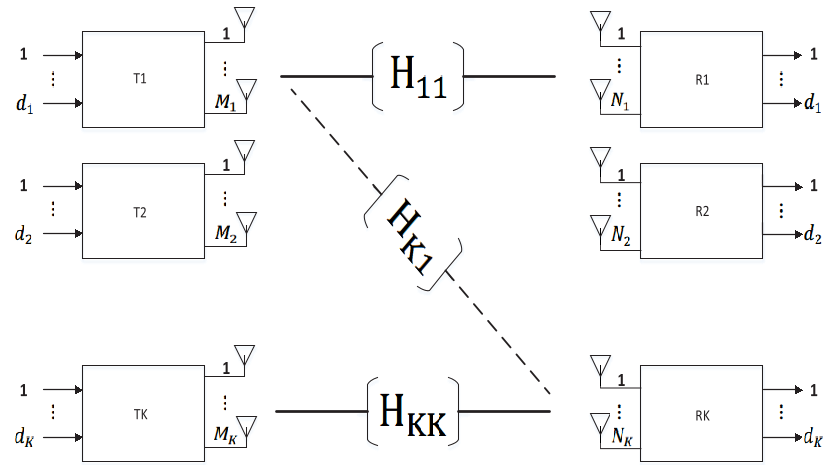 Figure 1: The MIMO-IC system model demonstrating the interplay between multiple transmitter-receiver pairs.
Experiments & Results
The researchers compared their methods against the ADEE (Asynchronous Distributed Energy Efficient) and Centralized methods commonly found in the literature.
Key Insights:
- Convergence: All proposed methods converged within roughly 10-20 iterations, proving their feasibility for real-time systems.
- Power Saturation: Unlike sum-rate maximization (where you always use max power), EE maximization shows a "sweet spot." Beyond a certain point, increasing power actually decreases efficiency.
- Scalability: As the number of antennas increases, the "Unselfish" method creates a wider gap over baselines, effectively exploiting spatial degrees of freedom.
| Method | Complexity | Implementation |
|---|---|---|
| Selfish | Distributed | |
| Worst-Case | Centralized | |
| Robust | Centralized |
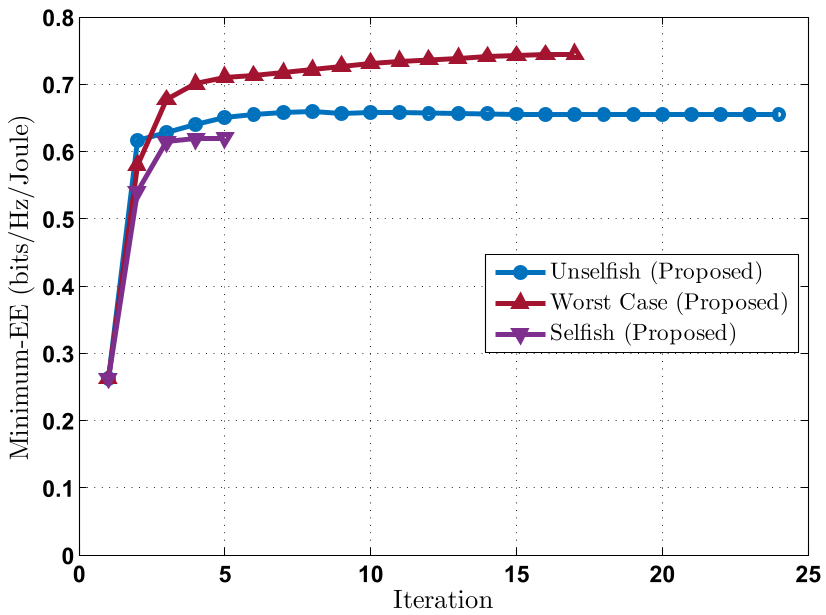 Figure 2: Sum-EE vs. Max Transmit Power. Note how the Unselfish and Selfish methods outperform ADEE as power constraints loosen.
Critical Analysis & Conclusion
This work represents a significant step toward "Green 5G." By transitioning from a centralized "know-it-all" optimization to distributed "Unselfish" cooperation, the authors provide a pathway for practical hardware implementation.
Limitations:
- The complexity of the Robust Method () is quite high for large-scale antenna arrays (Massive MIMO).
- The methods assume a somewhat static channel during the convergence phase, which might be challenged in high-mobility (fast-fading) scenarios.
Future Outlook: Integrating these fractional programming insights with Deep Unrolling or Graph Neural Networks could potentially reduce the per-iteration complexity, allowing these energy-efficient designs to run on low-power edge devices.
Final Takeaway
In the trade-off between "Greed" (Selfish) and "Altruism" (Unselfish), this paper proves that a managed level of cooperation can significantly extend the battery life of a network while maintaining high-speed throughput.