
Balancing Sight and Survival: Energy Optimization in Wireless Visual Sensor Networks
Energy Optimization and QoE Satisfaction for Wireless Visual Sensor Networks in Multi Target Tracking Scenario
The paper proposes an energy-efficient framework for Wireless Visual Sensor Networks (WVSN) in multi-target tracking scenarios by optimizing sensor selection and focal length. It utilizes a convex optimization framework to balance energy consumption with a user-defined Quality of Experience (QoE) threshold.
TL;DR
This research tackles the "efficiency vs. quality" dilemma in surveillance networks. By applying a decoupled convex optimization approach, the authors developed a system that selects the best camera nodes and adjusts their lenses to track multiple targets with minimal energy, achieving near-optimal results 50x faster than traditional search methods.
Background: The Visual Energy Crisis
Wireless Visual Sensor Networks (WVSNs) are the backbone of modern surveillance. Unlike standard sensor networks that transmit tiny data packets (like temperature), WVSNs deal with massive video streams. Every active node consumes energy for three things:
- Rotation: Turning the camera to face the target.
- Focal Adjustment: Moving the lens to keep the target sharp (Depth of Field).
- Transmission: Sending high-bandwidth visual data to the sink.
The technical challenge lies in multi-target tracking. When multiple objects move through a field, which cameras should follow which target? And how can we ensure we meet the user's Quality of Experience (QoE)—defined here as enough coverage area and image clarity—without killing the battery?
The Core Insight: Why Decoupling Matters
The original problem is a "Mixed-Integer Problem"—you either turn a sensor ON or OFF (Integer), and then you fine-tune the focal length (Continuous). Solving these simultaneously often leads to mathematical divergence or extreme computational lag.
The authors' "Aha!" moment was realizing they could solve these separately without losing significant accuracy:
- Step 1 (The Selection Strategy): They use the Ellipsoid method and KKT conditions to rank sensors. They calculate a "Priority Function" that considers the cost of switching targets and resetting lenses.
- Step 2 (Hardware Tuning): Once the sensors are picked, they use the Log-Barrier method to find the exact focal length that satisfies the coverage requirement while minimizing the physical movement of the lens.
Methodology & Architecture
The system model treats the camera as a geometric frustum where FOV (Field of View) and DOF (Depth of Field) are functions of the focal length.
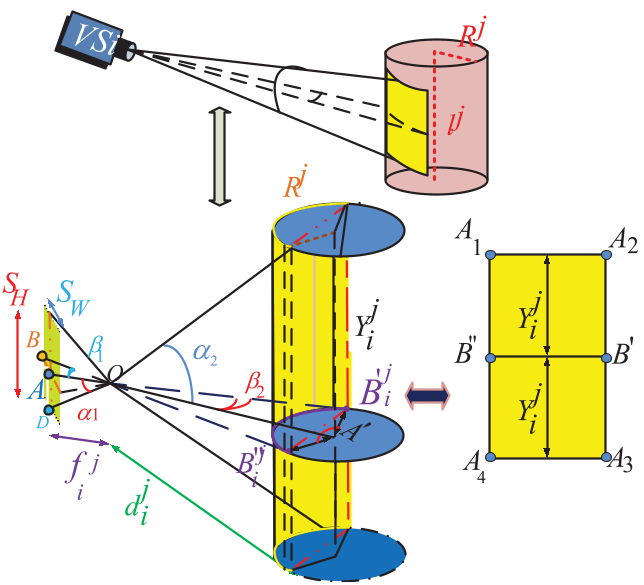 Figure 1: Mathematical modeling of target coverage based on sensor placement and focal parameters.
The optimization cost function aggregates transmission power (based on the free-space path loss law) and the mechanical energy of the lens motor.
Experimental Battle: Proposed vs. Exhaustive Search
The authors pitted their algorithm against an Exhaustive Search (ES)—the "brute force" method that finds the absolute best possible answer by checking every combination.
1. Accuracy vs. Efficiency
As shown in the performance metrics, the proposed algorithm tracks targets with the same precision as ES but completes the calculation in a fraction of the time.
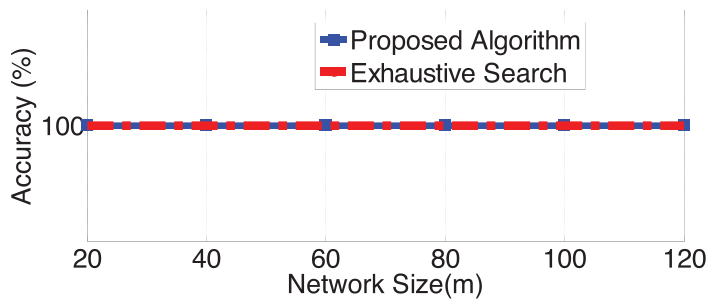 Figure 2: Performance accuracy across different network sizes shows the proposed method matches the optimal baseline.
2. Time to Converge
The real breakthrough is the 50x speed increase. In a live tracking scenario, waiting for a brute-force calculation means the target has already moved. The proposed algorithm's low complexity allows for "real-time" lens adjustment.
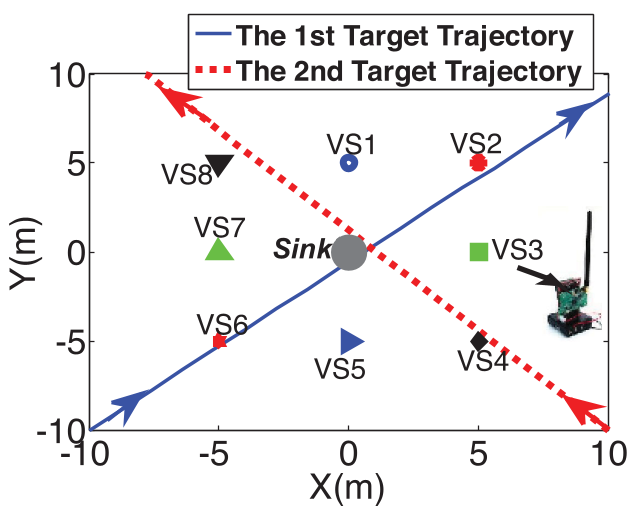 Figure 3: Real-time focal length setting as targets move through the grid.
Critical Analysis & Takeaways
The beauty of this work lies in its physical intuition. By acknowledging that focal length resetting has a physical cost (), the algorithm avoids "jitter"—constantly switching settings—which preserves battery and hardware longevity.
Limitations:
- The coverage model assumes cylindrical targets and a homogeneous forest of sensors.
- It ignores the "joint coverage" of three or more cameras for simplicity, which might be necessary in extremely dense urban environments.
The Future: This framework could easily be adapted for 5G mm-Wave networks or UAV-based surveillance, where energy is even more critical and the "camera" might be a directional antenna seeking a signal target.
Conclusion
This paper proves that you don't need infinite computing power to achieve optimal energy efficiency. By smartly partitioning the problem into selection and tuning, we can create surveillance systems that are both eagle-eyed and incredibly long-lived.