
Beyond Keywords: Decoding Market Sentiment with LDA-POS
Engineering Applications of Artificial Intelligence
This paper introduces LDA-POS, a novel graphical model that integrates Part-of-Speech (POS) tagging with Latent Dirichlet Allocation to predict stock price movements from social media sentiment. Testing across English (Yahoo Finance) and Persian (Sahamyab) datasets, the model achieves SOTA accuracy (up to 56.24%) by capturing semantic nuances often missed by standard topic models.
TL;DR
Predicting stock movements via social media sentiment is often dismissed as "noise." This paper introduces LDA-POS, a model that filters that noise by separating words into grammatical categories (Verbs, Adjectives, etc.) before analyzing topics. It consistently beats standard sentiment labels and topic models across both English and Persian markets, proving that how people speak is just as important as what they say.
Background: The Noise vs. Signal Dilemma
In the world of quantitative finance, the Efficient Market Hypothesis (EMH) suggests that all known information is already baked into stock prices. However, social media has created a "behavioral" layer where collective mood—fear, greed, and optimism—precedes price action.
The challenge? Previous methods typically treated messages as a "bag of words," ignoring the fact that "sell" as a verb has a very different impact than "sell" as part of a noun phrase in a technical discussion.
The Core Insight: Why POS Tagging Matters
The authors argue that sentiment isn't just about finding "good" or "bad" words. It's about understanding the semantic role of those words. By grouping words into functional buckets—Adjectives (indicators of quality), Verbs (actions), and Nouns (subjects)—the model can detect subtle shifts in communal sentiment that a flat frequency count would miss.
The LDA-POS Architecture
Unlike standard LDA which processes everything at once, LDA-POS follows a stratified approach:
- Tagging: Every word is assigned a POS tag (e.g., NNP for Proper Noun, JJ for Adjective).
- Grouping: Words are funneled into four specific "documents" per trading day based on their tags.
- Topic Inference: LDA generates 50 topics for each category, resulting in a 200-dimensional feature vector.
- Prediction: An SVM (Support Vector Machine) uses these distilled linguistic features to predict whether the stock goes Up or Down.
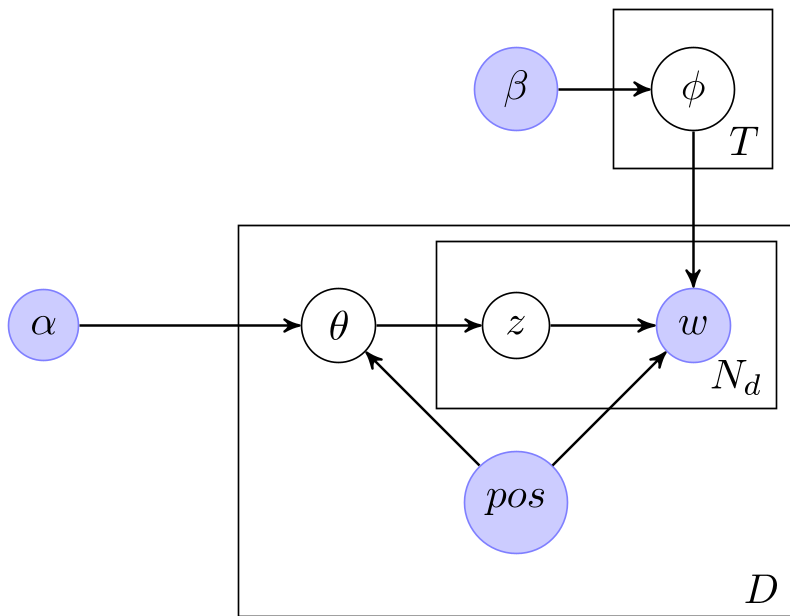 Figure 1: The LDA-POS graphical representation, showing how topic distributions (theta) are conditioned on POS categories.
A Cross-Linguistic Revelation
One of the most fascinating findings of this study is the difference between English and Persian (Farsi) sentiment.
- In English: Removing prepositions (like "under," "over," "with") had almost no impact on accuracy.
- In Persian: Prepositions were crucial indicators of sentiment. Adding them to the model caused a visible jump in accuracy.
This highlights a massive flaw in "standard" NLP pipelines: many stop-word lists (which remove prepositions) are designed for English and can inadvertently "blind" models when applied to other languages.
Experimental Battleground: LDA-POS vs. The World
The authors tested their model against several baselines, including a "Human Sentiment" method (using explicit 'Buy/Sell' tags from users) and "Aspect-Based Sentiment."
Key Results:
- Accuracy: LDA-POS achieved 56.24% on English stocks. While 56% might sound low to a layman, in the world of stock prediction, anything consistently above 54% is considered a significant "alpha" generator.
- Versus Human Labels: Interestingly, the automated LDA-POS model outperformed the explicit "Buy/Sell" labels provided by the users themselves. This suggests that the subconscious language used in comments is more predictive than the deliberate labels users choose.
 Figure 2: Performance comparison across 15 English stocks. LDA-POS shows lower variance and higher average accuracy compared to standard LDA and Price-only models.
Critical Insight: The Value of Simplicity
Despite the hype around Deep Learning, the researchers found that a 2-layered Neural Network actually performed worse than their SVM approach. Why? Data Scarcity. Financial datasets, even with 700k+ comments, are "small" in terms of daily decision points (samples). Deep models overfit the noise; the LDA-POS + SVM approach provides the necessary Inductive Bias to stay grounded in the linguistic reality of the market.
Summary & Future Outlook
LDA-POS proves that linguistic structure is a powerful feature for financial forecasting. By moving away from static dictionaries and towards dynamic, structure-aware topic modeling, we can build tools that work across languages and market regimes.
Future Directions:
- Granular Labels: Moving beyond binary (Up/Down) to predicting the magnitude of change.
- Market Simulation: Testing the model in a "paper trading" environment to account for transaction costs and slippage.
- Hybrid Engines: Combining POS-aware sentiment with real-time macroeconomic indicators.