
ECSN: Bridging the Social Gap in Academic Recommendations
An Enhanced Content-Based Recommender System for Academic Social Networks
The paper introduces ECSN (Enhanced Content-based Algorithm using Social Networking), a recommender system tailored for academic social networks. By integrating a user's preference tree with the interests of their "friends" and "faculty mates," the system outperforms traditional collaborative and content-based filtering on the MyExpert platform.
TL;DR
The paper presents ECSN (Enhanced Content-based Social Networking), a recommendation algorithm designed specifically for academic social networks (ASNs). Unlike traditional systems that look only at your past clicks, ECSN looks at what your colleagues and friends are reading. This "socially-aware" approach significantly boosts recommendation accuracy and effectively tackles the notorious "cold-start" problem.
Context: Why Academic Networks are Different
In a world of information overload, researchers struggle to find relevant papers and resources. While traditional Recommender Systems (RS) work well for movies or retail, academic interest is deeply structural. We don't just follow trends; we follow our faculty peers and research circles. Most existing systems ignore these social relationships, treating users as isolated data points.
The Core Innovation: The Socially-Weighted Preference Tree
The authors argue that your interests are a reflection of your environment. They developed a mathematical model to represent user interest as a hierarchical tree, where each category (e.g., "Machine Learning" or "Fluid Dynamics") gains a score based on four distinct signals:
- Self-Click Score: Explicit interaction (What you clicked).
- Self-Rank Score: Explicit feedback (The 1-5 star ratings you gave).
- Faculty Mates Score: What people in your department are looking at (Weight: 3).
- Friends Score: What your direct social connections prefer (Weight: 1).
By assigning the highest weights to personal actions but supplementing them with departmental trends, the system can provide meaningful suggestions even to a brand-new user who hasn't clicked a single link yet.
 The prioritized selection logic ensures that high-interest categories receive more "slots" in the weekly newsletter than lower-interest ones.
Methodology: The 14-Week Live Trial
The researchers didn't just simulate this; they built MyExpert, an academic social network in Malaysia with 920 members. They ran a real-world "online study" (the gold standard for RS evaluation) comparing four strategies:
- Random: Luck of the draw.
- Collaborative Filtering (CF): User-to-user similarity.
- Content-Based (CB): Only keyword matching.
- ECSN: The proposed socially-enhanced model.
Results: Superior Accuracy
The results from the ANOVA tests were definitive. ECSN didn't just perform better; it performed significantly better across multiple metrics.
- Precision: Reached a peak of 0.248, a 21% boost over pure content-based methods.
- Fallout: Successfully lowered the rate of "junk" recommendations to just 0.077.
- F1-Score: Showed a steady upward trend as the system learned from the social graph over the 14-week period.
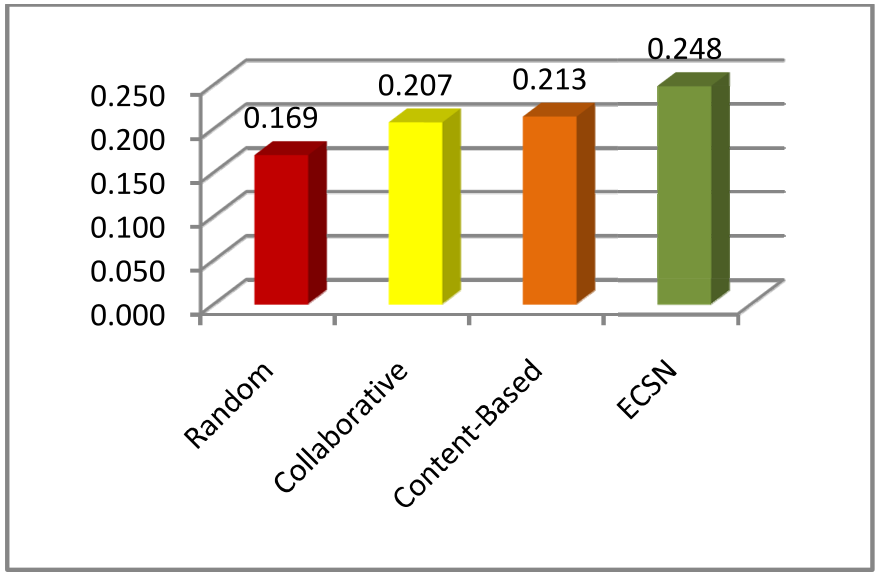 The steady rise in Precision (a) and reduction in Fallout (c) highlights how ECSN refines its understanding of user needs over time.
Critical Insight & Limitations
The beauty of ECSN lies in its simplicity. It uses a Linear Classifier approach to combine social and personal data, making it computationally efficient enough for real-time newsletters.
However, as the authors note, the weights (5 for self, 3 for faculty, 1 for friends) were determined heuristically. Future iterations could use Machine Learning (Neural Networks) to dynamically optimize these weights for every individual. Furthermore, while the tree structure captures hierarchy, it may struggle with "multi-disciplinary" interests that don't fit into a single branch.
Conclusion
This study proves that in specialized domains like academia, "who you know" is almost as important as "what you like." By integrating social computing with content-based filtering, ECSN provides a roadmap for building more human-centric recommendation engines that understand professional context.
Takeaway for Devs: If you're building a niche social platform, don't ignore the organizational structure (companies, schools, departments). It’s the best feature engineering you have for solving the cold-start problem.