
EnSocialMF: Bridging the Sparsity Gap with Multi-Factor Social Interaction
An enhanced social matrix factorization model for recommendation based on social networks using social interaction factors
The paper introduces EnSocialMF, an enhanced social matrix factorization model for personalized recommendations. It fuses trust relationships, interpersonal interest similarities, and item attributes via a unified probabilistic framework, achieving SOTA performance on Epinions and Movielens datasets.
TL;DR
Recommender systems are shifting from simple rating analysis to complex social modeling. EnSocialMF is a sophisticated Matrix Factorization (MF) framework that doesn't just look at "who you know," but "how you interact." By fusing enhanced trust propagation, user interest clusters, and time-sensitive item similarity, it slashes recommendation error (MAE) by up to 12% and handles cold-start users with 30% greater accuracy than traditional methods.
The Problem: When Ratings are Not Enough
Collaborative Filtering (CF) is the backbone of modern commerce, from Amazon to Netflix. But it has a fatal flaw: Data Sparsity. Most users only rate a tiny fraction of available items, making the user-item matrix more than 99% empty. When a new user joins (Cold-Start), the system is blind.
Earlier attempts to solve this used social networks—if I trust you, maybe I'll like what you like. However, these models were often too simplistic. They ignored:
- Indirect Trust: If A trusts B and B trusts C, A likely trusts C.
- Contextual Decay: Your interest in a movie five years ago is less relevant than what you watched yesterday.
- Implicit Circles: Users might not "follow" each other but belong to the same interest cluster.
Methodology: The Three Pillars of Interaction
EnSocialMF solves these by redefining the social relationship as an "Enhanced Social Matrix."
1. Enhanced Social Relationships
Instead of a binary "trust" or "no trust," the model calculates a social relationship degree influenced by:
- Propagation Enhancement: Mathematical transitivity that discovers trust in the network.
- Common Interest Enhancement: Using Gaussian Mixture Models (GMM) to cluster users and strengthen ties between those in the same "interest circle."
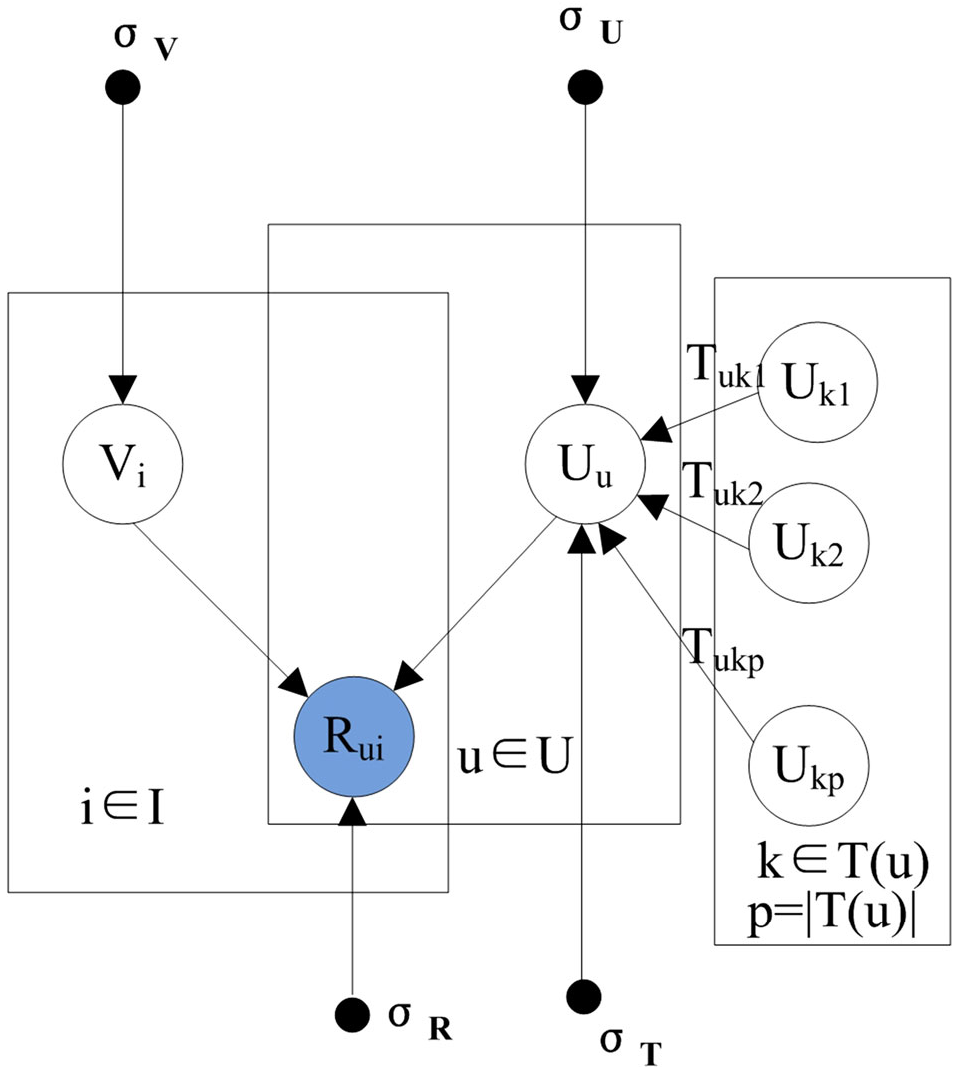 Figure 1: The Probabilistic Graphical Model of EnSocialMF, showing the fusion of Social (S), Interest (Z), and Item (G) factors.
2. Time-Aware Item Similarity
Items aren't static. The authors introduce a Time Decay Factor (). If you rated two items in a very short interval, the similarity between those items is weighted higher than if they were rated years apart. This captures the "burstiness" of user tastes.
3. Social Regularization
The core of the MF optimization includes a regularization term that forces the latent feature vectors of trusted friends to be closer together in the latent space. This "social constraint" guides the model to find better solutions even when ratings are missing.
Experimental Results: Crushing the Cold Start
The model was tested against major baselines (PMF, SoRec, SocialMF, etc.) on Epinions and Movielens.
Key Findings:
- Overall Accuracy: EnSocialMF consistently achieved the lowest MAE and RMSE across all test cases.
- Cold-Start Performance: This is where the model shines. For users with 3 or fewer ratings, EnSocialMF outperformed PMF by over 30% in RMSE.
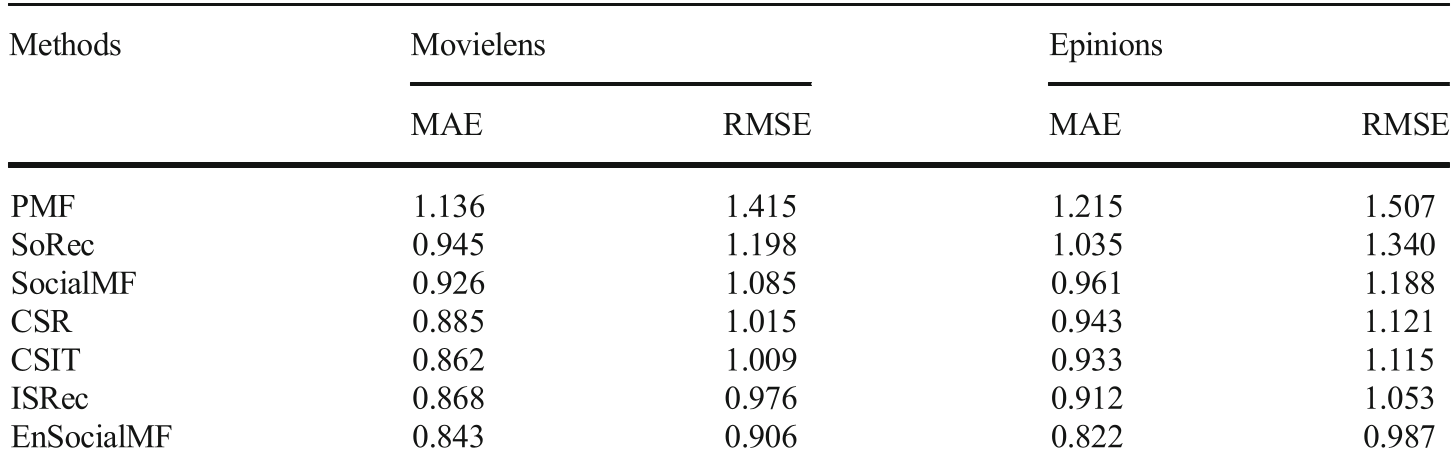 Table 1: Performance comparison on cold-start users, demonstrating the superior robustness of EnSocialMF.
Hyperparameter Sensitivity
The authors found that the dimension of latent features () and the regularization coefficients () follow a "U-shape" curve. Increasing helps capture more nuances up to a point, after which it introduces noise. The optimal was found to be 15 for Movielens and 10 for Epinions.
Critical Insight & Conclusion
The success of EnSocialMF lies in its multi-source fusion. It transitions Matrix Factorization from a 2D problem (User-Item) to a multi-dimensional graph problem.
Limitations: While powerful, the model currently ignores geographical location and user mood, which are increasingly relevant in pervasive computing. Future work will likely involve moving these interaction factors into a Deep Learning or Graph Convolutional Network (GCN) context to model even higher-order non-linear interactions.
Takeaway for Industry: If your recommendation engine is struggling with sparse data, stop looking at ratings alone. Modeling the speed of trust and the decay of time is the key to mastering the cold-start problem.