
Modern Identity Theft: Enhancing and Identifying Cloning Attacks in Social Networks
Enhancing and identifying cloning aacks in online social networks
This paper introduces enhanced cloning attack strategies—Snowball Sampling and Iteration Attack—for Online Social Networks (OSNs) and proposes CloneSpotter, a lightweight server-side detector. The study demonstrates how automated identity theft can be scaled to compromise entire communities, achieving significantly higher success rates than traditional Sybil attacks on the Renren network.
TL;DR
Social media "clones"—fake accounts that mimic real people—are far more dangerous than random bots. This paper from Peking University researchers demonstrates how attackers use Snowball Sampling and Iteration Attacks to systematically infiltrate friend groups. To fight back, they propose CloneSpotter, a system that uses login IP history to catch clones with nearly zero performance overhead.
Background: The Trust Gap in OSNs
When you receive a friend request from a stranger, you likely ignore it. But what if that request comes from someone with the same name, same school, and even the same profile picture as your friend Jack? This is a Cloning Attack.
Traditional Sybil detection (like SybilGuard) assumes fake accounts form isolated "bubbles" in a network. However, cloning attacks break this assumption by "warping" into the middle of trusted communities, making them incredibly difficult for both users and algorithms to catch.
Methodology: Weaponizing Social Circles
The authors identify two key ways to make these attacks more potent:
1. Snowball Sampling
Instead of just targeting one victim's friends, a "Snowball" clone uses every successful connection as a springboard. Once the clone is accepted by 'Alice,' it gains access to Alice's friend list and sends requests to her contacts. To a third party like 'David,' the clone now appears to have mutual friends, drastically increasing the psychological pressure to accept.
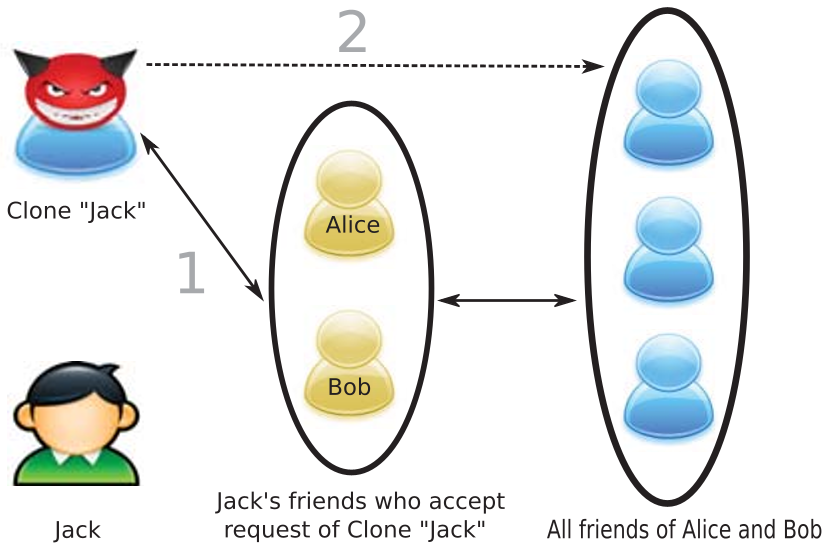
2. Iteration Attack
This strategy focuses on depth. Once a clone gains access to a victim's private profile, the attacker steals even more specific data (private photos, blogs) to create a "Level 3" clone. By repeating this, an attacker can eventually control a fleet of clones that represent an entire social clique, effectively "owning" the community's trust.
Proving the Threat: The Renren Experiment
The researchers tested these patterns on Renren (formerly the "Facebook of China"). They categorized clones into three levels based on profile detail.
| Attack Type | Acceptance Rate (Avg) |
|---|---|
| Traditional (Random Bot) | 11.2% |
| Original Clone (Basic) | 26.2% |
| Enhanced Clone (Snowball) | 52.1% |
The results were startling: Snowball sampling doubled the effectiveness of cloning. Most users accepted the requests simply because the clone appeared to be "engaged" in their network.
Defense: The CloneSpotter Detector
How do we stop a clone that looks exactly like a real user? The authors propose looking at physical evidence rather than visual content.
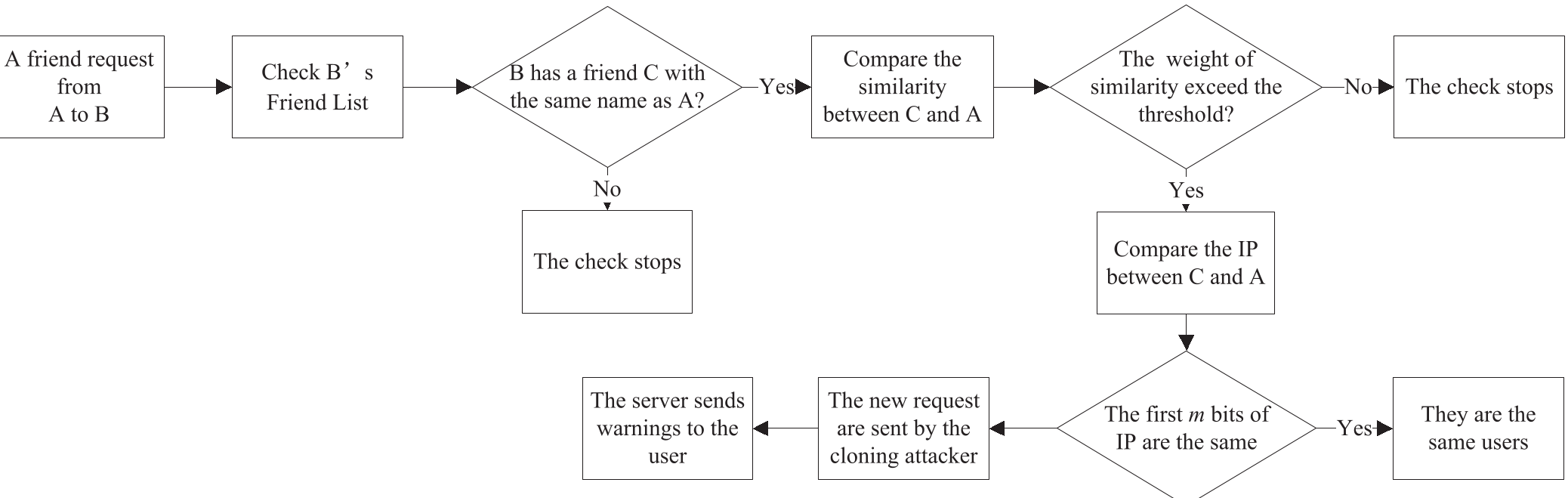
CloneSpotter works on a simple but powerful heuristic:
- Identity Check: If 'User A' asks 'User B' to be friends, the system checks if B already has a friend with A's name.
- Conflict Resolution: If a name match is found, the system compares their profiles.
- The IP Litmus Test: It compares the 16-bit IP prefix history of the two accounts. Since a real user and an attacker are rarely in the same 16-bit IP subnet, a mismatch serves as a "smoking gun."
Critical Insight & Future Outlook
While the paper was published in 2013, its lessons are more relevant today than ever. With modern LLMs (Large Language Models), the "Iteration Attack" described here could be fully automated—generating posts and chatting with victims in the original user's voice.
CloneSpotter provides a brilliant blueprint for lightweight security: instead of expensive AI analysis of every post, it uses metadata (IPs and network paths) to find physical inconsistencies. However, as the authors note, attackers using VPNs or residential proxies can bypass IP checks, suggesting that the next generation of detectors must combine network physics with behavioral biometrics (like typing speed or click patterns).
Conclusion
Cloning attacks don't just steal data; they steal identity and trust. By understanding how these attacks "snowball," platform developers can build faster, more resilient detectors that protect users before the first malicious request is ever accepted.