
Enhancing Online 3D Products: Bridging Text and Geometry via the Crowd
Enhancing online 3D products through crowdsourcing
The paper introduces a framework to enhance e-commerce 3D product pages by establishing semantic links between textual descriptions and specific 3D viewpoints. Using a crowdsourcing approach with the X3DOM framework, the authors generate "recommended views" that automatically orient the 3D model when a user clicks on a product feature.
TL;DR
Navigating 3D product models in a web browser is often more frustrating than helpful. This paper proposes a system that links textual descriptions (e.g., "stabilizer switch") directly to optimized 3D viewpoints. By leveraging crowdsourced user navigation data, the system builds a semantic bridge that makes finding features faster and more accurate, outperforming both static 2D galleries and raw 3D viewers.
Background: The 3D Interaction Gap
As e-commerce shifts toward immersive experiences, 3D models have become more common. However, the "degrees of freedom" problem remains: users often struggle to rotate or zoom into the specific nut, bolt, or button mentioned in a technical manual or marketing blurb. Automated "best view" algorithms exist, but they are often designed for aesthetics—not for functional identification.
Motivation: The Collective Intuition
The authors' core insight is that customers are the best detectors of interesting features. Instead of hiring expensive experts to manually tag every viewpoint for thousands of products, why not record how users naturally seek out information? By analyzing the "traces" of early users (workers), we can distill a "recommended view" for every subsequent visitor.
Methodology: From Traces to Semantics
The researchers developed a web platform using X3DOM, allowing users to interact with 3D objects (like cameras and guitars) without plugins.
1. The Crowdsourcing Pipeline
- Part 1 (Annotation): Users are asked to locate features mentioned in the text and "double-click" the spot on the 3D model.
- Data Aggregation: The system collects world coordinates, camera positions, and normal vectors. It uses the median of these points to find the "common marked-point," making the system robust against outliers or malicious users.
- Part 2 (Evaluation): New users use the generated "recommended views" and rate whether they were helpful.
2. Feature Classification
The system identifies three types of features based on the variance of crowd answers:
- Easy Features: High consensus, low variance (e.g., a coffee machine's steam button).
- Technical Features: High "I don't know" rates; benefited significantly from "Expert" filtering.
- Hard Features: High error rates (e.g., small switches on a complex camera).
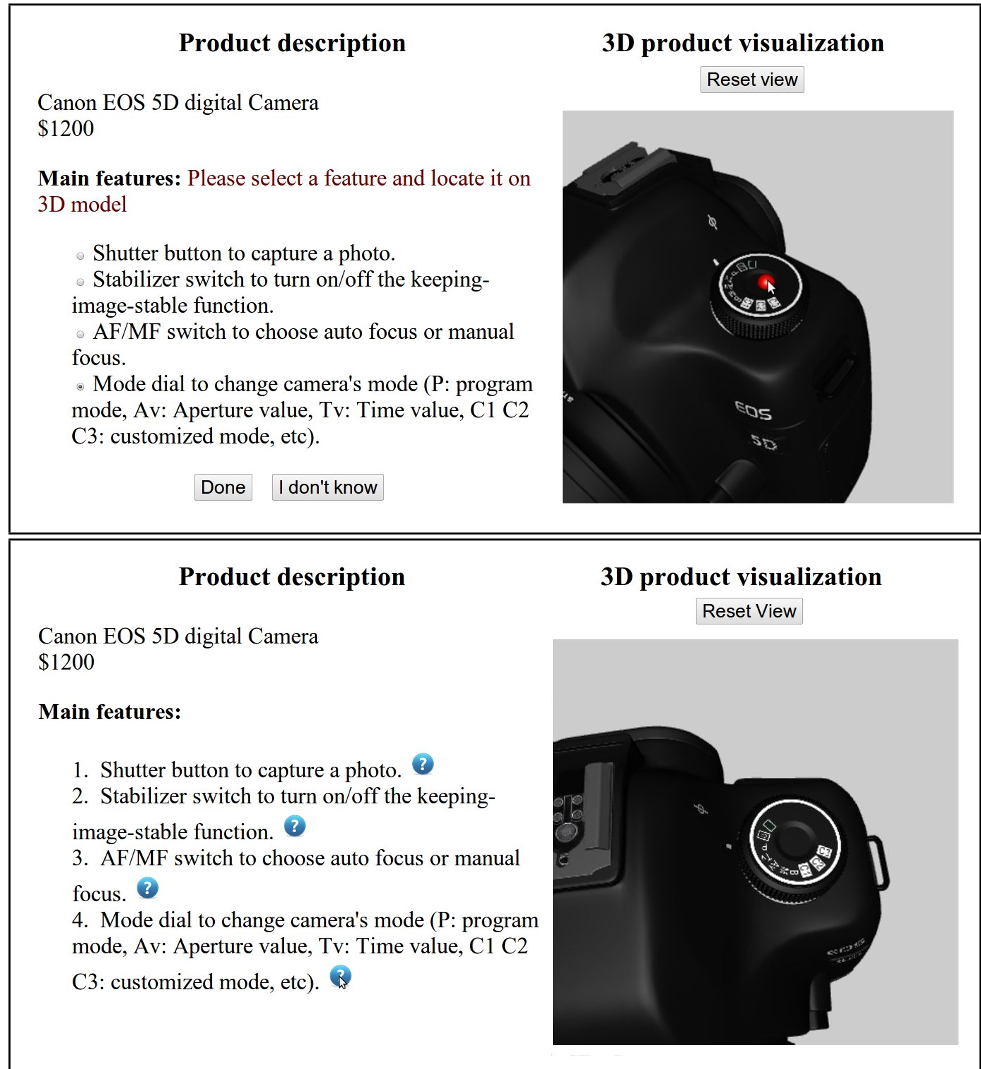 Figure 1: The top section shows the trace collection interface; the bottom shows the final enhanced interface with clickable semantic links (blue bullets).
Experiments & Results: Speed and Accuracy
The study involved 82 participants and 6 diverse 3D models. The quantitative results were striking:
Performance Gains
- Time Savings: Recommended views cut the time-to-locate features significantly across almost all object categories.
- Accuracy: The percentage of "Right" answers increased from 75% to 80% when recommendations were provided.
- The "Helpfulness" Feedback Loop: By showing users how previous users rated a view, "wrong" answers on hard features dropped as users became more cautious of low-confidence recommendations.
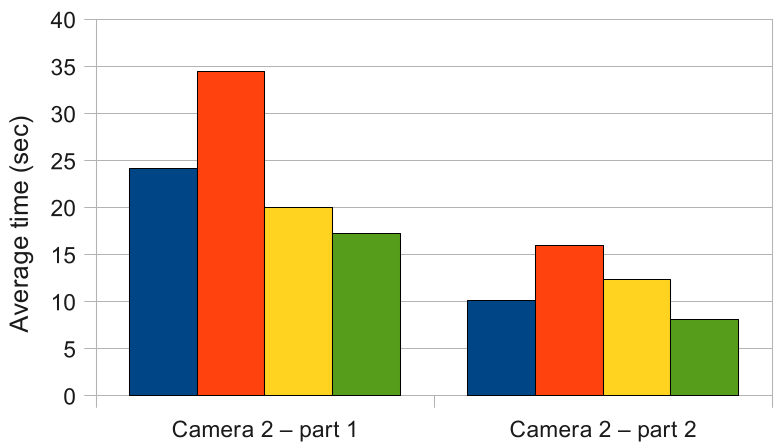 Figure 2: Average time to locate features. In almost every case, the "Recommended" (Part 2/3) approach is faster than the manual search (Part 1).
Critical Analysis & Conclusion
Takeaway
The beauty of this approach lies in its iterative refinement. It treats crowdsourcing not just as a one-time data labeler, but as a continuous feedback loop. By combining implicit clues (answer dispersion) and explicit feedback (helpfulness ratings), the system effectively identifies its own limitations without human oversight.
Limitations & Future Work
The 2012 study was limited by the hardware and browsers of its time. Today, this could be extended using:
- Automated Saliency: Using AI to suggest initial candidates for the crowd to verify.
- Commercial Intent: Ranking features by their influence on purchasing decisions to create an "automated 3D highlights" tour.
Ultimately, this work proves that for complex 3D data, the shortest path to high-quality metadata is through the eyes—and clicks—of the community.