
Enhancing Ontology Alignment: Why "Social" Context is the Key to Semantic Interoperability
Enhancing Ontology Alignment Recommendation by Exploring Emergent Social Networks
The paper introduces the Social Network intermediary (SN-i) for the AEMOS e-commerce platform, which utilizes emergent social network analysis (SNA) to recommend ontology alignments. By capturing implicit relationships between agents, the system significantly improves the accuracy of semantic mapping in automated negotiations.
TL;DR
In the world of automated e-commerce, software agents often "speak" different languages (ontologies). While mapping these languages is standard, current methods are brittle and ignore the human-like nuances of trust and preference. This paper introduces a Social Network intermediary (SN-i) that observes agent behavior to recommend the best linguistic mappings, boosting transaction satisfaction by nearly 45%.
The Problem: When "Mapping" Isn't Enough
In a digital marketplace, a buyer's agent might look for a "Portable Audio Player" while a seller lists an "MP3 Device." Ontology alignment provides the bridge between these terms. However, existing methods in the AEMOS (Agent-based Electronic Market with Ontology Services) platform faced three critical hurdles:
- Semantic Ambiguity: Different tools yield different results; not all "correct" mappings are equal in a specific business context.
- Ignored Preferences: A buyer might care deeply about "Battery Life," but a standard alignment might prioritize "Storage Capacity" simply because the word appears more often.
- No Feedback Loop: Traditional systems don't learn from failed deals caused by poor translations.
Methodology: The Emergent Social Network
The authors suggest that agents don't exist in a vacuum. By analyzing interactions, we can build a Virtual Social Network.
1. Capturing Proximity
The system calculates an agent-to-agent relation (atar) based on:
- Profile Similarity: Do they have similar interests?
- Success Rate (srn): Do they have a history of successful deals?
- Transitive Trust: If Agent A trusts Agent C, and Agent B also trusts Agent C, then A and B are "socially" closer.
2. The Confidence Value (atbc)
When recommending an alignment, the SN-i assigns a confidence score. This isn't just a linguistic check; it's a weighted average of:
- Coverage: Does the alignment include the properties relevant to this specific product?
- Historical Success: How has this specific mapping performed in the past for this pair (or similar pairs) of agents?
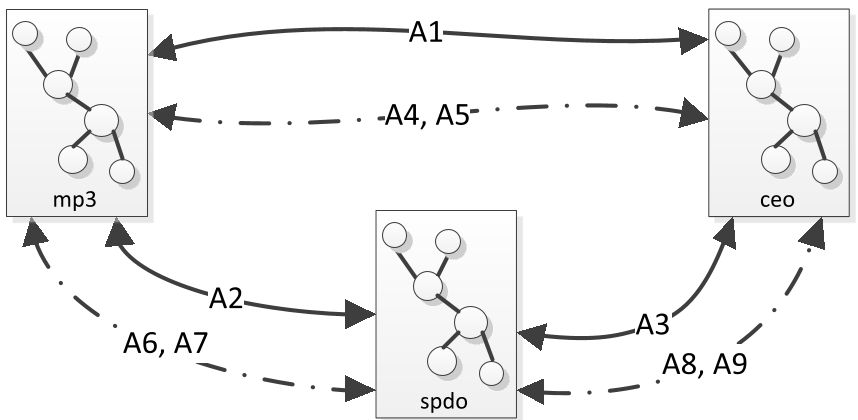 Figure 1: Illustration of the considered alignments and the varying semantic validity between ontologies.
Experiments: Real-World Gains
The researchers simulated a marketplace with 11 agents (7 buyers, 4 sellers) using three distinct ontologies (). They compared a baseline scenario against the new SN-i integrated system.
Key Findings:
- Satisfaction: Deals reached a satisfaction score of 0.961 (out of 1.0) with SN-i, compared to a mediocre 0.67 without it.
- Efficiency: The number of negotiation steps dropped significantly. Without social insights, agents had to negotiate 20% more to overcome communication roadblocks.
- Success Rate: Failed negotiations plummeted by nearly 30%.
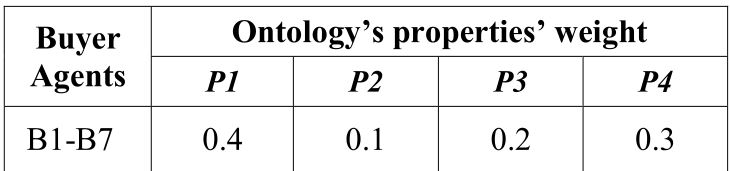 Table 1: Example of property weighting—showing how personalized "relevance" (P1-P4) shifts the value of an alignment.
Critical Insight: Semantic Trust
The brilliance of this work lies in treating Ontology Alignment as a Reputation problem. By observing which "translations" lead to happy customers, the system effectively crowdsources the validation of complex semantic mappings.
Limitations: The model assumes agents are willing to share (parts of) their profiles and outcomes with the intermediary. In highly competitive or private environments, a "Privacy-Preserving" version of this social network would be required to prevent leaking business strategies.
Conclusion
This paper proves that the "Social Web" isn't just for humans. For software agents to truly automate commerce, they need more than dictionaries—they need a sense of community trust and historical context. The SN-i model provides a robust blueprint for making automated negotiations more resilient and human-centric.