
Enhancing Social Matrix Factorization: When Privacy Becomes a Feature for Accuracy
Enhancing social matrix factorization with privacy
This paper introduces a privacy-preserving social collaborative filtering framework that utilizes a dynamic privacy inference model. By integrating probabilistic matrix factorization with an exponential trust-privacy dependency function, the method generates personalized visible rating matrices to provide recommendations while respecting user privacy.
TL;DR
This research tackles the "Privacy-Utility" trade-off in social recommender systems. Instead of treating privacy as a barrier to accuracy, the authors propose a Dynamic Privacy Inference Model. By linking profile visibility to a trust-based exponential function, the system creates a personalized view of the network that actually reduces prediction error (MAE) by filtering out noise from untrusted or dissimilar users.
Background & Motivation: The Privacy Dilemma
In the era of socialized web services, recommendation engines rely heavily on user profiles and social trust. However, two major hurdles persist:
- Trust Sparsity: Most users have very few explicit trust links.
- Privacy Concerns: Users are reluctant to share their entire rating history with the public or even "friends of friends."
Prior works like SoRec attempted to solve sparsity using Matrix Factorization but often treated privacy as a binary or static setting. The authors of this paper argue that privacy should be dyanamic and proportional to trust.
Methodology: The Trust-Privacy Dependency
The core innovation lies in the Secondary Privacy Inference. The process follows these steps:
- Joint Matrix Factorization: Simultaneously factorize the rating matrix and the social trust matrix to fill in missing gaps (solving the sparsity problem).
- Exponential Mapping: Use a mathematical function to map the inferred trust () to a privacy coefficient ().
The Core Formula:
The relationship is defined by:
This ensures that:
- If trust is higher than a threshold (), privacy decreases (more data shared).
- If trust is lower than the threshold, privacy increases (more data hidden).
 Note: The framework integrates social trust and ratings into a unified factorization space before applying the privacy barrier.
Empirical Evaluation
The authors tested their approach on the Epinions dataset, comparing it against the Resnick algorithm and standard Social Matrix Factorization.
Key Findings:
- Accuracy Paradox: Lowering the amount of available data (due to privacy) actually improved the MAE. This is because the privacy model acts as a "relevance filter," only allowing ratings from highly trusted (and likely similar) users to influence the recommendation.
- Coverage: The method maintains competitive coverage even when strict privacy settings are applied.
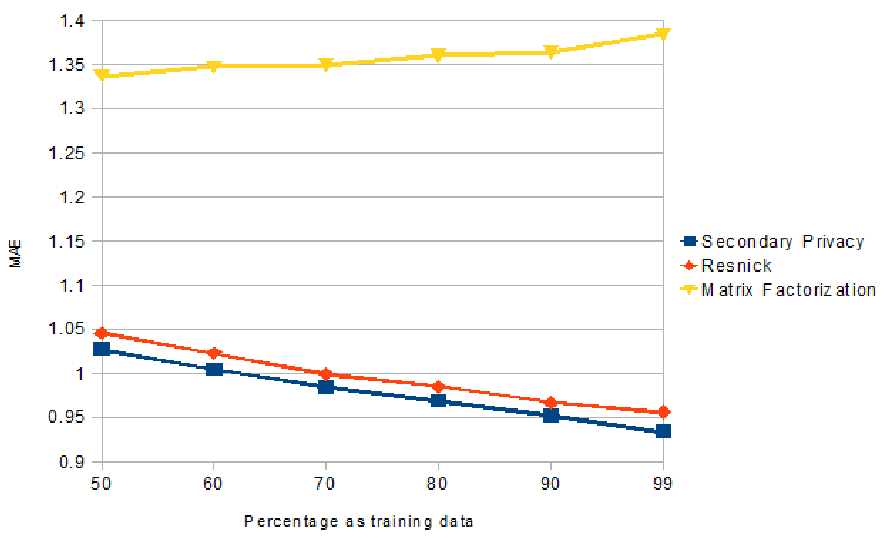 Figure 1: MAE Comparison. The Secondary Privacy method (proposed) consistently achieves lower error rates as the training dataset size increases.
Critical Analysis & Conclusion
Takeaway
The genius of this paper is the insight that Privacy is an Inductive Bias. By restricting information flow based on trust, the model focuses on higher-quality signals. This challenges the common assumption that "more data is always better" in Collaborative Filtering.
Limitations
- Cold Start: The model still relies on an initial trust matrix. In extremely sparse social networks, the "inferred trust" might still be unreliable.
- Computation: Creating a "personalized view" of the rating matrix for every user-pair could be computationally expensive at the scale of modern social networks (e.g., Facebook or X).
Future Outlook
As privacy regulations (like GDPR) tighten, this type of Privacy-by-Design architecture that aligns user incentives (better recommendations) with data protection will likely become the industry standard for decentralized or social-based AI agents.