
Beyond the Echo Chamber: Enhancing Social Networks by Recommending Weak Ties
Enhancing structural diversity in social networks by recommending weak ties
The paper introduces a novel framework for contact recommendation in social networks that prioritizes structural diversity over simple accuracy. By proposing the Community Edge Gini Complement (CEGC) metric and a greedy reranking algorithm, the authors demonstrate that recommending "weak ties" across different communities significantly enhances the diversity and novelty of information flow.
TL;DR
Most social network recommenders act like "more of the same" machines, suggesting friends of friends and strengthening existing clusters. This paper challenges that status quo by arguing that Weak Ties—connections that bridge disparate social communities—are vital for a healthy network. The authors propose new metrics to measure this structural diversity and prove that recommending these ties breaks "filter bubbles" and injects fresh, novel information into a user's feed.
Background: The Trap of Accuracy
In the world of Recommender Systems (RecSys), "Accuracy" is king. If a system predicts a link that eventually happens, it wins. However, in social networks, this often encourages Triadic Closure (if A knows B and B knows C, A should know C). While accurate, this makes the network denser and more redundant. We end up seeing the same news, the same opinions, and the same people.
The authors argue that we should treat contact recommendation as an opportunity to steer the global properties of a network. Instead of just making the network "thicker," we should make it "broader."
The Core Insight: Not All Weak Ties are Created Equal
Drawing from Mark Granovetter’s seminal work on "the strength of weak ties," the authors look at links that cross modular communities. However, they take it a step further. Simply crossing a community isn't enough; if all your "weak ties" go to the same outside group, you've just built a redundant bridge.
Introducing CEGC (Community Edge Gini Complement)
The paper proposes the Community Edge Gini Complement (CEGC). This metric doesn't just count links between communities; it uses the Gini Index—a measure of inequality—to ensure that recommendations are spread across many different communities.
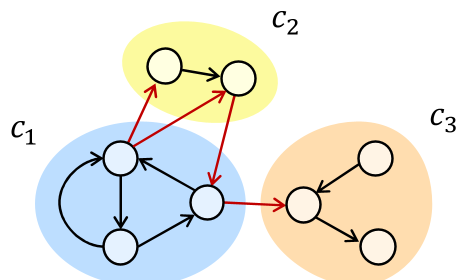 Figure 1: Illustration of diverse vs. redundant weak ties. High CEGC requires links to be spread across multiple diverse clusters.
Methodology: Reranking for Diversity
The authors don't just invent a new algorithm from scratch. Instead, they take high-performing models like Implicit Matrix Factorization (IMF) and apply a Global Greedy Reranking process.
By using a parameter , they can tune the trade-off. At , the system provides the most accurate (but redundant) links. As increases, the system sacrifices some accuracy to boost the CEGC or other structural diversity metrics.
(Note: Refer to Algorithm 1 in the paper for the exact iterative swap logic)
Experimental Battleground: Twitter Data
Using real-world Twitter interaction data, the authors tested various algorithms including SALSA (used by Twitter's 'Who To Follow'), Adamic-Adar, and Jaccard.
Key Findings:
- Neighborhood-based methods (Jaccard, MCN) are the enemies of diversity. They literally look for common neighbors, which maximize triadic closure.
- SALSA and Matrix Factorization are naturally better at structural diversity than neighborhood methods, but still benefit significantly from reranking.
- The Diversity-Accuracy Tradeoff: There is a clear "cost" to diversity. To get a more diverse network, you must accept a lower Precision@10.
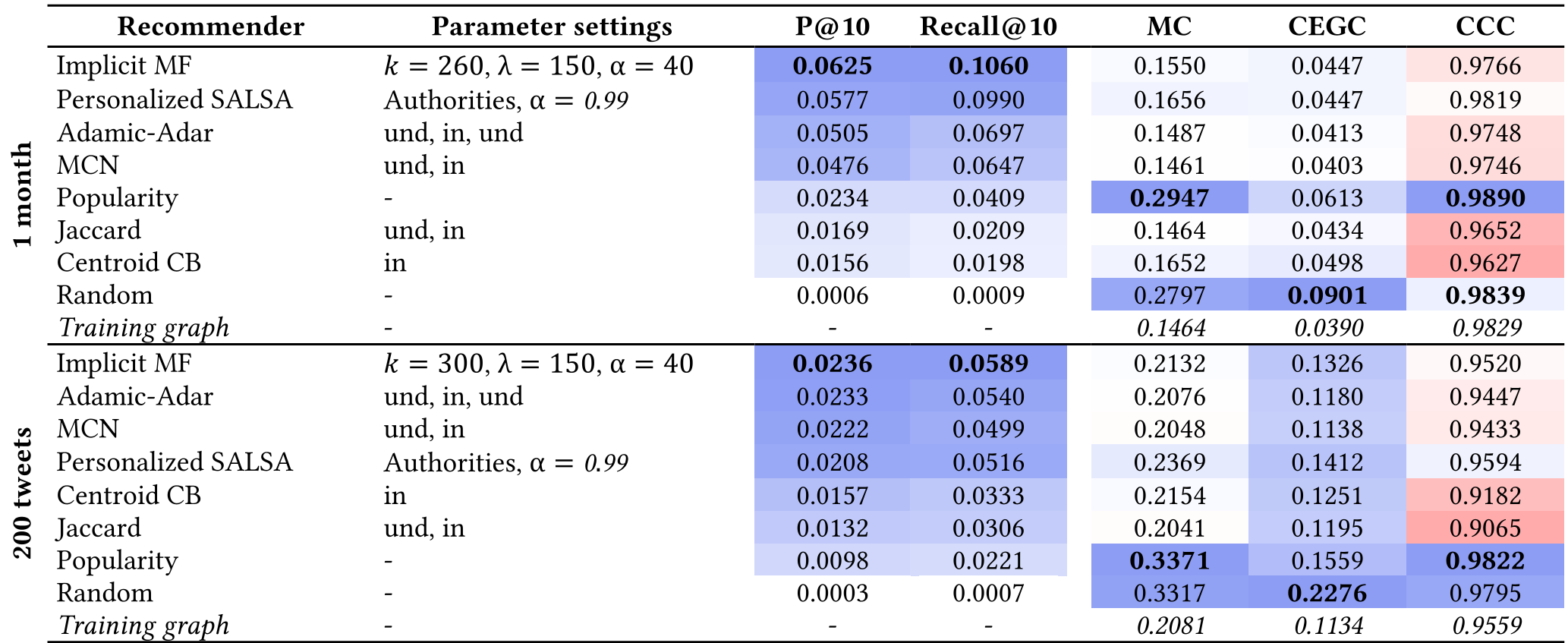
Real-World Impact: Breaking the Filter Bubble
The most striking part of this research is the simulation of Information Flow. By simulating how hashtags spread across the modified networks, the authors found that:
- Higher CEGC = Higher Novelty: Users were exposed to hashtags they had never used before.
- Better Distribution: Information wasn't just spreading faster; it was spreading to a more diverse set of people.
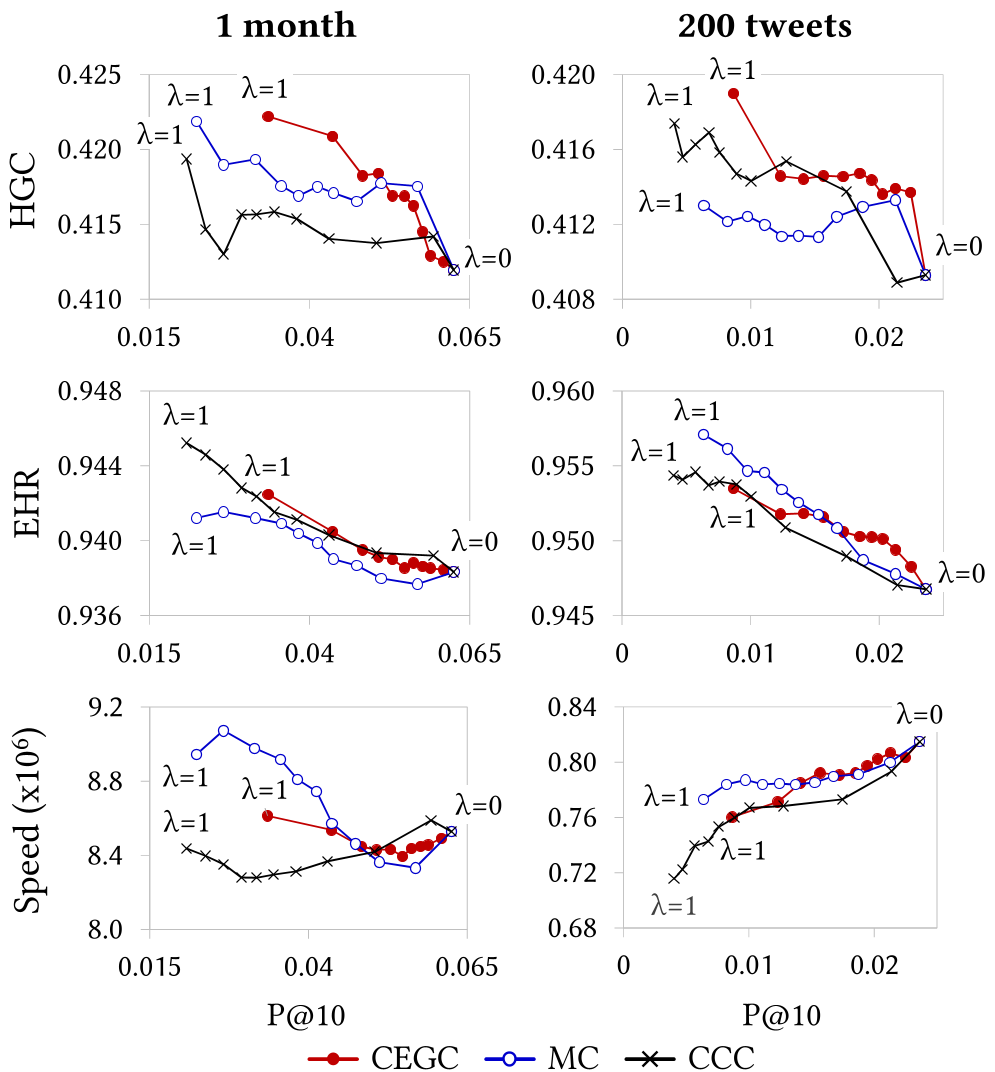 Figure 4: The correlation between structural diversity (X-axis) and the novelty/diversity of information spread (Y-axis).
Critical Insight & Conclusion
This paper provides a mathematical bridge between Social Network Analysis (SNA) and Recommender Systems. It reminds us that "Accuracy" is a narrow lens. If our algorithms only recommend what is "obvious," they fail to provide the "serendipity" that makes social networks valuable for discovery and professional growth.
Future Outlook: As platforms face increasing pressure to handle Echo Chambers and Polarization, the metrics proposed here (like CEGC) could become standard KPIs for social algorithms, moving beyond click-through rates to "network health" scores.