
Beyond Single Classifiers: Boosting Emotion Recognition with Ensemble Learning
Exploiting the Use of Ensemble Classifiers to Enhance the Precision of User's Emotion Classification
This paper presents a functional Ensemble Classification (EC) model designed to enhance the accuracy of user emotion recognition based on facial motor expressions. By combining specialized classifiers like kNN, SVM, and Decision Trees via a weighted voting mechanism, the model achieves a median accuracy of 75.0%, significantly outperforming standalone classification methods.
TL;DR
Recognizing human emotion through a camera lens is a cornerstone of next-generation Human-Computer Interaction (HCI). This paper proposes a weighted Ensemble Classification (EC) framework that aggregates multiple machine learning models to interpret facial motor expressions. By combining the strengths of SVM, kNN, and Decision Trees, the authors achieved a 75% median accuracy, proving that the "wisdom of the crowd" in algorithms significantly reduces error rates in affective computing.
Background: Why Single Models Struggle with Feeling
Emotions are not just subjective feelings; they are physiological and motor-expressive events. While individual classifiers like Support Vector Machines (SVM) are powerful, they often have a specific inductive bias that makes them prone to coincident failures. In the task of emotion recognition—where a "sad" face and a "neutral" face might share high geometric similarity—a single model often lacks the generalization power to distinguish subtle nuances.
The authors' core insight is that by using an Ensemble approach, the specific errors made by one classifier (e.g., a Naive Bayes model misidentifying sadness) can be corrected by others, provided the classifiers are sufficiently diverse.
Methodology: The Architecture of Affect
The proposed system follows a two-stage pipeline: Facial Mapping and Ensemble Selection.
1. Geometric Feature Extraction
Using the FaceTracker framework, the system identifies 66 landmark points on the user's face. To optimize for mobile performance, the authors reduced this to 33 core points focusing on the mouth, eyes, eyebrows, and nostrils.
- Dimensionality: By calculating distances and angles between all possible point combinations, they created a feature vector with 1130 dimensions.
- Visual Logic: This replicates how humans perceive expressions—by the curve of a lip or the narrowing of an eye.
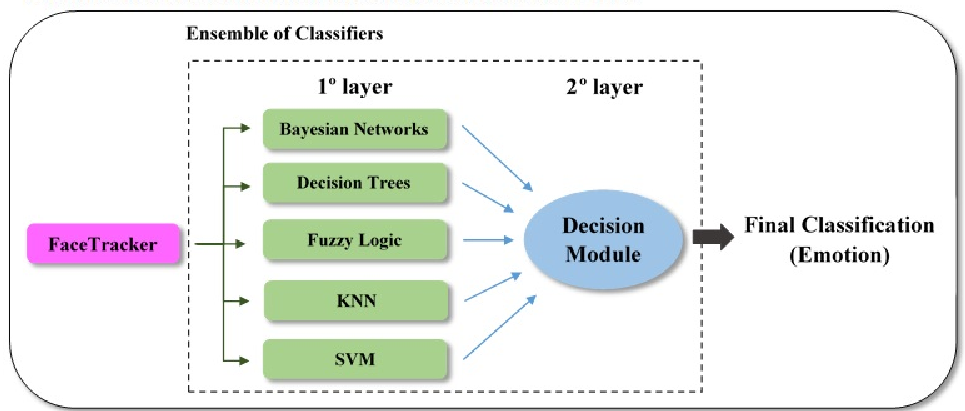 Figure 3: The multi-layered architecture where facial features flow into parallel classifiers before being weighted for a final decision.
2. Weighted Voting Mechanism
Unlike a simple majority vote, this model uses a normalized weighting procedure. Each classifier's vote is scaled by its historical accuracy (AR):
This ensures that more "reliable" models have a louder voice in the final decision.
Experiments and Results
The model was validated using the Radboud Faces (RaFD) and Extended Cohn-Kanade (CK+) datasets, totaling 720 balanced images.
Performance Gains
The results were conclusive: the Ensemble approach achieved higher median accuracy and, crucially, lower dispersal (variance) than any single model.
- SVM Performance: 0.680 Median Accuracy
- Ensemble Performance: 0.750 Median Accuracy
- Statistical Significance: Wilcoxon Rank Sum Tests confirmed that the Ensemble provided a statistically significant improvement over almost all individual baselines.
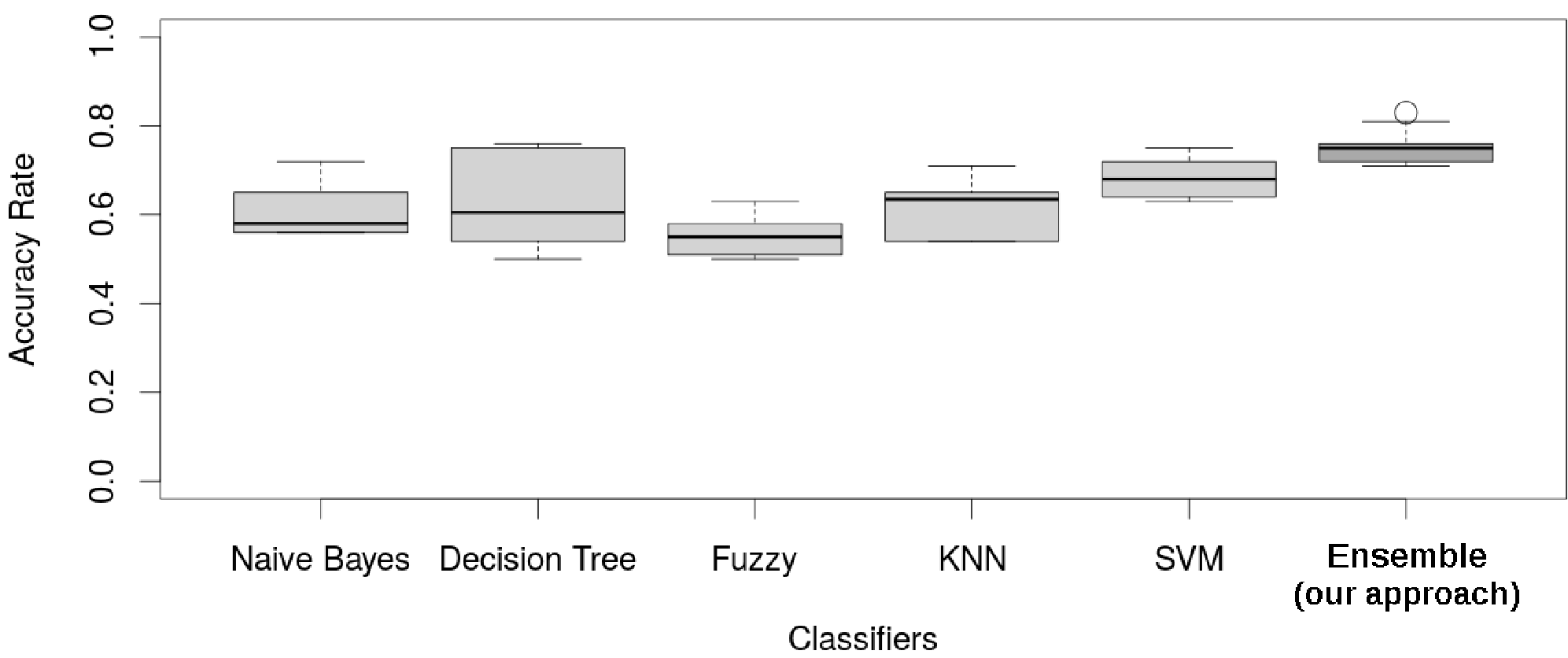 Figure 4: The darker boxplot represents the Ensemble model, showing both higher accuracy and tighter stability.
The "Happy" Advantage
The error matrix reveals that certain emotions are much easier to classify. "Happy" and "Surprise" reached near-perfect True Positive rates (0.983 and 0.908 respectively), likely due to the distinct muscular movements (wide mouth, raised eyebrows) associated with these states. Conversely, "Sad" and "Neutral" remained the most challenging, often blurring into one another.
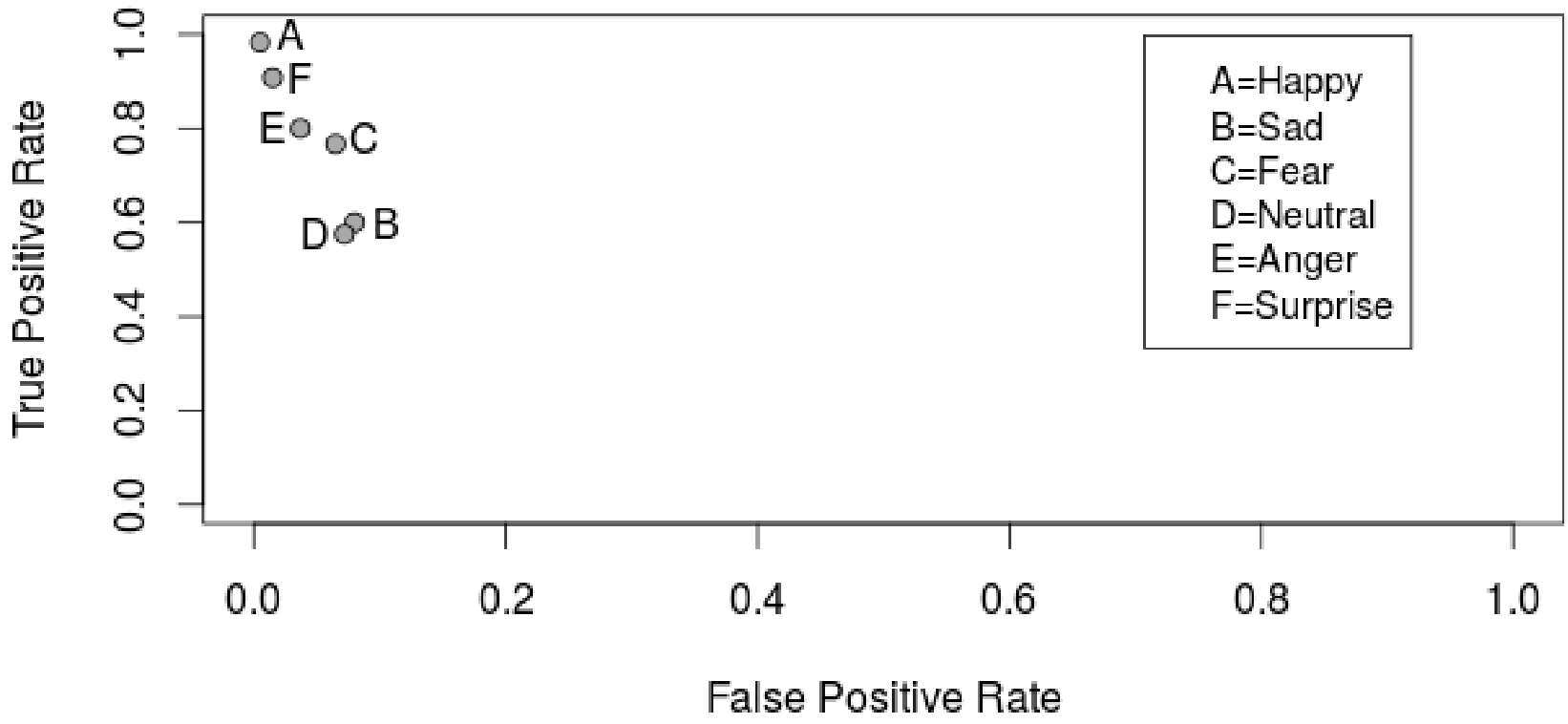 Figure 5: ROC curves for specific emotions; notice the extreme top-left performance for "Happy".
Critical Insight & Outlook
The value of this work lies in its pragmatic scalability. By focusing on geometric distances rather than raw pixel data (common in later Deep Learning approaches), the authors proposed a method that stands the test of computational efficiency for 2015-era mobile devices.
Takeaway: If you are building an affective system, don't hunt for the "perfect" classifier. Instead, build a diverse committee of learners. The future of HCI lies in systems that don't just see a face, but understand the multi-faceted nature of the expression through a consensus of models.