
Ensemble Learning for Disaster Response: Detecting Situational Awareness in the Barbados Water Crisis
An Ensemble Learning for Detecting Situational Awareness Tweets during Environmental Hazards
This paper introduces a two-stage ensemble learning framework to identify Situational Awareness (SA) tweets during environmental hazards, specifically focusing on the 2014-2018 Barbados water and sewage crisis. By combining traditional TF-IDF features with psychometric and linguistic variables, the Random Forest model achieved a peak accuracy of 85.13%.
TL;DR
In the wake of environmental hazards, social media becomes a lifeline for information. This paper details a machine learning framework designed to filter out the noise of Twitter and extract "Situational Awareness" (SA) — tweets that report facts, request aid, or provide actionable updates. By utilizing an ensemble learning approach and multi-dimensional text features (TF-IDF, Psychometric, and Linguistic), the researchers achieved an 85.13% accuracy in identifying critical information during the Barbados sewage and water crises.
Problem & Motivation: The Signal-to-Noise Challenge
During a crisis, emergency responders face an "information overload" paradox. While platforms like Twitter provide real-time data, only a tiny fraction of posts contribute to actual Situational Awareness. Most tweets are either expressions of sympathy, personal opinions, or irrelevant chatter.
The authors observed that existing methods often treat tweets purely as bags-of-words (TF-IDF), ignoring the psychometric (emotional/cognitive) and linguistic (formal vs. informal) patterns that distinguish an eye-witness report from a casual comment. The challenge lies in high-dimensional feature spaces where redundant data can actually degrade model performance.
Methodology: A Two-Stage Framework
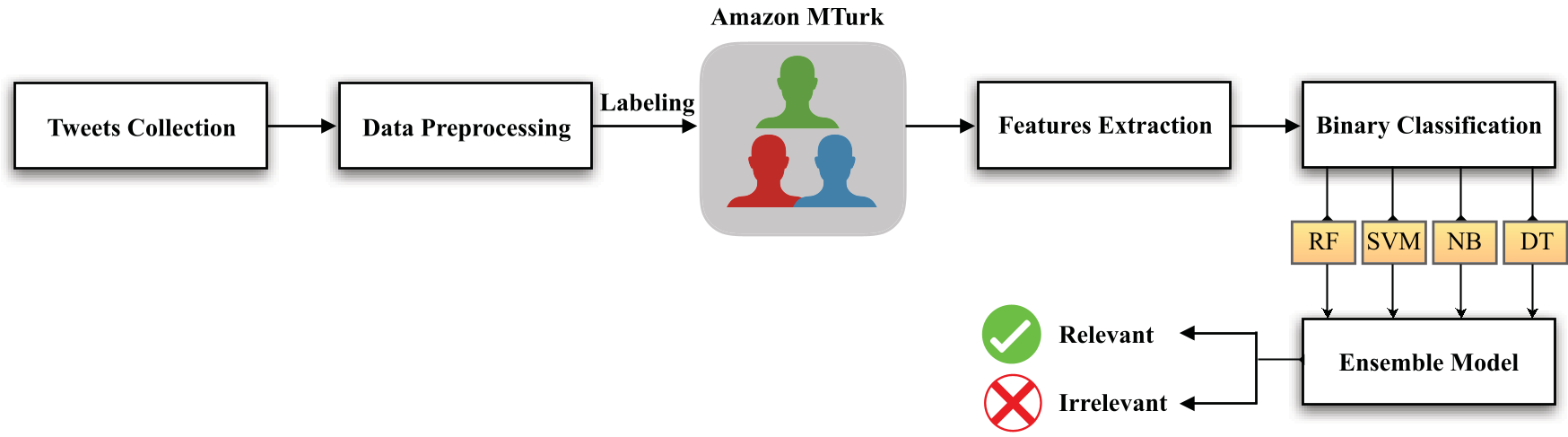
The core of this research is a two-stage classification pipeline that treats different "perspectives" of a tweet—its frequency, its psychology, and its grammar—as distinct inputs.
1. Multi-Dimensional Feature Extraction
Instead of relying solely on keywords, the study extracts:
- TF-IDF: Capturing the statistical weight of crisis-specific terms.
- Psychometric Features (via LIWC): Measuring drives, needs, and biological processes (e.g., words related to "health" or "risk").
- Linguistic Features: Analyzing "Clout," "Authenticity," and "Analytical Thinking" to see if the user is speaking as an expert or an affected individual.
2. The Ensemble Mechanism
The researchers hypothesized that combining the predictions of models is better than combining the features themselves. They used Majority Voting:
- Three classifiers (e.g., Random Forest) are trained on the three different feature sets.
- The final decision is made by an agreement of at least two out of three models.
Experiments & Results: The Power of Ensembles
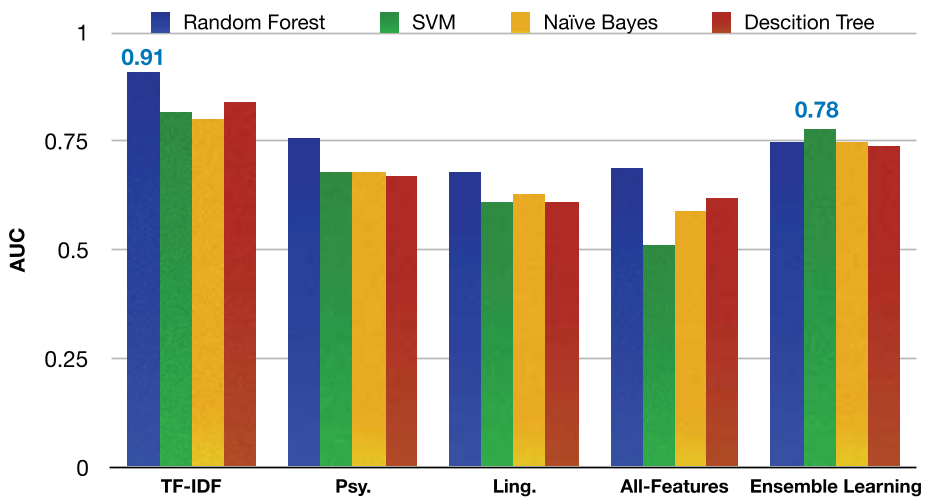
The study utilized a manually labeled dataset of 4,000 tweets related to the Barbados water crisis. The results revealed a significant insight regarding feature engineering:
- The Winner: Random Forest (RF) on TF-IDF features reached the highest accuracy of 85.13%.
- The Ensemble Advantage: The Ensemble approach achieved 79.5% accuracy, significantly outperforming the "All-Features" model (which crashed to 49.88%).
- Why did concatenated features fail? The authors noted that "All-Features" models suffered from redundancy. When you simply stack TF-IDF, psychometric, and linguistic vectors together, the noise increases, and the feature selector struggles to find the true signal.
Critical Analysis & Conclusion
Takeaway
This work demonstrates that Situational Awareness is not just about what words are used (TF-IDF) but how they are used (Psychometrics/Linguistics). However, the statistical power of N-grams (TF-IDF) remains a formidable baseline that is hard to beat even with complex behavioral features.
Limitations
- Labeling Quality: Using Amazon Mechanical Turk for labeling can introduce noise compared to hiring domain experts in environmental health.
- Geographic Specificity: The model was tuned for Barbados; its generalizability to other regions with different dialects or social media habits remains to be tested.
Future Work
The authors suggest moving toward Deep Learning and incorporating Twitter-specific metadata (retweets, mentions) to further refine the detection of "viral" situational awareness. Building a specialized disaster lexicon is also a key next step to bridge the gap between academic linguistic tools and real-world hazard reporting.