
Late-BMA: Elevating Image Emotion Recognition through Multimodal Ensemble Learning
Ensemble learning on visual and textual data for social image emotion classification
This paper presents a multimodal ensemble learning framework for image emotion classification across eight distinct categories (amusement, awe, contentment, excitement, anger, disgust, fear, and sadness). The authors propose Late-BMA and Early-BMA, which utilize Bayesian Model Averaging to combine visual (hand-crafted and deep CNN features) and textual data, achieving a new SOTA accuracy of 76% on a large-scale social media dataset.
TL;DR
Recognizing emotions in social media images is a notorious challenge due to the high subjectivity of human feelings. This paper introduces a robust ensemble approach called Late-BMA (Bayesian Model Averaging), which fuses deep visual features with associated textual metadata. By smartly weighting the reliability of individual classifiers, the authors achieved a 76% accuracy on a large-scale dataset, crushing the previous SOTA of 65%.
Problem & Motivation: The Affective Gap
Why is it so hard for AI to tell if a photo is "sad" or "contented"?
- The Affective Gap: There is no simple mathematical relationship between low-level pixels (colors, edges) and complex psychological states.
- Subjectivity: One person’s "awe" might be another’s "fear."
- Context Failure: Visuals alone can be misleading. A dark, low-contrast image might look sad, but the user's caption "Late night fun!" explicitly signals amusement.
Previous works mostly focused on visual features alone, ignoring the goldmine of textual descriptions available on social networks.
Methodology: The Power of Ensemble and Fusion
The researchers didn't just pick one "best" model; they built a committee. They utilized five core classifiers: Naive Bayes, Bayesian Networks, KNN, Decision Trees, and SVM.
1. Bayesian Model Averaging (BMA)
The core innovation is how these voices are combined. Unlike "Simple Voting," where everyone gets one equal vote, BMA weights each model based on its reliability. The authors introduced a Sigmoid-AUC weighting mechanism: Using the Area Under the Curve (AUC) in the weighting function makes the system resilient to imbalanced data (e.g., since "sadness" is rarer than "amusement" on social media).
2. High-Level Fusion Schemes
- Early-BMA: Features from text and images are glued together (concatenated) before being fed into the models.
- Late-BMA: Each model looks at images and text separately, then their independent decisions are fused at the end.
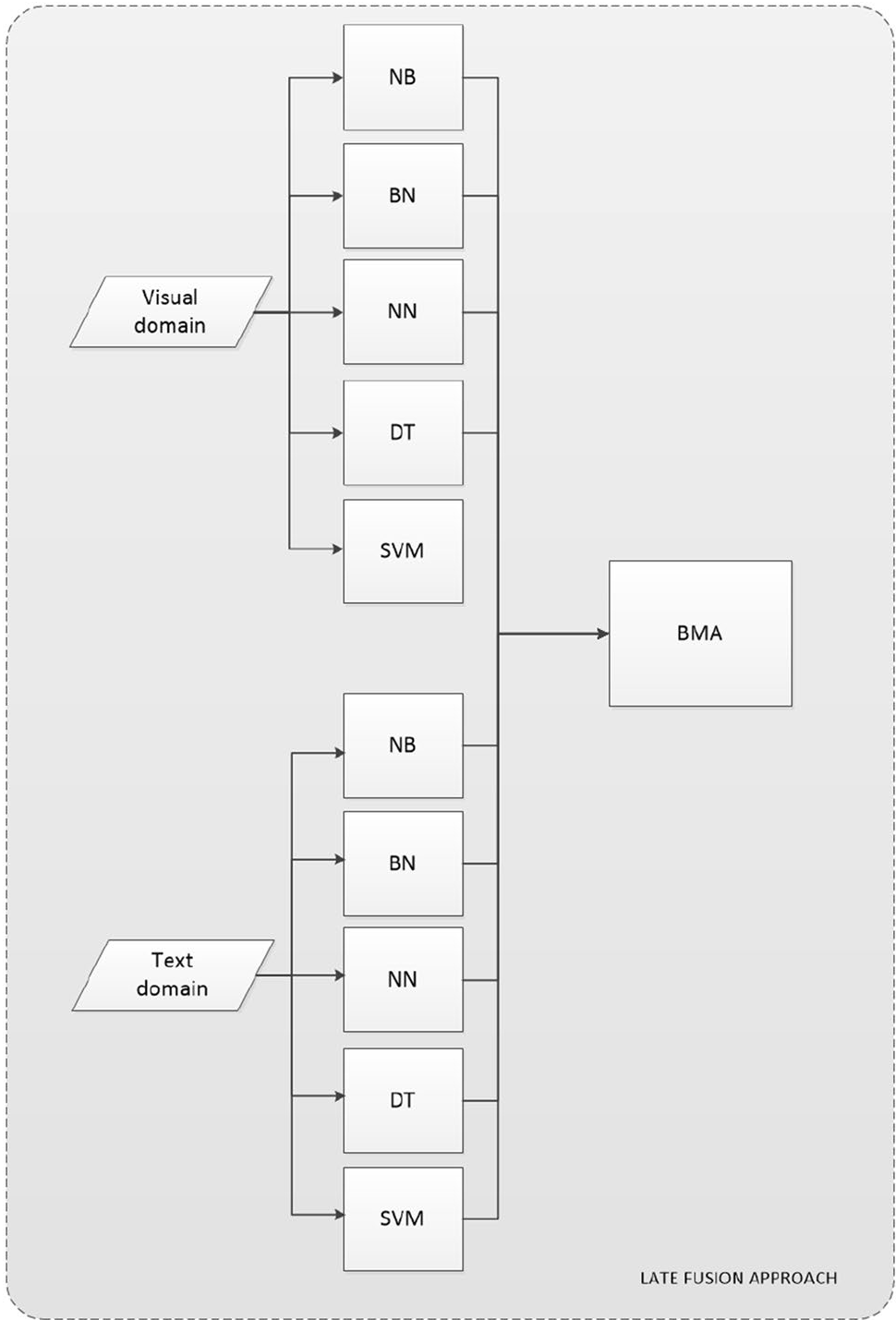 Figure: The BMA Late Fusion architecture showing the integration of unimodal classifiers.
Experiments & Results
The authors tested two types of visual features: Hand-crafted (color, texture) and Deep Features (AlexNet L7).
Key Findings:
- Deep over Hand-crafted: CNN-based features provided a ~10% accuracy boost across the board.
- Late Fusion Wins: Late-BMA consistently beat Early-BMA. This is because late fusion allows each modality (text vs. image) to use its own best-tuned model structure without muddling the feature space.
- SOTA Breakthrough: Compared to existing deep learning models, Late-BMA jumped the accuracy from 65.2% to 76%.
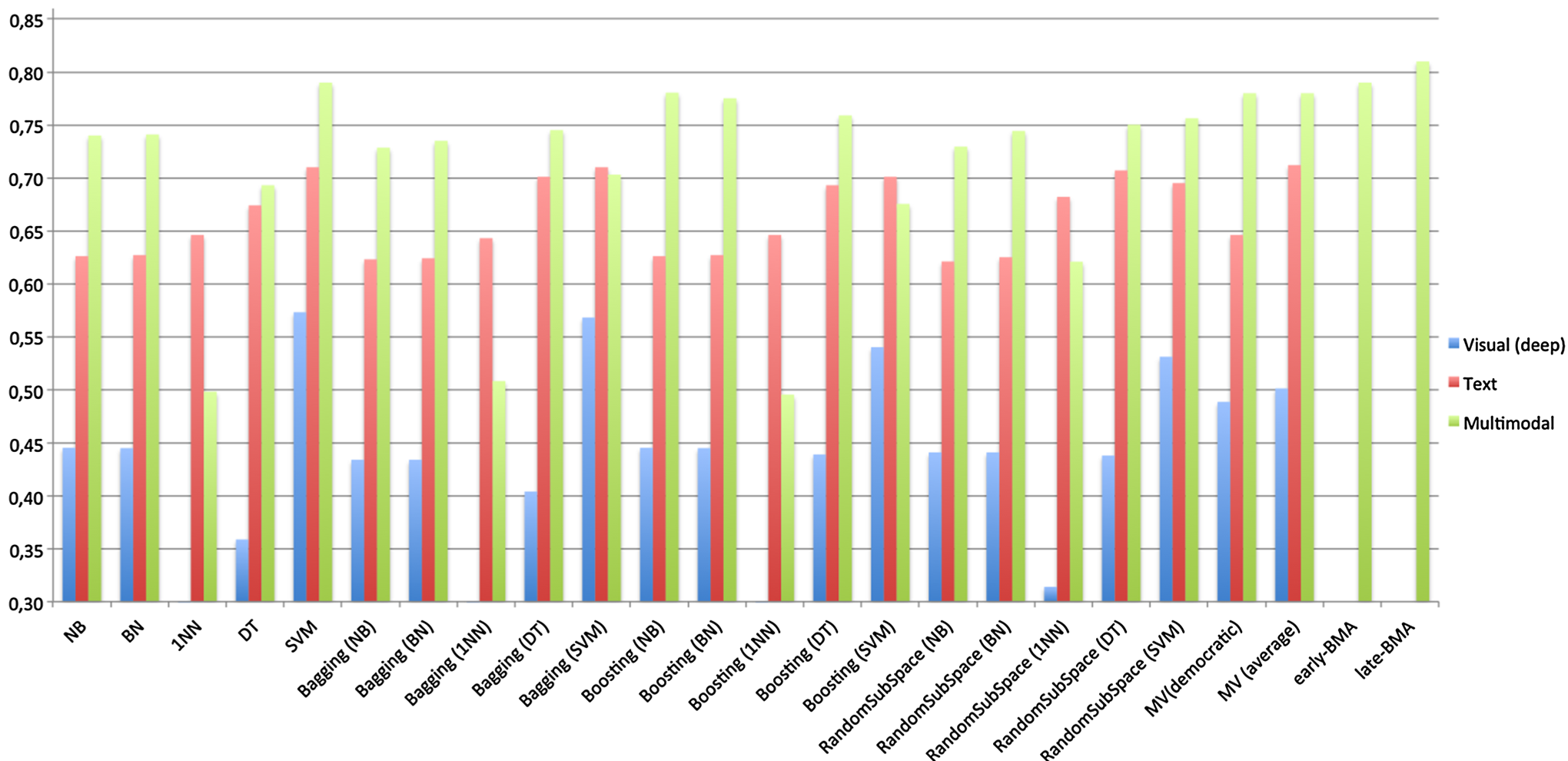 Figure: Performance comparison across different modalities. Note how multimodal approaches consistently outperform unimodal ones.
Error Analysis
The confusion matrix reveals that "Positive" emotions (Amusement, Contentment) are much easier for the AI to identify than "Negative" ones (Anger, Fear). This is largely due to the "Social Media Bias"—people post far more happy content, creating a data scarcity for negative emotions.
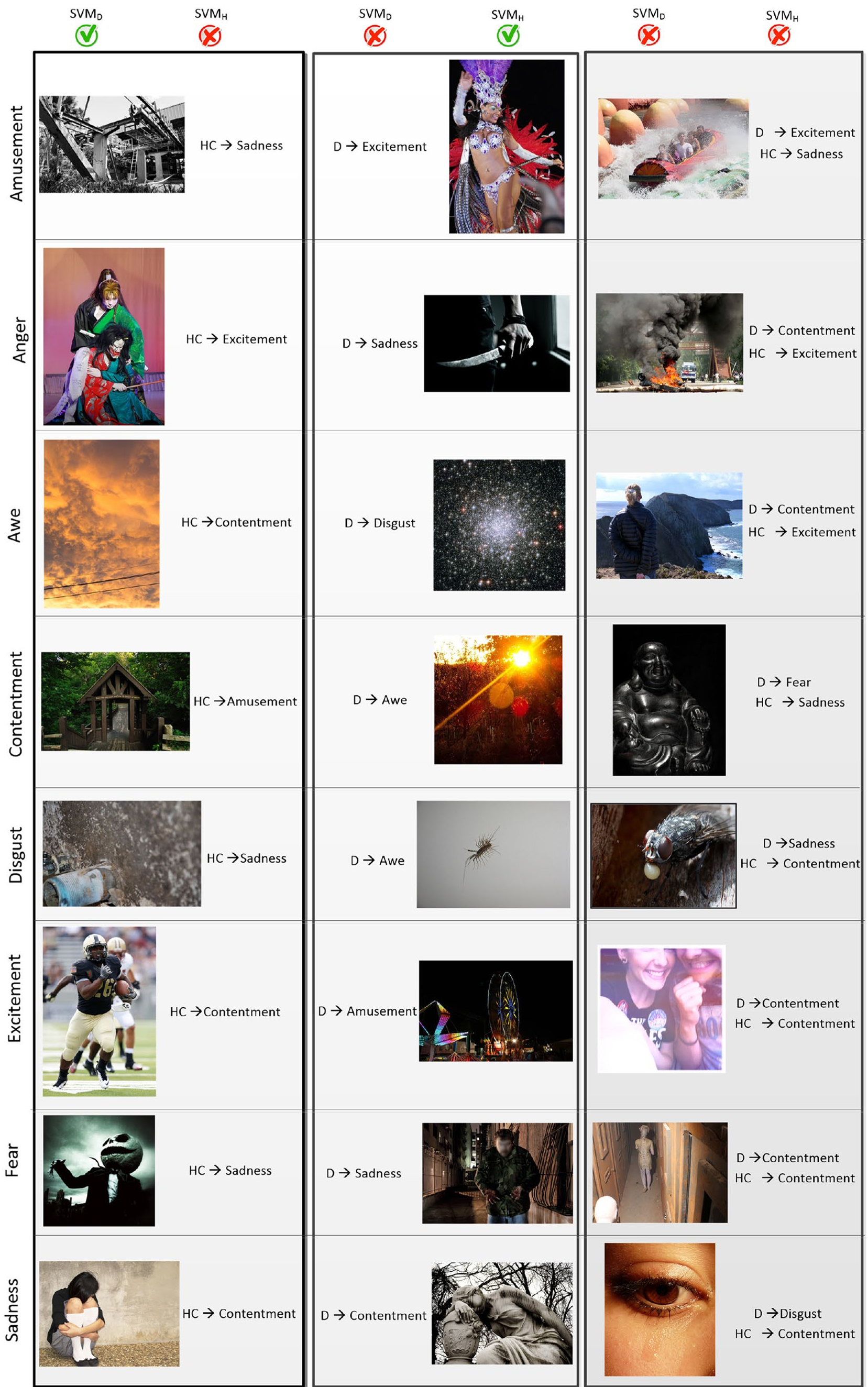 Figure: Misclassification examples. Grayscale images are often mistakenly labeled as 'Sadness' by hand-crafted features.
Critical Analysis & Conclusion
Takeaway: This paper proves that for "subjective" classification tasks, context is king. Text provides the semantic anchor that pixels often lack.
Limitations:
- The study used AlexNet (already dated by modern standards). Swapping this for a Vision Transformer (ViT) would likely yield even higher gains.
- The text processing was limited to unigrams. Modern LLM embeddings (like BERT or GPT) could capture much deeper sentiment nuances.
Future Outlook: The success of Late-BMA suggests that future emotion-aware AI—like those used in personalized mental health apps or empathetic recommendation engines—must be multimodal by design.