
Enterprise Crowdsourcing: Turning the "Bench" into a Competitive Advantage
Enterprise Crowdsourcing Solution for Software Development in an Outsourcing Organization
The paper proposes an "Enterprise Crowdsourcing Solution" designed for large IT outsourcing organizations like Tata Consultancy Services (TCS). It introduces a structured platform featuring a job marketplace, reputation mechanisms, and automated workflows to mobilize untapped human capital—such as trainees and unallocated staff—for software development tasks.
TL;DR
This paper introduces a specialized crowdsourcing framework designed for massive IT outsourcing organizations (starting with TCS). By creating an internal marketplace for software tasks, the system allows unallocated employees ("the bench") and trainees to contribute to high-priority projects, bypassing the friction of traditional HR resource allocation.
Background & Motivation: The Latent Resource Problem
In the world of IT outsourcing, "bench strength"—the pool of employees between projects—is both a necessity and a cost center. Large firms like TCS, with over 200,000 employees, often struggle with:
- Underutilization: Experts stuck in roles that don't use their primary skills.
- Structural Rigidity: The traditional process of interviewing and allocating resources to a project is too heavy for smaller, bite-sized tasks.
- The Gap: Trainees and bench staff possess high potential but lack a "frictionless" way to contribute to live production environments.
The authors' insight is to apply the Jeff Howe "Crowdsourcing" model—originally intended for the open web—to the interior of a corporation.
Methodology: The Internal Marketplace
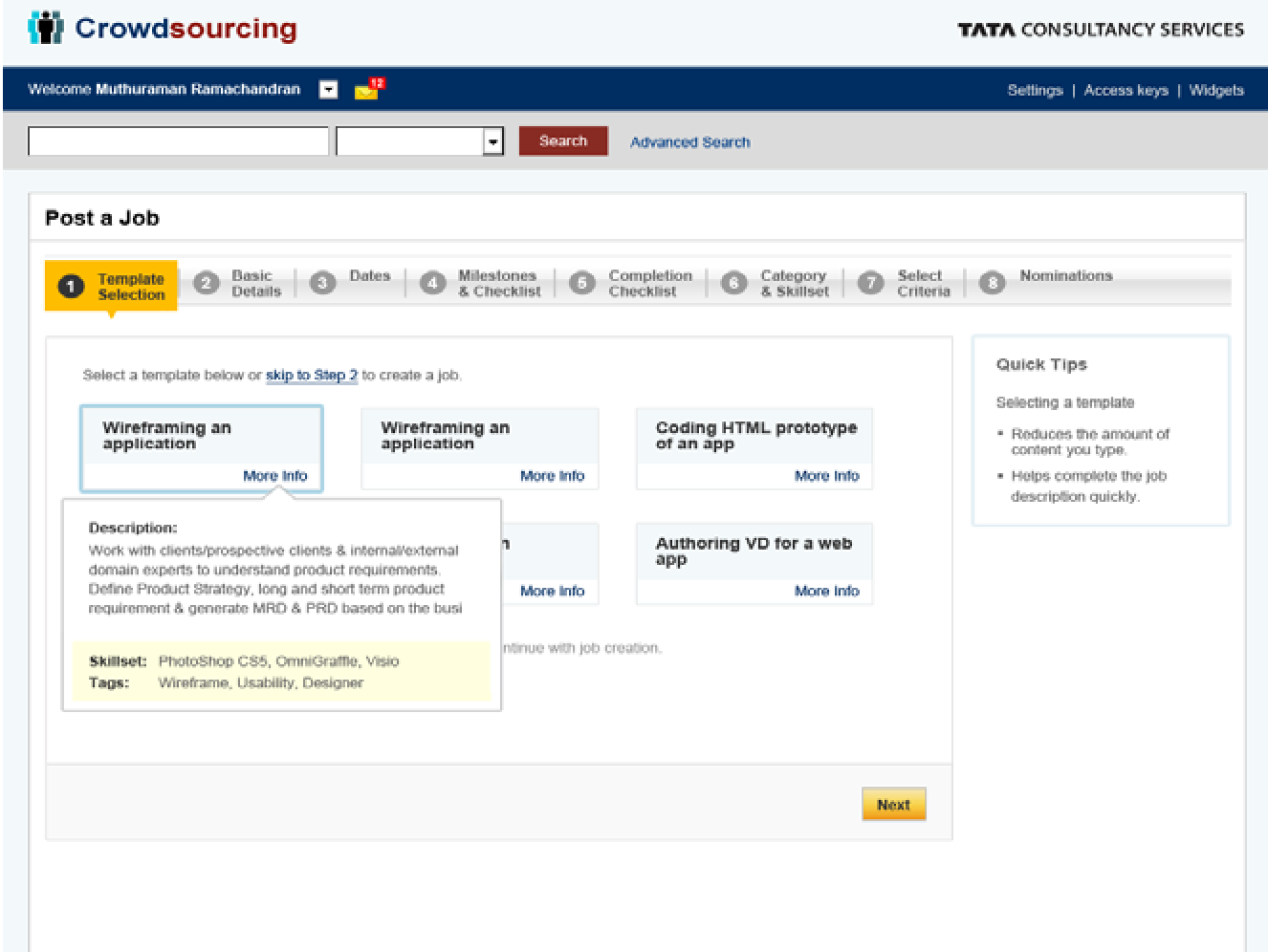
The system treats software development not as a monolithic project, but as a series of granular "Jobs."
1. The Marketplace Ecosystem
The platform facilitates a three-role interaction model:
- Requesters: Project managers who break down their backlog into jobs.
- Freelancers: Internal employees seeking to utilize their "spare cycles."
- Reviewers: Domain experts who validate the quality of submissions based on their established reputation scores.
2. Task Allocation Models
Recognizing that not all tasks are equal, the system supports three distinct modes:
- Deterministic: The requester nominates a specific freelancer for critical tasks.
- Volume-driven: First-come-first-served for tasks like mass testing.
- Competitive: A "hackathon" style model where multiple freelancers submit solutions, and the best one is chosen.
Key Features: Reputation and Currency
To ensure quality in a decentralized system, the authors emphasize two social-technical pillars:
- Reputation Mechanism: As freelancers complete jobs, their scores in specific technology categories (e.g., Java, QA, UI/UX) increase, which in turn allows them to be nominated as Reviewers.
- Virtual Currency: This provides an incentive structure within the organization, rewarding extra effort without necessarily disrupting standard payroll systems.
Critical Insight & Future Outlook
The beauty of this approach is that it tackles the "customer data" problem. While generic tasks can be crowdsourced to the whole company, customer-specific tasks are filtered so that only employees already cleared for that specific client project can see the jobs.
Limitations & Future Work
While the paper outlines a robust structure, the primary challenge remains the managerial culture. Will project managers be willing to trust "outsiders" from the bench with critical path tasks? The pilot study mentioned for the upcoming months will be crucial in proving that the quality of crowdsourced internal code meets enterprise standards.
Takeaway
For any organization with 1,000+ employees, "Internal Crowdsourcing" is no longer a luxury—it is a mandatory efficiency play. It shifts the HR paradigm from "owning" a resource to "accessing" a talent cloud.