
EWTR: Bridging Organizational Silos via Weak Ties Recommendation
A Framework for Enterprise Social Network Assessment and Weak Ties Recommendation
This paper introduces the Enterprise Weak Ties Recommendation (EWTR) framework, a system designed to identify and suggest professional "weak ties" within an organization. By integrating explicit social network data with implicit collaboration streams and organizational hierarchies, the framework achieves state-of-the-art results in link prediction tailored for employee career development.
TL;DR
Career success in large enterprises is often driven by "who you know" outside your immediate team. This paper presents EWTR (Enterprise Weak Ties Recommendation), a framework that leverages implicit collaboration data (blogs, wikis) and the official org-chart to recommend strategic "weak ties"—connections that bridge different departments and provide access to non-redundant information.
Background: Why "Weak Ties" Matter at Work
Most social recommenders suggest people similar to you. While this is great for finding friends, it is detrimental to professional growth. According to Granovetter’s Strength of Weak Ties Theory, your closest colleagues likely know exactly what you know. Growth occurs at the "Structural Holes" (Burt’s theory)—the gaps between clusters of people. The challenge is: how do we mathematically identify these bridges in a noisy corporate environment?
The Problem: Noise and Redundancy
Enterprise Social Networks (ESNs) like IBM Connections are often cluttered with:
- Noisy Links: People connect but never interact.
- Redundant Links: Recommendations keep suggesting people within your own team.
Current SOTA link prediction models often ignore the formal organizational hierarchy, treating the social graph as a flat entity, which misses the crucial professional context.
Methodology: The EWTR Framework
The authors solve this through a sophisticated two-step pipeline.
1. Link Assessment (The Noise Filter)
Before predicting new links, the framework cleans existing ones. It crawls "Implicit Interaction Networks"—activities like liking a blog post or co-authoring a wiki page. If an explicit "friendship" exists but no implicit interaction is found across multiple applications, it's flagged.
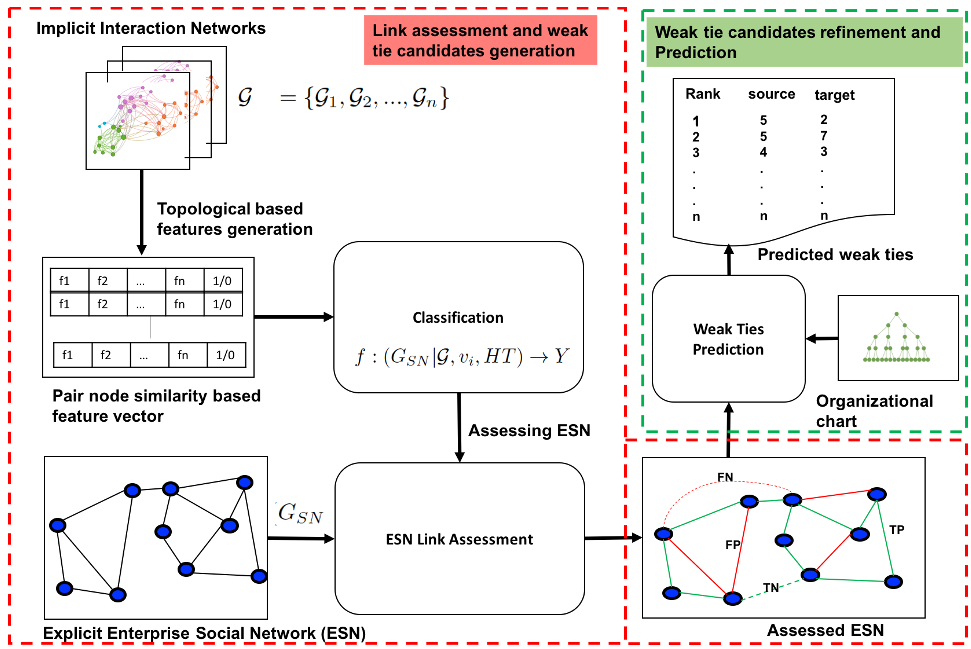
2. Social-Organizational Overlap (The Bridge Discovery)
The core innovation is the Social-Organizational Overlap (SOO). The authors modified traditional metrics like the Adamic-Adar (AA) index into an Optimized AA (OAA).
The logic is elegant:
- If a common neighbor () between two people () is in the same team as them, the contribution of that neighbor to the recommendation score is penalized.
- If the common neighbor is in a different team, the contribution is boosted.
This ensures the algorithm prioritizes "bridges" over "cliques."
Experiments and Results
Testing on a massive dataset of 100k+ employees over 2.5 years, the researchers found that:
- Activity Matters: Blogging data was the strongest predictor of meaningful connections (AUC 0.782), far superior to file-sharing patterns.
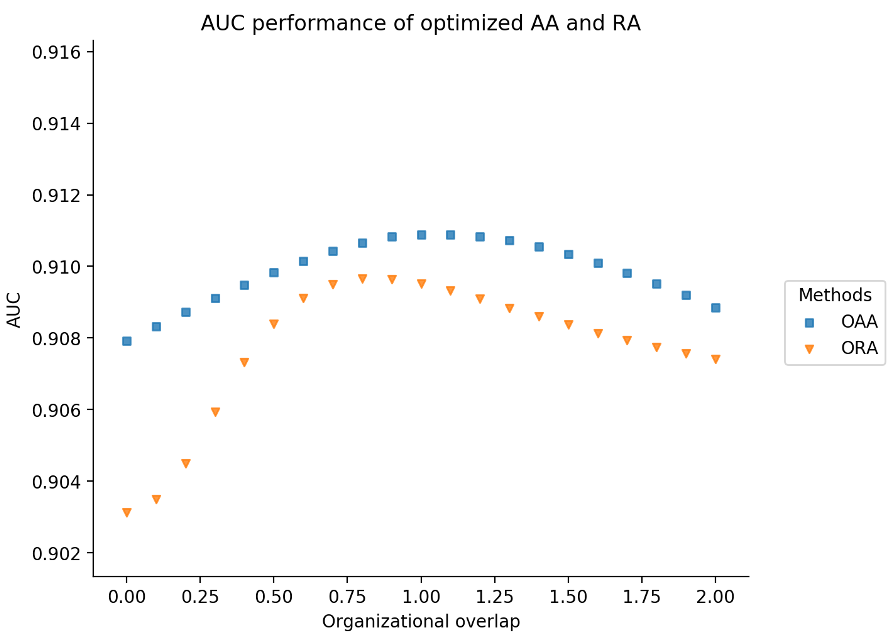
- The "Sweet Spot": Performance (AUC and Precision) of the optimized measures peaked when the organizational overlap was low. This confirms the physical intuition: the most valuable connections are those that connect us to "strangers" who share some common ground (like a mutual acquaintance) but operate in different business units.
Critical Insight
The brilliance of EWTR lies in its acknowledgment that professional networks are hybrid. You cannot understand an employee's social capital without looking at both their informal interactions and their formal position in the org-chart. By mathematically "punishing" intra-team similarity, the model successfully simulates the sociological concept of a bridge.
Conclusion
This work moves beyond "people you may know" and towards "people you should know." While the framework currently relies on topological metrics, the next frontier will likely involve using Graph Neural Networks (GNNs) to capture even deeper semantic relationships between different departments.
Takeaway for Tech Leaders: Don't just build a social network for your employees; build a "serendipity engine" that explicitly breaks silos by recommending ties across the organizational divide.