
Beyond the Feed: Using Enterprise Social Networks to Build the Ambidextrous Organization
Enterprise social networks for the benefit of ambidextrous organisation? The case of a major oil company
This study investigates the use of Enterprise Social Networks (ESNs) to foster "contextual ambidexterity" by analyzing a breakthrough innovation challenge at Technip, a major oil company. It demonstrates that ESNs can facilitate distributed exploration across geographical boundaries while maintaining a structured, steered innovation process.
TL;DR
Can a corporate social network act as more than just a digital watercooler? This research explores a breakthrough "Innovation Challenge" at Technip, a global energy leader. While ESNs like Yammer are often abandoned, the study reveals how they can be engineered into a "space for exploration," identifying hidden talent across 26 countries—provided that management is willing to move beyond a "hands-off" approach.
The Ambidexterity Paradox
In the industrial world, the "Productivity Dilemma" is a constant ghost. Companies are excellent at exploitation—refining current processes and meeting deadlines. However, they often fail at exploration—the messy, risky business of breakthrough innovation.
The authors argue that "Contextual Ambidexterity" (the ability for an individual to balance both) is often a myth in high-pressure environments. Without a specific "device" or dedicated space, daily operations will always cannibalize the time needed for innovation. Enterprise Social Networks (ESNs) were hypothesized to be that bridge, offering visibility, persistence, editability, and association.
Methodology: The Technip "Pipeline of the Future" Challenge
The study focused on a 2016 experiment where Technip aimed to "invent the pipeline of the future."
- The Reach: 1,075 participants signed up via Yammer.
- The Phases: Knowledge sharing, concept generation, and a final vote.
- The Steering: A mix of internal innovation managers and external consultants (STIM).
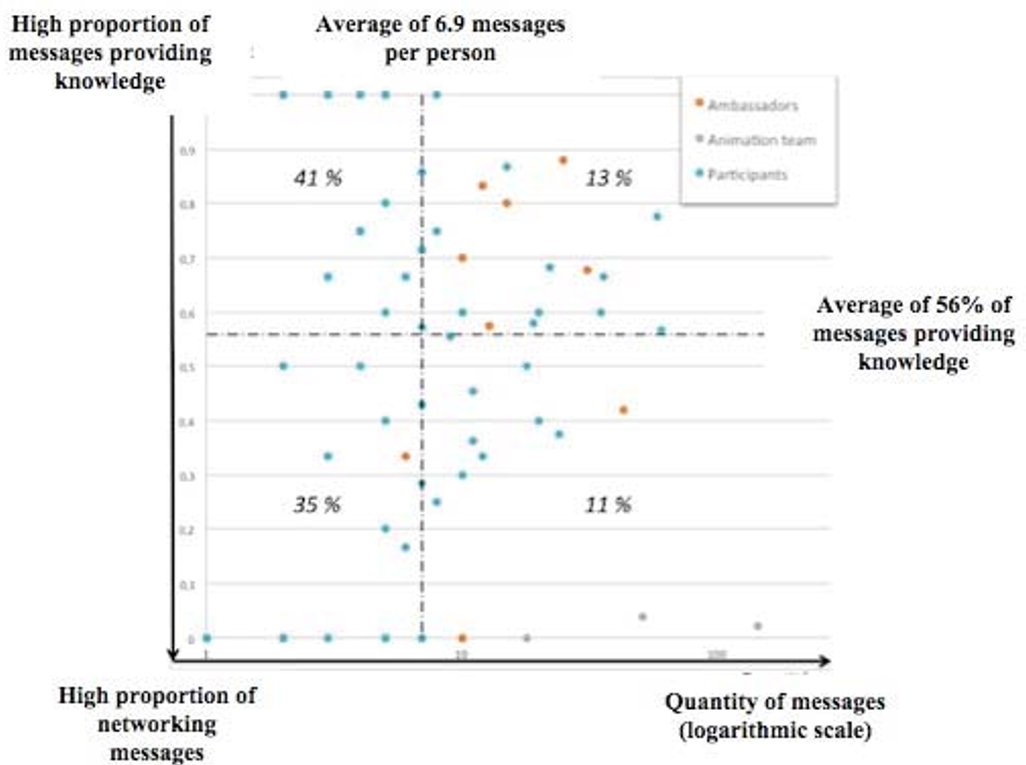 Key Finding: The research mapped participants into four categories: Observers, One-off Generators, Intensive Generators, and Socializers.
Key Insights: The Silent Majority and the Hard Core
The data revealed a fascinating participation structure:
- Intensity vs. Socialization: Only 13% of active users were "Intensive Generators," providing high knowledge content frequently.
- The Power of Silent Learning: 40% of participants were "silent readers." While they didn't post, they provided a "reserve" of knowledge. Surprisingly, many members of the teams formed in the second phase were drawn from these former "observers."
- The Time Trap: The #1 reason for non-participation was "insufficient time" (59%). This highlights the friction between the digital "innovation space" and the physical "work site."
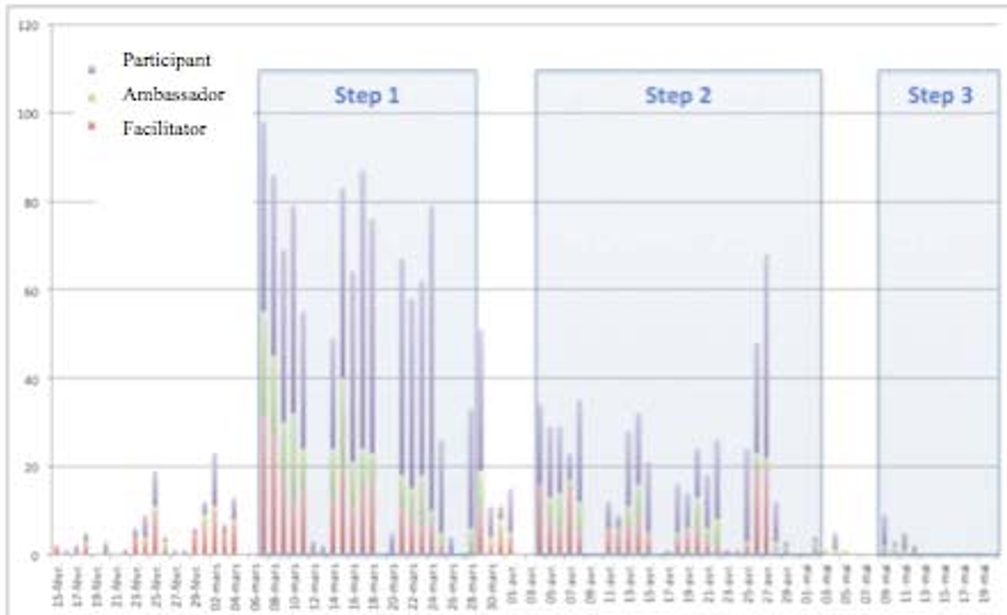 The facilitation effort (in grey) was highest at the start to "prime the engine" of the conversation.
Why Steering Matters
The researchers debunked the idea that digital innovation is "low cost." The challenge required intensive steering across three dimensions:
- Volume Control: Keeping the feed active without "drowning" users in noise.
- Controlled Freedom: Filtering content to keep it on-topic without discouraging "out of the box" thinking.
- Technicality vs. Inclusivity: Ensuring the discussion didn't become so esoteric that non-engineers felt excluded.
Critical Perspective: The Managerial Gap
The most striking finding was the Management Paradox: Participation owed very little to managerial encouragement (only 19 users cited their boss as a factor), but non-participation was heavily linked to a lack of managerial involvement.
For ESNs to truly foster ambidexterity, the "virtual" space cannot remain a "parenthesis" in the company's business-as-usual operations. It requires a "Real World" tolerance where managers formally recognize and reward the time spent on exploration.
Conclusion: A New Hybrid Model
This case study suggests that "pure" contextual ambidexterity (where everyone innovates spontaneously) is unlikely in restrictive industrial settings. Instead, ESNs allow for a hybrid model: a central "Exploration Entity" that uses the social network to facilitate and steer distributed participation.
For CTOs and Innovation Directors, the takeaway is clear: An ESN is a platform, not a strategy. Its value lies in its ability to act as a "shop window" for innovation, turning silent observers into active contributors through expert facilitation and legitimate managerial backing.