
The EO-Innovation Nexus: Why Social Media is the Unused Engine for SME Growth
Entrepreneurial Orientation and Open Innovation: Social Media as a Tool
This paper explores the relationship between Entrepreneurial Orientation (EO) and the proclivity for Open Innovation, positioning social media as a critical tool for small and medium-sized enterprises (SMEs). It proposes a theoretical framework where EO dimensions—innovativeness, risk-taking, and proactivity—drive a firm's willingness to adopt outside-in, inside-out, and coupled innovation processes.
Executive Summary
TL;DR: Most SMEs struggle with innovation due to high costs and market uncertainty. This paper argues that the secret to breaking this cycle lies in Entrepreneurial Orientation (EO)—a managerial mindset of risk-taking and proactivity—which transforms social media from a mere communication channel into a powerful tool for Open Innovation.
Strategic Positioning: This work acts as a theoretical bridge, connecting the psychological dimensions of management (EO) with the structural implementation of Open Innovation (OI) strategies. It specifically addresses why SMEs, despite their agility, often fail to leverage external knowledge.
The "Closed Door" Problem
Traditional innovation is inherently risky: only 10% of new products succeed. For Small and Medium-sized Enterprises (SMEs), the stakes are higher due to limited financial and human capital. While "Open Innovation"—the practice of integrating external ideas—offers a solution, many firms suffer from the "Not-Invented-Here" (NIH) syndrome. The barrier isn't the technology; it's the management's proclivity (or lack thereof) to let the outside world in.
Methodology: The EO-Proclivity Framework
The author posits that a firm's journey toward open innovation is governed by three specific dimensions of its Entrepreneurial Orientation:
- Innovativeness: The ability to pursue new ideas and adapt structures.
- Risk-Taking: The willingness to invest in projects with uncertain outcomes (crucial for social media, where IP control is lower).
- Proactivity: A forward-looking stance that seeks market trends before they become obvious.
The Theoretical Model
The following diagram illustrates how EO acts as the driver for the various processes of Open Innovation and the application of social media.
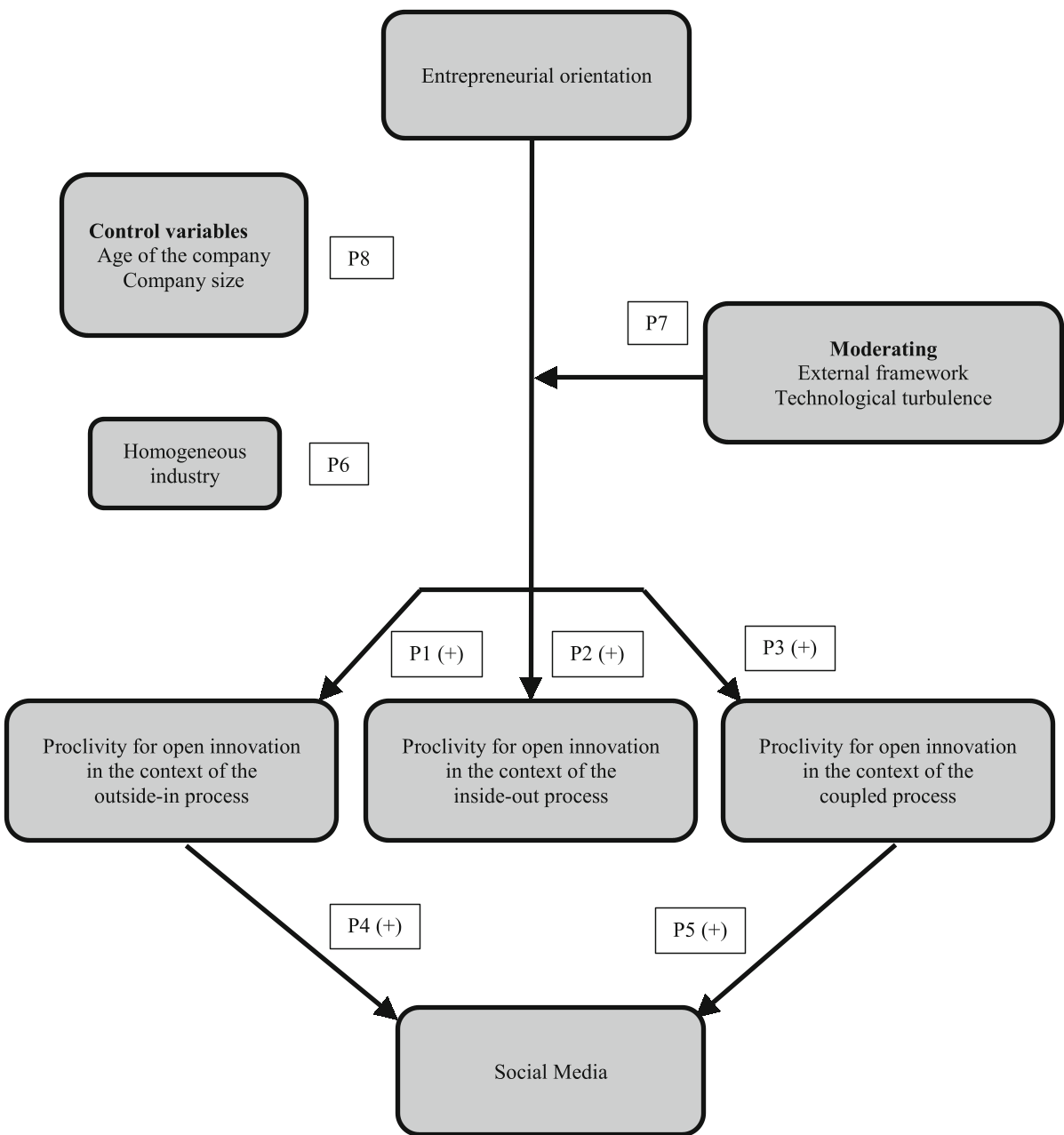
The model suggests that while EO drives all three OI processes—Outside-in (integrating external actors), Inside-out (exploiting internal IP), and Coupled—SMEs are most likely to succeed with the "Outside-in" approach via social media due to lower complexity and cost.
Key Results & Insights
- The Outside-In Prerogative: Over 85% of SMEs that innovate openly prefer the "Outside-in" process, primarily involving customers and suppliers.
- Social Media as a Sensor: Social media allows for low-cost, high-speed interaction with "lead users" who act as co-innovators during the ideation and prototype phases.
- The Industry Context: The effectiveness of EO is not universal; it is highly dependent on Technological Turbulence. In rapidly changing industries, a high EO is mandatory for survival, whereas stable industries might see lower proclivity for openness.
- Limiting Factors: Company size and age remain significant moderators. Older companies often have more rigid cultures that resist the "open" paradigm.
Critical Analysis & Conclusion
Takeaway
Innovation is no longer a "lab-only" activity. For SMEs, Entrepreneurial Orientation is the psychological prerequisite for digital transformation. If management doesn't embrace a risk-prone and proactive attitude, the most advanced social media tools will remain nothing more than digital billboards.
Limitations
The primary limitation of this paper is its theoretical nature. While the propositions are logically sound and grounded in EO theory, they lack empirical validation across different global markets. Furthermore, the paper focuses heavily on the "Outside-in" process, potentially overlooking how SMEs can manage the risks of the "Inside-out" process (protecting intellectual property).
Future Outlook
The next frontier for this research lies in quantifying the "ROI of Openness." As AI-driven social listening tools become more prevalent, the ability of high-EO managers to filter "meaningful signals from social noise" will become a core competitive advantage.