
Entropy-Assisted Emotion Recognition: Boosting Physiological Analysis with XGBoost
Entropy-Assisted Emotion Recognition of Valence and Arousal Using XGBoost Classifier
This paper proposes an entropy-assisted emotion recognition framework using physiological signals (EEG, ECG, GSR) and the XGBoost classifier. By integrating non-linear entropy domain features (RCMSE, TPR, Shannon Entropy), the system achieves State-of-the-Art performance on the AMIGOS database, reaching 80.1% accuracy for valence and 68.4% for arousal.
TL;DR
Researchers from National Taiwan University have developed a superior emotion recognition framework that transitions from simple statistical features to Entropy Domain features. By pairing these non-linear regularities with XGBoost, they achieved a 80.1% accuracy in predicting valence, significantly outperforming traditional SVM and Naive Bayes baselines on the AMIGOS dataset.
Positioning: This work represents a significant refinement in the feature engineering and model selection stage of affective computing, moving towards non-linear dynamics.
Problem & Motivation
How do computers "feel" us? Most systems look at our faces or listen to our voices. But we don't always wear our hearts on our sleeves. Physiological signals—like the electrical conductance of our skin (GSR) or the rhythm of our hearts (ECG)—provide a "hidden" window into our true emotional state.
The challenge lies in the complexity of biological data. Standard Power Spectral Density (PSD) often misses the underlying "order" or "chaos" in our heart rate or sweat response. Furthermore, most existing models like Gaussian Naive Bayes are too simplistic for the high-dimensional nature of multi-sensor data, while SVMs require heavy manual feature selection to be effective.
Methodology - The Core
1. Entropy Domain Features: Quantifying Chaos
The authors argue that the "regularity" of a signal is as informative as its frequency. They introduced three key entropy variants:
- Refined Composite Multiscale Entropy (RCMSE): Used on ECG signals to evaluate complexity across different time scales, solving the "short signal length" problem of traditional entropy.
- Turning Point Ratio (TPR): A non-parametric test to measure the randomness of heart rate variability (RRI).
- Shannon Entropy: Measures the overall distribution uncertainty of the signals.
2. The XGBoost Engine
Instead of using separate feature selection algorithms that might lose information, the authors employed XGBoost (Extreme Gradient Boosting).
- Why it works: XGBoost is an ensemble of Classification and Regression Trees (CART). It inherently performs feature selection by choosing the most discriminative features for its node splits.
- Regularization: It includes L1/L2 regularization to prevent overfitting in small datasets (like the 528 data samples in AMIGOS).
 Figure 1: The proposed workflow from multi-modal input to affect dimension prediction.
Experiments & Results
The study utilized the AMIGOS database, focusing on short-video stimuli across 33 subjects.
SOTA Comparison
The proposed "Scheme 3" (Entropy + XGBoost) was compared against the original AMIGOS baseline (Scheme 1) and a standard RFE-SVM approach (Scheme 2).
| Affect Dimension | Accuracy (All Modalities) | F1-Score (All Modalities) |
|---|---|---|
| Valence (Positivity) | 80.1% | 0.800 |
| Arousal (Intensity) | 68.4% | 0.698 |
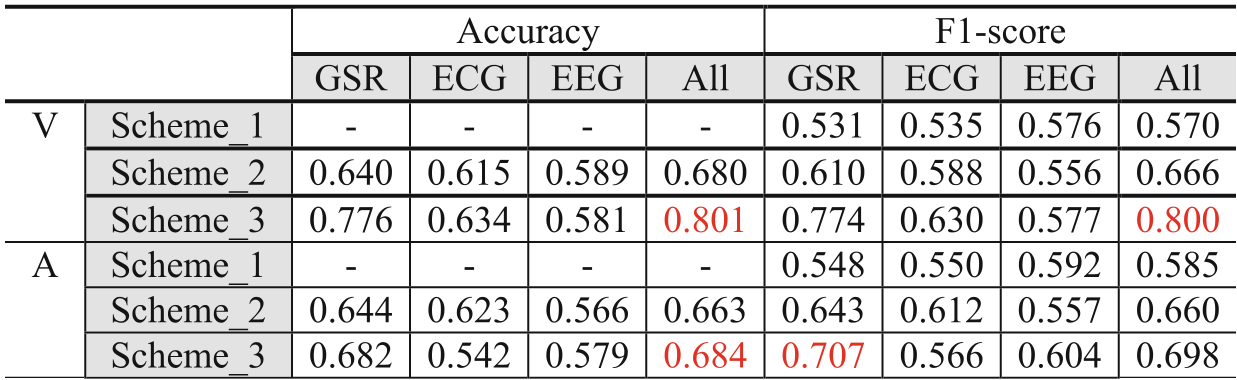 Figure 2: Comparative performance across different schemes and modalities.
Key Insights:
- GSR is King: Despite having only 32 features compared to 105 for EEG, GSR was the most powerful single modality. This suggests that skin conductance is a highly direct proxy for emotional arousal and valence.
- XGBoost Efficiency: The model learned efficiently from high-dimensional data, proving that expensive feature selection (like RFE) can be bypassed by using boosted tree architectures.
Critical Analysis & Conclusion
Takeaway
The integration of Entropy domain features is a game-changer. Biological systems are non-linear; thus, features that describe the "predictability" of the signal (RCMSE) provide deeper physiological insight than simple averages or frequency peaks.
Limitations
- Sample Size: While AMIGOS is a standard dataset, 528 samples is still relatively small for deep learning, which explains why the authors stuck to XGBoost.
- Arousal Performance: Accuracy for Arousal (68%) remains lower than Valence (80%), suggesting that the intensity of emotion might require even more complex temporal modeling (perhaps RNNs or Transformers) in the future.
Future Prospect
Expect to see this entropy-based approach integrated into wearable IoT devices. Because entropy calculations are relatively lightweight compared to deep neural networks, this framework is a prime candidate for real-time emotion monitoring on smartwatches.